


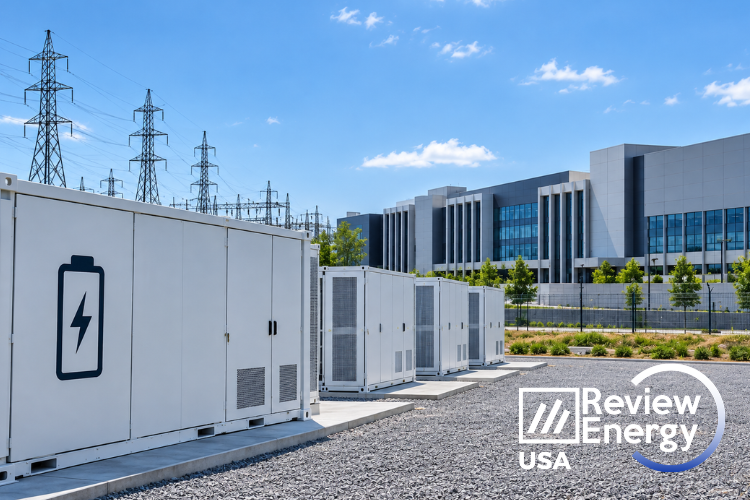


AI boom drives 330 GW of planned data centers and opens new opportunities for battery storage in the US
The rapid expansion of data centers, driven in part by the development of artificial intelligence, is increasing pressure on the US power system. A new report from Aurora Energy Research, prepared for Fluence, identifies battery energy storage systems (BESS) as one of the tools available to narrow the gap between the pace of data center development and the time required to expand power generation and grid infrastructure.
According to Aurora, approximately 330 GW of data center projects are currently planned across the United States. Its projections indicate that data centers could account for 7% to 20% of total US electricity consumption by 2035, compared with roughly 4%-5% today.
Access to power has become one of the main constraints on new development, according to the report. Interconnection queues across major US electricity markets remain heavily backlogged, with timelines that can extend for several years, while new thermal generation and transmission upgrades can take between three and seven years to complete.
These timelines contrast with the pace of AI infrastructure development, as companies seek to bring new computing capacity online much more quickly.
Batteries can be deployed within 12 to 18 months
Aurora estimates that battery storage systems can be deployed within approximately 12 to 18 months, potentially allowing them to serve as a bridge while full grid interconnection for data centers is completed.
Beyond accelerating access to power, batteries can respond to the rapid fluctuations in electricity demand associated with GPU clusters used to train artificial intelligence models, provide support during periods of grid stress and help facilities comply with voltage ride-through requirements, which determine their ability to remain connected during certain voltage disturbances.
Their flexibility also allows storage assets to participate in wholesale, ancillary services and capacity markets when their stored energy is not required on-site, creating additional revenue opportunities that can improve project economics.
The report examines three main battery deployment configurations: front-of-the-meter systems connected directly to the grid, behind-the-meter installations linked directly to data center consumption, and islanded systems capable of operating independently.
Aurora assesses these configurations across six areas: speed to power, reliability and backup, voltage ride-through, load ramping control, market participation, and bridging or islanded operation.
However, the consultancy stresses that there is no single configuration that provides the best solution for every project. The appropriate model depends on the electricity market, regulatory framework and the requirements of stakeholders such as hyperscalers, colocation developers, powered land developers, independent power producers and utilities.
Regulatory reforms create new opportunities for storage
The report also highlights regulatory changes underway across US electricity markets that could expand the commercial opportunities available to battery storage.
Aurora points to actions by the Federal Energy Regulatory Commission (FERC) concerning the interconnection of large loads. Section 206 show-cause orders have directed six of the seven US independent system operators to address issues involving large-load interconnection rules, cost allocation and voltage ride-through requirements.
In ERCOT, the Texas grid operator, Aurora highlights the Provisional Controllable Load Resource program alongside Capacity Attribution Contracts. According to the report, combining these mechanisms with co-located storage could significantly reduce data centers’ exposure to curtailment.
In PJM, the Bring Your Own Generation pathway could benefit battery storage because of its ELCC (Effective Load Carrying Capability) ratings. Aurora argues that storage can require significantly less installed capacity than variable renewable resources to meet equivalent accredited capacity requirements.
Meanwhile, in Southwest Power Pool (SPP), the HILLGA fast-track process could allow qualifying battery projects to complete interconnection studies in approximately 150 days, according to Aurora.
Virginia, Georgia and Arizona advance new measures
Changes at state level are also creating different pathways for storage deployment, ranging from new electricity tariffs to large-scale capacity procurement and clean energy requirements.
The report points to a 14-year large-load tariff in Virginia, as well as gigawatt-scale utility procurements in Georgia and Arizona. Aurora also identifies clean energy mandates in Washington and Oregon as potential drivers of additional battery storage investment.
For Farhad Billimoria, Head of USA West at Aurora Energy Research, the AI infrastructure buildout represents one of the most significant new sources of electricity demand faced by the US grid in a generation.
The question, he argues, is no longer simply whether battery storage can form part of the solution, but rather where, under which configurations and within which regulatory frameworks it can deliver the greatest value.
The expansion of data centers is therefore adding a new dimension to the growth of the US battery storage market. Beyond its established role in renewable energy integration and grid flexibility, storage is increasingly being considered as a tool to serve large new electricity consumers in a system where grid development timelines are struggling to keep pace with demand growth.

Comentarios
Sé el primero en comentar...