



U.S. energy storage reaches highest Q1 performance on record
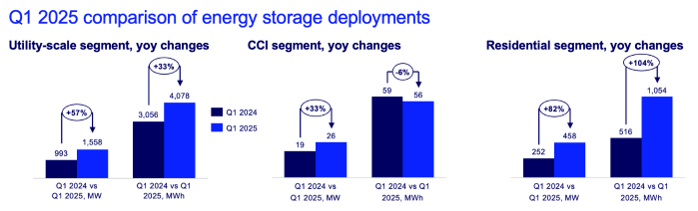
The U.S. energy storage market added over 2 GW of capacity across all segments in the first quarter of 2025, setting a new Q1 record, according to the latest U.S. Energy Storage Monitor report from Wood Mackenzie and the American Clean Power Association (ACP). Utility-scale projects led growth, contributing more than 1.5 GW, an increase of 57% compared to the same period in 2024.
“Surging energy demand is putting the electric grid under strain. The energy storage market is responding to help keep the lights on and support this unprecedented growth in an affordable and reliable way,” said John Hensley, ACP SVP of Markets and Policy Analysis. “Policy uncertainty is now one of the most significant risks that remains on the horizon as we tackle a balanced approach to allowing our economy to expand while maintaining the energy reliability that Americans deserve.”
Expansion beyond early adopters
The report highlights growing geographic diversification in the sector, as states beyond early leaders like Texas and California begin to scale up deployments. Indiana, in particular, added 256 MW of new storage in Q1—quadrupling its operational capacity. The state now has over 10 GW of projects in the interconnection queue, ranking fifth nationally.
Factors such as available land and streamlined permitting processes are enabling Indiana’s growth. “We're now seeing significant deployment of energy storage resources in emerging markets like Indiana, while states across the Southwest like Nevada and Arizona continue to expand their energy storage portfolio,” said Noah Roberts, ACP Vice President of Energy Storage.
Residential market breaks new ground
The residential segment also saw its strongest Q1 on record, installing 458 MW, driven primarily by California and Puerto Rico, which together accounted for 74% of the total. New markets, including Illinois, are beginning to emerge as adoption spreads.
According to the ACP, energy storage was the second most deployed electricity resource in the U.S. during Q1 2025, underscoring its role in supporting grid reliability and meeting rising power demand.
The total 5-year utility-scale capacity forecast remains strong. However, the segment is at risk for a potential 29% contraction in 2026 due to policy uncertainty.
The community-scale, commercial, and industrial (CCI) segment has seen a 42% reduction in its five-year outlook, struggling with tariff uncertainty and slower-than-anticipated transition to NEM 3.0 projects in California.
Strong long-term outlook faces near-term risks
The report cautions that potential changes to current tax credits could significantly impact the industry’s overall growth. If access to the Investment Tax Credit (ITC) is severely reduced as proposed in the reconciliation bill passed by the House, it could lead to a 27% reduction in buildout over the forecast period. (This report was developed before the U.S. Senate Finance Committee released its version of the reconciliation bill on June 16.)
Distributed storage would be the most impacted segment, with a potential 46% drop from the base case over the next 5 years. Utility-scale installations would decrease by 16 GW over the next 5 years if the tax provisions are changed.
In the near term, the report projects that 15 GW/49 GWh of energy storage capacity will be installed across all segments in 2025. The utility-scale segment is expected to grow 22% YoY in 2025.
As the market evolves, continued innovation, supportive policies, and strategic planning will be crucial to navigate the changing landscape and capitalize on the immense potential of energy storage in the U.S. energy transformation.
“The Q1 2025 results demonstrate the demand for energy storage in the US to serve a grid with both growing renewables and growing load. However, the industry stands at a crossroads, with potential policy changes threatening to disrupt this momentum,” said Allison Weis, Global Head of Energy Storage at Wood Mackenzie. “It's crucial that policymakers understand the importance of stable, supportive policies for the continued expansion of energy storage.”



Comentarios
Sé el primero en comentar...