


Data centres increase pressure on Portugal’s power system as ACER calls for improved planning
The European Union Agency for the Cooperation of Energy Regulators (ACER) has called on Portugal to improve the modelling of its electricity system amid strong projected demand growth, particularly from new data centres and large industrial consumers. The EU regulator considers that Portugal’s assessment identifies potential adequacy risks, but may overestimate the capacity gap by not fully accounting for investments that could respond to market signals, demand-side flexibility and resources that could be available to safeguard security of supply.
The warning is included in ACER’s Opinion on Portugal’s National Resource Adequacy Assessment (NRAA), prepared by the Directorate-General for Energy and Geology (DGEG) and transmission system operator Rede Elétrica Nacional (REN) as part of the RMSA-E 2025 security of supply monitoring report. The Portuguese assessment identifies adequacy concerns in 2028, 2030 and 2035, unlike the European Resource Adequacy Assessment (ERAA) 2025, which found no adequacy concerns for Portugal in those years.
The difference between the two assessments is significant. Portugal’s reliability standard sets a loss of load expectation (LOLE) of 1.46 hours per year. While the ERAA estimates 0.82 hours in 2028, zero in 2030 and 0.06 hours in 2035, the Portuguese assessment projects 1.71 hours in 2028, 8.29 hours in 2030 and 68.3 hours in 2035.
Data centres drive higher electricity demand projections
One of the main factors behind the divergence is the strong increase in electricity consumption expected in Portugal. By 2035, peak demand in the national assessment is 1,896 MW higher than in the ERAA and around 3.4 GW above the historical trend. According to ACER, the difference is primarily driven by new energy-intensive consumers, particularly data centres.
As of February 2026, Portugal had received around 41 GW of grid connection requests from large electricity consumers. Of this volume, approximately 9.2 GW had already secured grid connection permits, while a further 4.6 GW had entered the Continental Large Demand Zone Procedure. In total, around 13.8 GW was either secured or at an advanced stage of allocation.
ACER considers the high-demand assumption broadly justified because it is supported by a substantial pipeline of formal connection requests and applies different materialisation rates depending on project maturity. However, the agency warns that the assessment could overstate future adequacy concerns if projected demand does not fully materialise.
Slower renewable deployment widens the capacity gap
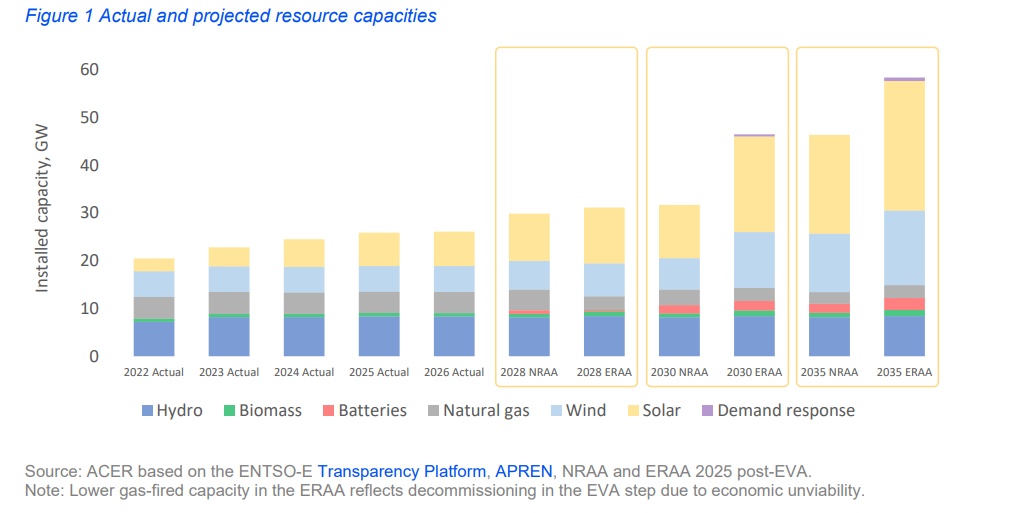
The Portuguese assessment also assumes considerably slower wind and solar deployment than the ERAA. In 2028, wind and solar capacity in the NRAA reaches around 86% of the ERAA projection. By 2030, installed capacity is roughly half the European assessment’s projection, before recovering to 77% by 2035.
ACER nevertheless considers Portugal’s more conservative renewable assumptions justified because they better reflect historical deployment trends, project development status and current licensing procedures rather than relying primarily on the country’s more ambitious 2030 energy targets.
 Source: ACER
Other assumptions further reduce the resources considered available. These include the exclusion of the 990 MW Tapada do Outeiro gas-fired power plant, which is treated as an out-of-market resource. The plant represents around a quarter of Portugal’s existing thermal fleet and remains available to the system operator for security of supply purposes. ACER considers its exclusion from potential activation during scarcity periods unjustified.
ACER questions conservative long-term battery assumptions
Storage is another major difference between the two assessments. Portugal expects battery capacity to reach 1,000 MW by the end of 2028, three times the ERAA assumption. However, growth subsequently slows, with the NRAA projecting 1,750 MW in 2030 and 1,875 MW in 2035, respectively 13% and 25% below the ERAA figures.
ACER notes that Portugal’s Recovery and Resilience Plan has already financed 43 storage projects, representing €100 million of investment and at least 500 MW of battery capacity, while an additional 750 MW is expected through competitive procedures. The agency highlights that the national assessment assumes only 125 MW of additional battery capacity between 2030 and 2035, which it considers a particularly conservative trajectory.
However, ACER does not conclude that this assumption is necessarily incorrect. Portugal has significant pumped-hydro storage capacity that competes with batteries for energy arbitrage and flexibility services. Without a full economic viability assessment, the regulator says it remains unclear how much merchant battery capacity could realistically enter the market once public support schemes end.
Up to 700 MW of demand response potential excluded
Portugal’s assessment also assumes no demand response capacity in any of the target years. By contrast, the ERAA’s economic viability assessment results in 440 MW of demand response entering the market in 2030, rising to 730 MW by 2035. ACER also points out that Portuguese regulator ERSE has identified around 700 MW of demand response potential.
For ACER, this flexibility is particularly relevant in a scenario of rapid data centre growth, as part of their electricity consumption could potentially become flexible and help reduce peak demand. The agency therefore considers the complete exclusion of demand-side flexibility from Portugal’s assessment unjustified.
ACER calls for better modelling of potential new investment
ACER’s main criticism concerns Portugal’s economic viability assessment. The NRAA examines the profitability of existing gas-fired generation but does not model how much new capacity could enter the market in response to future market conditions.
Portugal’s own results show that annual net profits for existing gas-fired plants could increase from almost €20,000/MW in 2028 to €1.3 million/MW by 2035, partly because growing scarcity would lead to significantly higher scarcity rents. ACER argues that those same market signals could attract new investments in generation, batteries or demand response that are not currently captured by the national model.
As a result, the agency says that without a fully implemented economic viability assessment, it remains unclear to what extent market-driven investments could reduce the projected adequacy gap and consequently reduce or eliminate the need for capacity mechanisms.
ACER recommends that Portugal fully implement the economic viability assessment, include out-of-market resources that can contribute to system adequacy and incorporate realistic demand-side response capacity into future projections, including its potential expansion as market conditions evolve.
The agency also calls for developments in Spain’s capacity mechanism to be considered. Given Portugal’s strong interconnection with Spain, additional capacity procured in the neighbouring market could affect the availability of electricity imports during scarcity periods and therefore influence Portugal’s actual resource adequacy needs.



Comentarios
Sé el primero en comentar...