


Europe enters winter 2026–2027 with 16% more renewable capacity and expanding battery storage
Europe is expected to have sufficient electricity resources to meet demand during the winter of 2026–2027, although some areas could face supply risks, particularly those with limited or no interconnection to the continental European network, according to the European Network of Transmission System Operators for Electricity (ENTSO-E). Its Winter Outlook 2026–2027 identifies Cyprus as the area with the most notable risks, while also detecting potential adequacy concerns in Malta, Ireland, eastern Denmark, Finland and Northern Ireland.
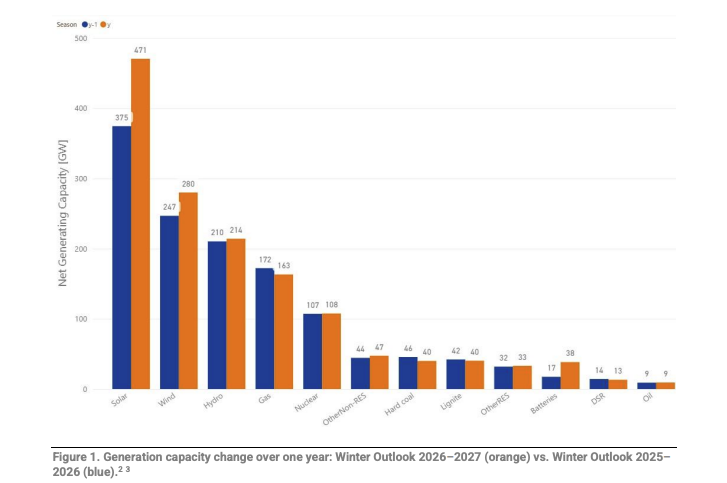
Compared with the previous winter, Europe's installed renewable energy capacity has increased by approximately 134 GW, or 16%, mainly driven by solar photovoltaic and wind power. Solar capacity grew by 26%, adding 96 GW, while wind capacity rose by 13%, equivalent to 33 GW. Battery energy storage capacity more than doubled, increasing by over 124% to reach 38 GW. Meanwhile, installed hard coal and lignite capacity declined by nearly 6 GW, or 9%, and gas-fired capacity fell by almost 9 GW, or 5%.
Despite the overall favourable outlook, ENTSO-E identifies different levels of risk across several electricity systems. Cyprus faces potential supply risks due to its lack of interconnection with the continental European network. In Malta and Ireland, some risks appear under normal market conditions, although dedicated non-market resources significantly reduce them. The report also identifies signs of expected energy not served and adequacy risks in eastern Denmark (DK2), Finland and Northern Ireland.
Ukraine and Moldova face higher risks for the coming winter. According to the report, Ukraine's electricity supply situation remains uncertain because of potential attacks on energy infrastructure. Moldova, meanwhile, is exposed to several vulnerabilities, including its strong dependence on electricity imports from Romania through a single Isaccea–Vulcanesti interconnector, insufficient net transfer capacity allocated for commercial trading to cover its electricity deficit, and potential disruptions in the Ukrainian power system linked to Russia's war of aggression.
ENTSO-E also notes that planned generation outages are slightly higher than last winter, mainly due to increased planned maintenance outages at French nuclear plants. Electricity demand is also slightly higher, while hydro reservoir levels are below average overall. The assessment adds that some European countries could need to rely on imports during periods of low renewable generation and limited conventional generation availability.
Cross-border cooperation and coordination between transmission system operators (TSOs) will therefore be essential to maintain the balance between electricity supply and demand throughout the winter. ENTSO-E highlights the role of weekly operational coordination between TSOs and regional coordination centres, alongside national Risk Preparedness Plans and regional processes designed to identify and address potential shortages.
The organisation stresses that the Winter Outlook is not a forecast, but an assessment of potential resource adequacy risks based on reference scenarios and different sensitivities. Actual conditions could become tighter if demand, weather, generation availability or cross-border electricity exchanges differ from the assumptions used in the analysis. European TSOs will continue to monitor supply adequacy throughout the winter.


Comentarios
Sé el primero en comentar...