


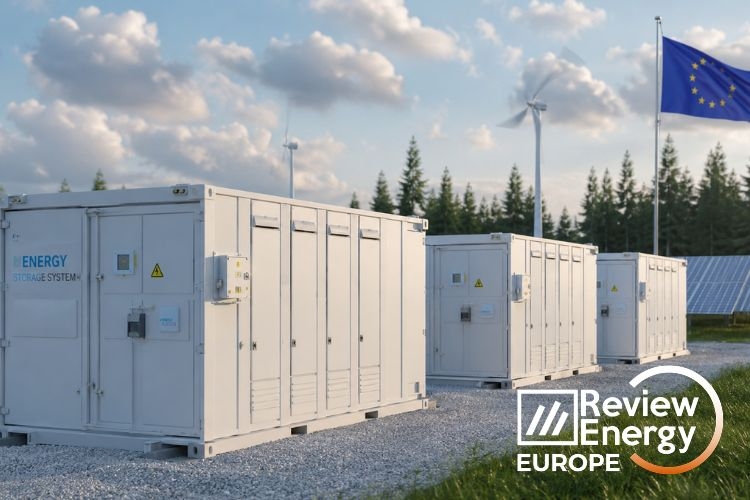


First EU tripartite agreement targets up to 35 GW of energy storage
The European Commission has brought together EU energy ministers, energy storage developers and manufacturers, renewable energy developers, energy-intensive industries and financial institutions to sign the first-ever EU tripartite agreement on energy storage.
The agreement was signed on the sidelines of the Council of Energy Ministers meeting in Luxembourg with the aim of accelerating the deployment of energy storage in the short term, strengthening the security and flexibility of the European electricity system.
According to the Commission, the agreement marks another step towards building a decarbonised energy system that is more efficient and capable of delivering lower energy costs.
The Commission describes energy storage as the "missing link" in the energy transition, highlighting its role in lowering and stabilising electricity prices. While expanding domestic renewable energy generation is essential to reduce the European Union's dependence on volatile fossil fuel markets and improve security of supply, the Commission stressed that increasing renewable capacity alone is insufficient. Instead, renewable deployment must be accompanied by a more efficient energy system, in which storage enables electricity to be retained until demand is highest, improving renewable energy integration and delivering greater benefits to consumers.
The tripartite agreement is intended to create a favourable business environment for rapidly scaling up energy storage deployment across Europe. According to the Commission, this will help reduce electricity system operating costs, ease the pressure of high and volatile energy prices on European businesses, send a strong market signal and strengthen the EU's manufacturing capacity in the energy storage sector.
As part of the agreement, 22 EU Member States have committed to ambitious energy storage targets over the next two years. Combined, these national pledges represent between 30 GW and 35 GW of energy storage capacity.
Commitments from industry, Member States and financial institutions
Under the agreement, developers of energy storage and renewable energy projects will provide annual estimates of new storage and hybrid projects, including their expected volumes. Energy-intensive industries have committed to developing energy storage projects at their own facilities while providing clearer information on when and how much electricity they consume. According to the Commission, greater visibility over future project pipelines is essential to provide clarity and certainty for investors.
Member States have committed to supporting the energy storage sector by removing barriers that delay deployment. They also pledged to enable National Regulatory Authorities to establish or approve cost-reflective and non-discriminatory network tariffs designed to encourage flexibility. Where necessary, governments will provide financial support for energy storage deployment and manufacturing through national and EU funding mechanisms, in line with State aid rules, including the Clean Industrial State Aid Framework (CISAF).
Financial institutions, including national and regional banks as well as promotional banks, committed to sharing expertise on energy storage projects to improve their attractiveness to investors. They will also cooperate with the European Investment Bank (EIB) Group and with one another to maximise the impact of funding for energy storage solutions.
For its part, the European Commission will support Member States in designing funding schemes for energy storage and in advancing the decarbonisation of energy-intensive industries, including through the Industrial Decarbonisation Bank. It will also explore options to support energy storage deployment under the Innovation Fund, update electricity network rules to encourage storage deployment, and assess possible ways to better align public-sector transition investments with the EU's environmental objectives during the review of the Taxonomy Disclosure rules scheduled for early 2027.
Implementation until 2028
The Commission will coordinate the implementation of the tripartite agreement and monitor progress annually through 2028. It will also facilitate exchanges among the signatories on challenges and best practices through the Energy Union Task Force, regional groups and existing forums, including the Concerted Action for Renewable Energy Sources (CA-RES).
According to the Commission, the European Union will require around 200 GW of energy storage capacity by 2030 to meet the needs of its energy system, compared with approximately 55 GW installed at the beginning of 2026. Achieving this target will require a significant acceleration in the deployment of different storage technologies alongside renewable energy and other non-fossil flexibility solutions.
The Commission also noted that the European Council, in its Conclusions of 19 March 2026, called for faster deployment and integration of renewable energy and energy storage to reduce dependence on volatile fossil fuel markets and strengthen security of supply.
The concept of tripartite agreements was introduced under the Affordable Energy Action Plan. According to the Commission, these agreements bring together industry, public authorities and financial institutions around shared commitments aimed at reducing investment risks. In doing so, they are intended to contribute to lower energy prices in the short term while improving the long-term competitiveness of European industry and businesses.

Comentarios
Sé el primero en comentar...