




Ukraine adds nearly 3 GWh of battery storage in 2025, ranking fourth in Europe
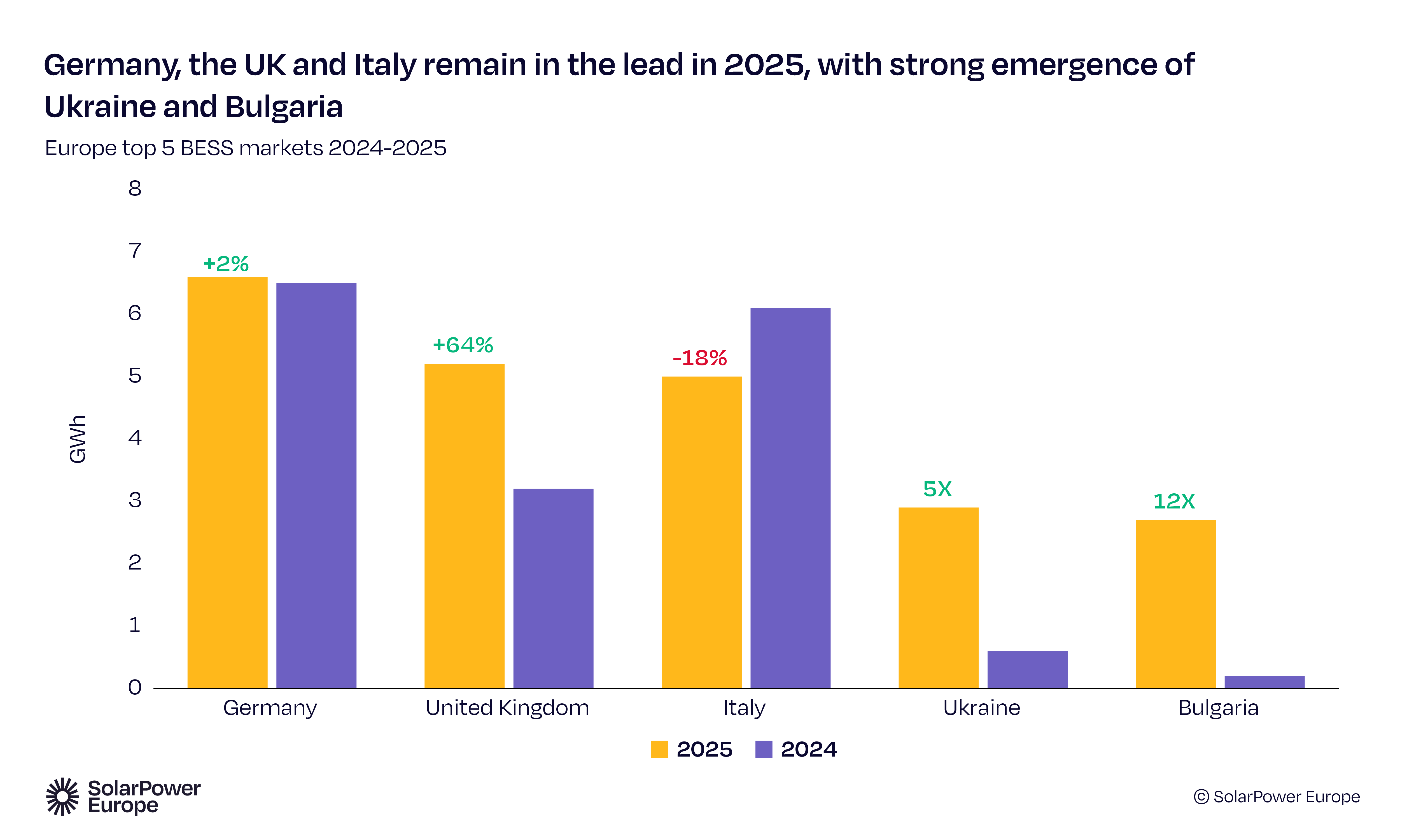
Ukraine became Europe’s fourth-largest battery storage market in 2025, installing almost 3 GWh of battery energy storage systems (BESS), five times the capacity deployed a year earlier.
The figures come from SolarPower Europe’s European Battery Market Outlook 2026-2030. Only Germany, the United Kingdom and Italy installed more battery storage capacity during the year, while Ukraine ranked ahead of Bulgaria.
 Source: SolarPower Europe
More than 60% of Ukraine’s new battery capacity came from distributed storage, as households, businesses, schools, hospitals, water treatment facilities and other critical infrastructure increasingly deployed storage systems to maintain electricity supply during outages.
Utility-scale batteries accounted for almost one-third of the new capacity, providing flexibility and balancing services to the Ukrainian power system.
Distributed storage drives Ukraine’s battery market
Ukraine’s battery storage market differs from much of the rest of Europe, where residential batteries are typically installed alongside rooftop solar systems to increase self-consumption and reduce electricity bills.
In Ukraine, energy security has become the main driver.
Vladyslav Sokolovskyi, Chairman of the Board of the Solar Energy Association of Ukraine (SEAU), said residential systems installed in the country typically average between 3 and 5 kWh, around half the European average.
Many of these batteries are installed without solar panels and are used primarily to provide electricity during blackouts.
“Ukraine is proving that batteries are more than an energy technology, they are a resilience technology,” Sokolovskyi said.
The residential segment also includes a large number of portable power stations ranging from 0.6 to 2.5 kWh, which households are purchasing as standalone sources of electricity during outages.
Small and medium-sized businesses are installing larger systems for similar reasons, with Sokolovskyi describing the market’s priorities as “energy security first, economics second.”
Utility-scale BESS expands its role
Alongside distributed installations, utility-scale battery projects are gaining ground in Ukraine.
According to SolarPower Europe, these projects are now competing in the ancillary services market and participating in energy arbitrage, expanding the role of batteries beyond backup power and into grid flexibility and balancing.
Sonja Risteska, Head of SolarPower Europe’s Battery Storage Europe Platform, said Russia’s invasion and attacks on critical energy infrastructure have accelerated the country’s deployment of solar and battery storage.
“Ukraine's experience shows that batteries are more than a clean energy technology; they are an essential asset for energy security and system resilience,” Risteska said.
Germany, the UK and Italy lead the European ranking
Ukraine entered Europe’s top five battery storage markets in fourth place in 2025, behind Germany, the UK and Italy.
Ukraine and Bulgaria each installed close to 3 GWh of battery storage capacity during the year, although their growth was driven by different factors.
SolarPower Europe attributed Ukraine’s expansion primarily to the need for energy security and power system resilience. Bulgaria, meanwhile, recorded Europe’s highest growth rate following utility-scale funding programmes and is expected to continue expanding rapidly through 2027.
European battery installations reach 36 GWh
Ukraine’s expansion came as battery storage deployment continued to increase across Europe.
European countries installed 36 GWh of new battery storage capacity in 2025, representing a 48% year-on-year increase and marking the twelfth consecutive year of record annual additions.
Europe’s total operational battery storage capacity also surpassed 100 GWh for the first time, according to SolarPower Europe.
The European market is increasingly being driven by utility-scale battery projects, which are taking a larger share of annual installations as demand for flexibility and grid balancing grows alongside renewable energy deployment.


Comentarios
Sé el primero en comentar...