




Ireland sees strongest wind planning approvals since early 2025
Five new wind energy projects were approved in Ireland during the second quarter of 2026, adding a combined 311 MW of generation capacity, according to Wind Energy Ireland (WEI). The projects could generate enough electricity to power just over 180,000 homes each year, marking the highest level of wind energy planning approvals since the first quarter of 2025.
The latest approvals represent a significant improvement from Q1 2026, when no new wind farms received planning approval. However, WEI is warning that the progress is being overshadowed by a growing backlog of projects awaiting decisions from An Coimisiún Pleanála, Ireland’s planning body. The number of projects in the planning system has increased by 70% compared with the same period in 2024.
Justin Moran, Director of External Affairs at Wind Energy Ireland, welcomed the increase in approvals, describing the progress as “welcome and badly needed.” He said the new wind farms would strengthen Ireland’s energy security while supplying clean and affordable electricity to homes and businesses.
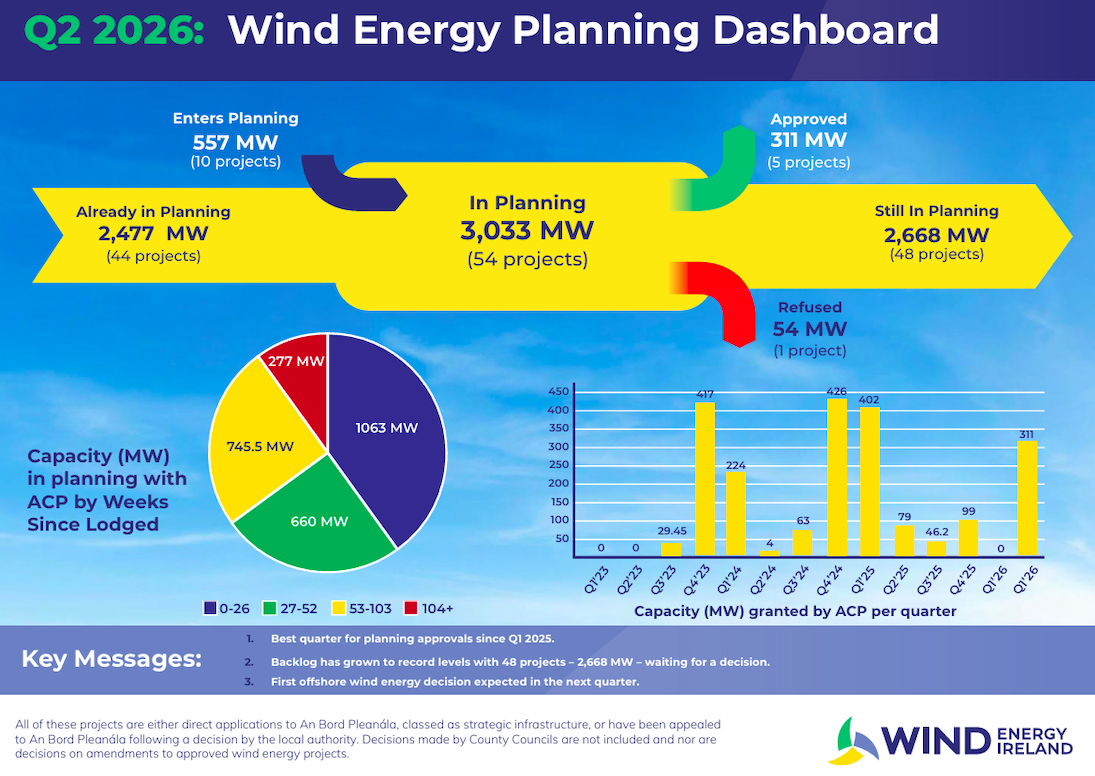
Wind planning backlog reaches 48 projects
Despite the five positive decisions during Q2, the number of wind projects awaiting a planning decision has continued to rise. There are currently 48 projects representing 2,668 MW of potential renewable energy capacity waiting for a decision from An Coimisiún Pleanála.
That compares with 31 projects totalling 1,643 MW in Q2 2025 and 28 projects representing 1,683 MW in Q2 2024.
The waiting period is also becoming a concern. More than 1,000 MW of capacity across 18 projects has been in the planning system for more than one year. Of these, five projects representing 277 MW have been awaiting a decision for more than two years.
“Projects are applying for planning permission faster than An Coimisiún Pleanála is able to make a decision,” Moran said.
He argued that every project awaiting a decision represents an opportunity to reduce Ireland’s dependence on imported fossil fuels, lower electricity costs and support employment and investment in local communities. According to WEI, maintaining the momentum seen in Q2 will require continued investment in planning capacity across State agencies so that projects can be assessed and decisions made more quickly.
Wind supplied 23% of Ireland’s electricity demand in July
The Q2 planning figures come after a strong month for wind generation. Wind farms across the island of Ireland generated 763 GWh of electricity in July, enough to meet 23% of the country’s electricity demand, according to WEI’s July figures.
Galway led Ireland’s counties in wind generation, producing 69 GWh during the month. It was followed by Offaly with 67 GWh, Kerry with 57 GWh, Mayo with 55 GWh and Donegal with 54 GWh.
The result comes as Galway also celebrated an All-Ireland Senior Ladies' Football Championship victory, adding to what WEI described as a memorable month for the county.
Gas use pushes July wholesale electricity prices higher
The increase in wind generation did not prevent wholesale electricity prices from rising in July. Greater use of gas during the month pushed the average wholesale electricity price to €155.54/MWh, an increase of €20 from June and the highest monthly average recorded so far in 2026.
Wind generation nevertheless continued to have a significant effect on market prices. When wind generation was at its highest, the average wholesale electricity price fell to €125.43/MWh.
That was 38% lower than the €202.97/MWh average recorded on days when Ireland relied more heavily on imported fossil fuels, according to WEI.
Moran said the July generation figures demonstrate the role wind farms play in supplying electricity to homes, businesses and communities across Ireland. He also reiterated the need to accelerate the planning process so renewable energy projects can move forward more quickly.
First Phase One offshore wind planning decision expected in Q3
Ireland is also approaching a key milestone for its offshore wind sector. A planning decision on the first of the country’s Phase One offshore wind energy projects is expected during the third quarter of 2026, according to Wind Energy Ireland.
Moran described the first planning decision for a Phase One offshore wind project as a landmark moment for Ireland’s energy transition.
Ireland’s offshore wind resource could play a critical role in strengthening the country’s energy security, according to WEI. The organisation argues that developing the sector could help protect consumers from volatile international fossil fuel prices while supporting economic growth and investment in ports, coastal communities and the electricity grid.
The latest figures therefore present a mixed picture for Ireland’s wind sector: planning approvals are beginning to recover, but a growing pipeline of projects remains stuck awaiting decisions. At the same time, July’s generation and price data underline the contribution wind power is already making to Ireland’s electricity system.

Comentarios
Sé el primero en comentar...