




NREL and GE researchers reveal critical adjustments to improve wind turbine design
The development of wind energy is becoming more and more widespread globally. Despite the supply chain issues facing this clean technology today, researchers continue to be the drivers of continuous improvement.
This is reflected in the new study jointly supported by the National Offshore Wind Research and Development Consortium and GE Offshore Wind, researchers at the General Electric Global Research Center (GE-GRC) and the National Renewable Energy Laboratory (NREL).
According to de new research, low-level jet streams, also known as low-level jets (LLJs), behave in powerful and complex ways that can impact numerous American lives and livelihoods. Winds that blow along the U.S. coastline hit the homes of over 128 million people; that same wind energy has the potential to bring ashore a tidal wave of clean, renewable electricity to power these homes for more decades to come.
For this reason, researchers have delved into the impact of LLJ behavior along the Atlantic coast on coastal wind farm installations to find critical insights for a burgeoning U.S. wind energy economy.
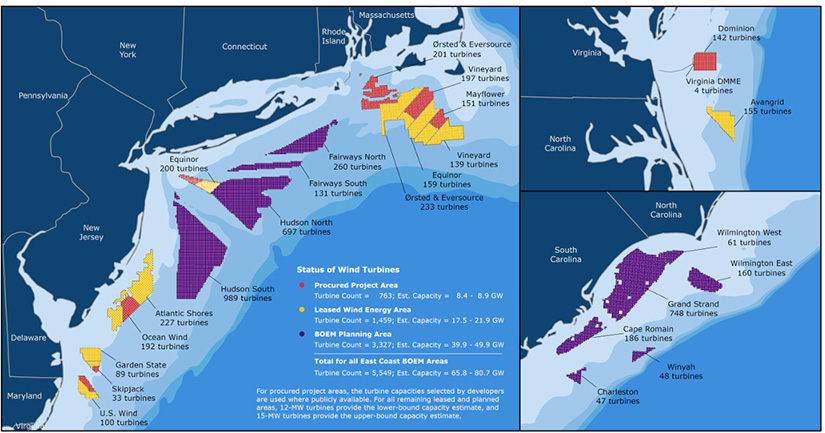
Turbine and capacity estimates for the Bureau of Ocean Energy Management’s North Atlantic wind energy areas. Source: Tufts University
“Site-specific high-fidelity simulations of windfarms are typically beyond the scope of the wind energy design process due to the sheer complexity of the science and computational modeling involved," said Balaji Jayaraman, senior engineer at GE Research and principal investigator (PI) of this project. "However, through advances in exascale computing algorithms and models for multiscale atmospheric flows—driven by the U.S. federal research labs including NREL and powered by the world’s leading supercomputing capabilities—we’ve been able to demonstrate the feasibility of new wind turbine designs previously not possible.”
Using such cutting-edge simulations, the NREL/GE-GRC team’s LLJ research study has revealed a propensity for severe wake-induced power losses and increased loads on wind turbines in offshore deployment. Specifically, the Atlantic coast is known for strong LLJs with jet noses at heights comparable to the larger wind turbines planned for coastal offshore installations. The report says that these turbines could experience LLJ-driven forces capable of rapidly depleting their lifetimes, lowering their efficiency, and even causing turbine shutdowns. The high-fidelity simulations enabled coastal LLJ studies to also help researchers discover strategies to mitigate those LLJ impacts.
“Realizing the opportunity to make wide-ranging impact on offshore wind energy in the United States, we were able to bring together, in a short period of time, some highly capable researchers from GE Research and NREL,” said NREL researcher and co-PI of the project Shashank Yellapantula. "This team was able to accomplish all the goals originally proposed back in 2019."
For his part, Rick Arthur, director of computing at GE Research, explained “this sort of public-private partnership allowed us to bring together the best minds across the fields of computational science and wind energy and leverage world-class modeling and simulation tools and computational infrastructure. Such a collaboration is transformative, enabling not only insight into hidden potential problems but also consequent and viable solutions. The amplified power of this interdisciplinary, cross-industry collaboration cannot be overstated."
Modeling low-level jet impacts
NREL explained that solving today’s energy problems is a matter of having the ability to capture, process, and understand large amounts of data. “A project like ECP, with so many affiliated subprojects that push the boundaries of what’s possible, can yield important transferable capabilities that can be leveraged immediately to solve problems in specific domains, such as LLJs along the U.S. Atlantic coastline, that are well beyond the original goals,” said Ray Grout, director of NREL’s Computational Science Center.
With the support of ECP and WETO, NREL is ensuring that the ExaWind codes are capable of simulating the complex fluid and structural dynamics of wind turbines and wind farms operating in a turbulent atmospheric environment.
Researchers at NREL used data from 20-turbine array simulations performed as a part of a collaboration between NREL and GE Global Research Center to study the effects of low-level jet streams on wind farm performance.
Using the ExaWind code, Oak Ridge National Laboratory’s Summit supercomputer, and NREL’s Eagle supercomputer, the NREL/GE Research team simulated the impact of LLJs within a small five-turbine array and a large 20-turbine wind farm spanning a region of 10 kilometers. This simulation containing 2 billion grid points was one of the largest ever done with ExaWind code and was enabled using a compute-time allocation on Summit at the Oak Ridge Leadership Computing Facility (OLCF). This compute time grant was part of an Advanced Scientific Computing Research Leadership Computing Challenge allocation awarded to the team in 2021 and 2022.
“High-resolution, highly accurate simulations like those produced for this LLJ study required a level of high-performance computing power like Summit’s that only a few facilities in the world have,” said Suzy Tichenor, director of OLCF’s industrial partnerships program. “This type of resource-sharing will continue to be the critical backbone for collaborations that lead to important scientific breakthroughs.”
Reducing loads without compromising net power
From these simulations, the project team discovered that LLJs lead to significant increase in loads on wind turbine blades. Additionally, the wind profile observed in these coastal LLJs lead to deeper wakes (i.e., areas of reduced velocity and increased turbulence) and thus reduced power output from large wind farms like those planned for the Atlantic coast.
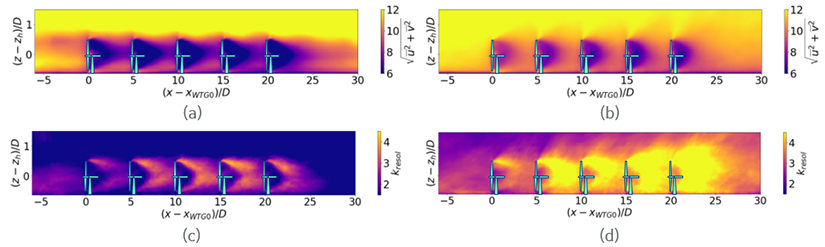
Source: NREL
Using the data from these large-scale simulations, the team is now designing real world strategies to mitigate the impact of LLJs on turbine loads. Before this study, derating the turbines (i.e., operating at a lower power level) was a common strategy employed by large wind farm developers; this leads to increased lifespan for wind turbines at the expense of net power output. The strategies being developed by the NREL/GE Research team will reduce loads on turbines without compromising on net power production of wind farms.
“We’ve never had this level of detail available to us before to understand that wind farms that are designed a certain way can withstand the power of LLJ phenomena,” Yellapantula said.






Comentarios
Sé el primero en comentar...