


US finalizes two offshore wind energy areas in Oregon with capacity up to 2.4 GW
The US Department of the Interior's Bureau of Ocean Energy Management (BOEM) announced the designation of two final Wind Energy Areas (WEAs) off the Oregon coast. These two areas, which hold a potential of 2.4 gigawatts of clean renewable energy, total approximately 195,012 acres and avoid 98% of the areas recommended for exclusion due to their importance as commercial fishing grounds.
The Coos Bay WEA is 61,204 acres and is located 32 miles offshore. The Brookings WEA is 133,808 acres and is about 18 miles offshore. A map of the final WEAs can be found on the BOEM website .
According to BOEM, the WEAs were developed after extensive involvement and comment from the state, tribes, local residents, ocean users, federal government partners, and other members of the public. BOEM Director Elizabeth Klein noted that they will continue to "work closely with tribal governments, federal and state government agencies, ocean users, coastal communities and all interested parties as we move forward with our environmental review."
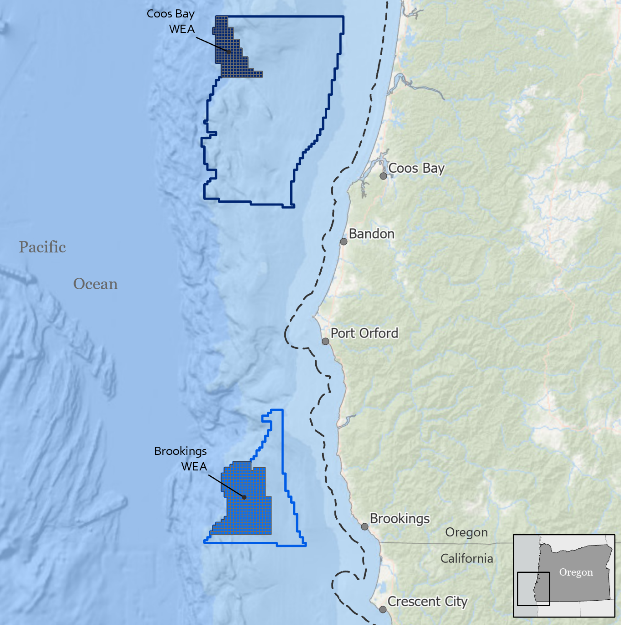
The Coos Bay WEA is 61,204 acres and is located 51 km from shore; the Brookings WEA is 133,808 acres and is about 29 km from shore (source: BOEM)
In addition to collaborating with the State, tribes, coastal communities, and ocean users, BOEM partnered with the National Oceanic and Atmospheric Administration's National Centers for Coastal Ocean Science (NCCOS) to evaluate opportunities for wind energy development and reduce or avoid impacts to other important ocean uses in Oregon.
The agencies developed a comprehensive ecosystem-based ocean planning model that leverages the best available data on natural resources, ocean industries such as fisheries and energy production, and areas of national security activities to identify areas with high potential for wind energy resources and lower potential impacts to other ocean users and sensitive environmental resources.
This approach provided valuable information about the seascape and its uses and facilitated greater transparency and positive coordination with government partners and ocean stakeholders through direct involvement and incorporation of their comments into the NCCOS model.
After being informed of BOEM's decision, Anne Reynolds, Vice President for Offshore Wind of the American Clean Power Association (ACP), sayd that "designating commercially suitable, environmentally sound areas of the Pacific Ocean for offshore wind energy moves the region one step closer to a clean energy future. We applaud BOEM for listening carefully to Oregonians while ensuring that Oregon offshore wind can be responsibly developed."
Reynolds added that "recognizing the urgent need to cut carbon emissions, the State of Oregon has set an ambitious goal to bring three gigawatts of offshore wind power online by 2030, enough energy to power over two million homes. The designation begins the process to meet that goal. It also advances the opportunity for greater reliability and price stability for the people of Oregon. This is a crucial next step in creating a floating offshore wind power industry on the West Coast."


Comentarios
Sé el primero en comentar...