




US wind capacity additions forecast to reach 48 GW by 2030
The US wind sector is set to continue its recovery trajectory, with installations forecast to rise to around 11 GW in 2026 from 8.2 GW in 2025, according to the US Wind Energy Monitor report released by Wood Mackenzie. The rebound follows a 49% year-on-year increase in 2025 and positions 2026 as the strongest installation year in five years.
Looking further ahead, Wood Mackenzie forecasts 48 GW of new wind capacity additions through 2030, supported by a sizeable pipeline of projects and improving execution visibility across both onshore and offshore segments.
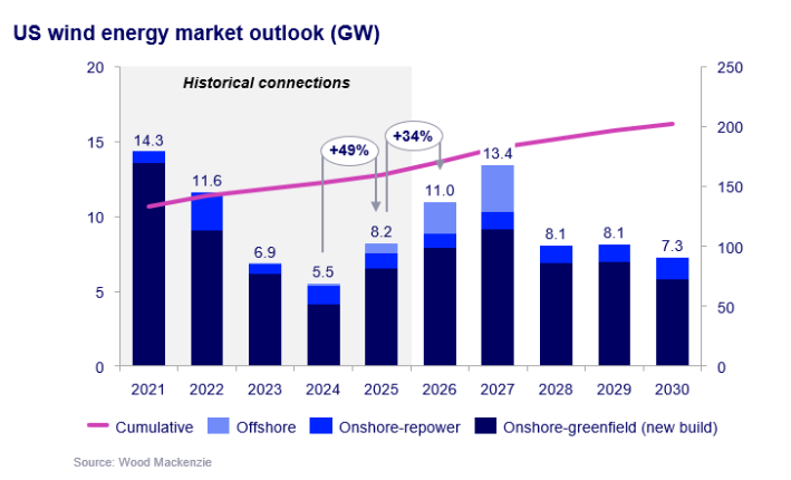
A key driver of near-term growth is a 15.4 GW pipeline of projects that have already cleared major commercial hurdles. According to the report, this provides strong visibility for installations through 2028, even as the sector continues to navigate policy volatility, elevated costs and ongoing permitting constraints.
Land-based wind leads near-term expansion
Land-based wind is expected to dominate US additions in the next three years, accounting for around 24 GW between 2026 and 2028. Approximately 64% of this pipeline is already in advanced stages, including projects under construction, which reduces execution risk and improves certainty around delivery timelines.
The regional distribution of projects is also shifting, says Wood Mackenzie. The West is expected to lead installations in 2026, accounting for around 64% of total capacity additions, largely driven by Pattern Energy’s 3.5 GW SunZia project in New Mexico.
In 2027, momentum is expected to shift to the Midwest, which will account for more than 40% of connections, supported by developments in Illinois, Minnesota and Iowa. By 2028, Texas is projected to regain its position as the leading state market with around 2.5 GW of new connections.
Offshore wind accelerates delivery
Offshore wind activity is also gaining pace, with Wood Mackenzie expecting around 6 GW of capacity to come online by 2027. Execution timelines have accelerated compared to previous forecasts.
In 2025, Avangrid’s Vineyard Wind project installed 624 MW, contributing to a 261% increase in US offshore wind capacity and reaching mechanical completion in early 2026.
Other major projects are also advancing. Revolution Wind and Coastal Virginia Offshore Wind (CVOW) have both reached first-power milestones and continue progressing through construction phases. Ørsted’s US portfolio is also moving forward, with Revolution Wind on track for commissioning in the second half of 2026, while Sunrise has been accelerated to H2 2027 from a previously expected 2028 timeline.
Policy uncertainty and permitting remain key risks
According to the report, despite strong pipeline visibility, the sector continues to face structural challenges. Federal policy volatility under the current US administration remains a concern, particularly for offshore wind investment decisions.
Permitting bottlenecks are also emerging as a critical constraint for land-based wind. The Federal Aviation Administration (FAA) and Department of Defense (DoD) review processes are increasingly impacting project timelines. According to Wood Mackenzie, around 60% of projects submitted for FAA Determination of No Hazard trigger a DoD review.
The backlog has grown significantly, with the number of turbines awaiting final determination rising more than five-fold in 2025 to nearly 5,000 units. Wood Mackenzie warns that if these projects are not cleared, US wind installations could be reduced by around 17% through the end of the decade, equivalent to roughly 7 GW.
Cost pressures across the sector remain high. Turbine prices are currently around 22% above early 2022 levels, while US onshore wind capital expenditure is projected to rise by 5% through 2029.
This increase is being driven by a combination of tariff exposure on materials and components, permitting delays and uncertainty over future build-out volumes. However, recent clarity on tax credit rules following the OBBBA framework and updated IRS guidance has helped reduce some near-term uncertainty for developers.
Beyond near-term dynamics, demand fundamentals continue to strengthen the long-term outlook for wind in the US. Around 183 GW of large-load capacity is currently backed by signed construction or long-term supply agreements, representing a major source of future electricity demand.
Approximately 72% of this capacity is concentrated in wind-rich regions such as ERCOT and PJM, reinforcing the strategic role of wind generation in meeting regional demand growth.
Overall electricity demand in the US is expected to grow at an average rate of around 3% through 2030, compared to just 0.7% in the previous decade. Data centres account for a significant share of this growth, increasing the need for scalable and cost-competitive power sources.
“Despite current headwinds, the fundamentals supporting US wind growth remain compelling,” said Diego Espinosa, senior research analyst at Wood Mackenzie. “Rising electricity demand, competitive economics and the safe harbour of federal tax credits create a strong foundation for continued deployment through the end of the decade.”


Comentarios
Sé el primero en comentar...