


Good summer for electric mobility: July registrations increased by more than 60% in the EU
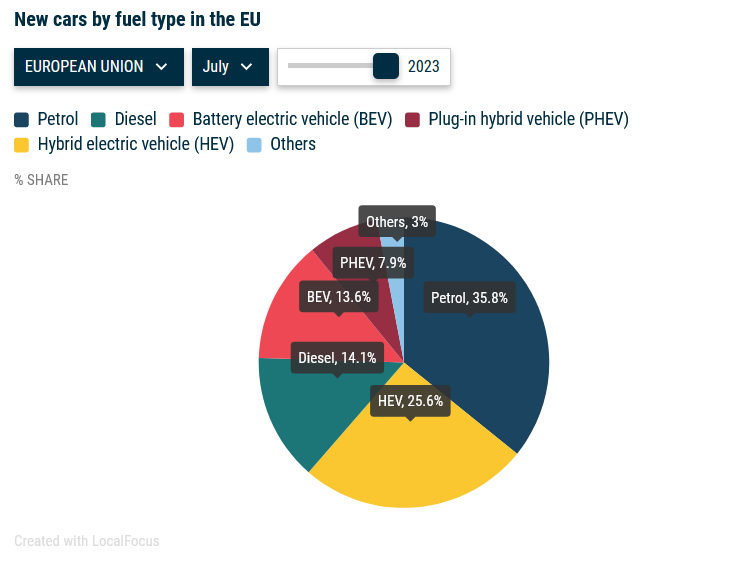
The summer is bringing important data for the electromobility drive in Europe. In July, new EU battery-electric car registrations substantially increased by 60.6%, reaching 115,971 units while accounting for 13.6% of the market (up from 9.8% the same month last year). Most EU markets grew significantly by double- and triple-digit percentage gains, including the two largest, Germany (+68.9%) and France (+32.4%).
These data, released by the European Automobile Manufacturers' Association (ACEA) show that, notably, Belgium recorded the highest sales with an impressive 235.9% growth. Cumulatively, battery-electric car sales recorded a significant 54.7% increase from January to July, with 819,725 units registered.
Hybrid-electric cars maintained their position as the second choice among new car buyers, capturing over a quarter of the market. New hybrid-electric carregistrations surged by 31.6% in July, primarily fuelled by solid growth in the region’s largest markets: Germany (+46.6%), France (+32.8%), Spain (+30.8%), and Italy (+16.7%). This led to a cumulative 28.5% increase, with almost 1.6 million units sold between January and July, equivalent to one-quarter of the market share.
Last month, new EU plug-in hybrid car registrations increased by 14.5%, reaching 67,060 units. Strong performance in major markets like the Netherlands (+107.6%), France (+80%), and Spain (+42.7%) was offset by a decline in Germany (-39.5%), the largest market for this fuel type. Despite this growth, the market share of plug-in hybrid cars remained stable at 7.9% in July.
 ACEA
ACEA
Overall, in July 2023, the EU car market continued its growth trajectory, expanding by 15.2% – the twelfth consecutive month of growth. New car registrations reached 851,156 units as the bloc recovers from last year’s component shortages. Most markets posted solid growth, including the four largest: France (+19.9%), Germany (+18.1%), Spain (+10.7%) and Italy (+8.7%). Despite indications of the European automotive industry’s recovery from pandemic-related supply disruptions, year-to-date volumes are still 22% lower than in 2019.




Comentarios
Sé el primero en comentar...