
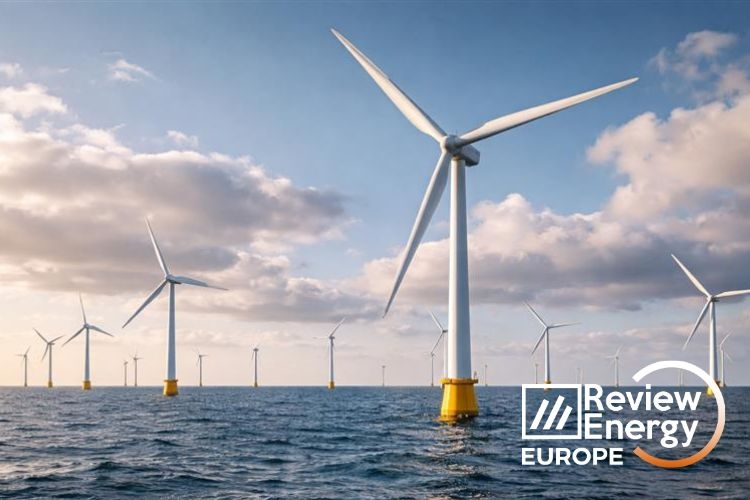


Delayed offshore wind and grid bottlenecks threaten UK climate ambitions for 2030
The United Kingdom is approaching a critical turning point in its climate commitments, with almost all of its 2030 energy transition targets now out of reach, despite having halved its emissions since 1990. According to the “United Kingdom Energy Transition Outlook 2025” report by Wood Mackenzie, the country faces a 12-percentage-point gap to meet its 2030 climate goals, even as cumulative low-carbon investment is projected to reach between £1.5 trillion and £2.1 trillion by 2060.
The analysis estimates that an additional £75 billion of accelerated investment is required during this decade alone to close the shortfall. Meanwhile, structural challenges — including grid bottlenecks, delayed offshore wind deployment, rising project costs and shifting government priorities — are slowing progress at a critical juncture.
Emissions progress slows as targets drift out of reach
UK energy-related CO? emissions fell from around 600 million tonnes per year in 1990 to 294 Mtpa in 2025, marking a 51% reduction over 35 years. This progress enabled the government to set ambitious Nationally Determined Contribution (NDC) targets for 2035.
However, Wood Mackenzie’s base-case scenario projects that emissions will fall only 56% by 2030, well short of the 68% reduction required under the NDC, pushing nearly all short-term climate targets beyond reach.
In what the report describes as a “new world order”, national security concerns, defence spending, and cost-of-living pressures are now competing directly with climate policy for political attention and public funding. As a result, climate-driven energy transition efforts are losing momentum, even as low-carbon domestic energy increasingly becomes central to UK energy security and geopolitical positioning.
Offshore wind deployment lags as commercial realities bite
Renewables generated more than 50% of the UK’s electricity in 2025, following the complete phase-out of coal. Wind and solar generation more than doubled between 2015 and 2025. Yet offshore wind — the backbone of the UK’s clean power strategy — is now at least 20% behind government capacity targets for 2030, following widespread project delays and cancellations throughout 2025.
Reforms to the Contracts for Difference (CfD) mechanism have shown encouraging signs. The seventh allocation round awarded a record 8.4 GW in 2025, and the UK signed a North Sea Investment Pact with eight neighbouring countries, committing to 15 GW per year between 2031 and 2040, aimed at mobilising £850 billion (€1 trillion) of capital.
However, grid connection queues, infrastructure bottlenecks and escalating costs continue to restrict deployment.
“The UK faces a critical paradox,” said Lindsey Entwistle, Principal Research Analyst at Wood Mackenzie. “The country has halved emissions since 1990, but the next phase requires accelerating renewables deployment while managing prolonged fossil fuel reliance. CfD reforms show policy can re-energise offshore wind, but the 20% shortfall highlights the scale of execution risk.”
North Sea policy deepens import dependency
Oil demand is forecast to decline 24% by 2035, while gas demand falls 18%, yet fossil fuels remain deeply embedded in the system. Transport still accounts for 72% of oil demand, while residential, commercial and agricultural sectors represent 54% of gas demand. Gas is expected to generate 22% of electricity in 2030 and 10% in 2035, despite clean energy ambitions.
Under the North Sea Future Plan, new exploration is banned and the Energy Profits Levy extended to 2030. As a result, domestic oil production falls to 79% of 2025 levels by 2035, while gas output plunges to just 40%.
By 2035, domestic supply will meet only 47% of oil demand and 21% of gas demand, forcing net imports of 600,000 barrels per day of oil and 39 billion cubic metres of gas, increasingly sourced from the United States following the ban on Russian LNG.
While the policy supports climate goals, it also creates structural import dependency, raising concerns about energy security, supply-chain vulnerability, and geopolitical exposure, while intensifying pressure to deliver a “just transition” for workers and communities in legacy energy regions.
Investment needs surge across power, grids and emerging technologies
Wood Mackenzie projects £1.5–2.1 trillion of cumulative low-carbon energy investment between 2025 and 2060, depending on policy ambition. Over 60% of total capital expenditure will be absorbed by power generation and grid infrastructure.
An additional £75 billion between 2026 and 2030 would narrow the gap between current trends and national commitments. Offshore wind and low-carbon generation account for 60% of this incremental investment, followed by carbon capture and sustainable fuels (13%), and grid reinforcement and EV charging infrastructure (10%).
Nuclear, carbon capture and hydrogen: slow but strategic
The government has selected Rolls-Royce to lead a small modular reactor (SMR) pilot, with first grid connection expected in the early 2040s. Nuclear capacity is forecast to reach 10.5 GW by 2050, far below the government’s 24 GW target.
Carbon capture capacity is projected to reach 6 Mtpa by 2030 and 37 Mtpa by 2050, with power generation and blue hydrogen accounting for 64% of captured volumes. The Carbon Border Adjustment Mechanism (CBAM), launching in 2027, is expected to boost deployment by protecting domestic low-carbon industries.
Low-carbon hydrogen remains commercially constrained. High-profile project cancellations during 2024–2025 reflect persistent cost and demand uncertainties, pushing deployment toward industrial and power generation uses, where alternatives remain limited.
Grid integration and interconnection expand
The UK is expected to reach 20 GW of electricity interconnection capacity with the EU by 2035, with net exports approaching 25 TWh annually through the 2030s, reinforcing its growing role within the European energy system.
Key findings
-
UK emissions fell 51% between 1990 and 2025, but 2030 targets are now largely unattainable, with a projected 56% reduction versus the 68% target.
-
£1.5–2.1 trillion in low-carbon investment required by 2060; £75 billion extra needed by 2030.
-
Offshore wind deployment is 20% below 2030 targets, despite 8.4 GW awarded in 2025 and an £850bn North Sea investment pact.
-
North Sea exploration ban increases structural import dependency, with oil imports rising to 600,000 bpd and gas imports to 39 bcm by 2035.
-
Nuclear capacity reaches 10.5 GW by 2050, far below the 24 GW target.
-
Carbon capture reaches 6 Mtpa by 2030 and 37 Mtpa by 2050.




Comentarios
Sé el primero en comentar...