
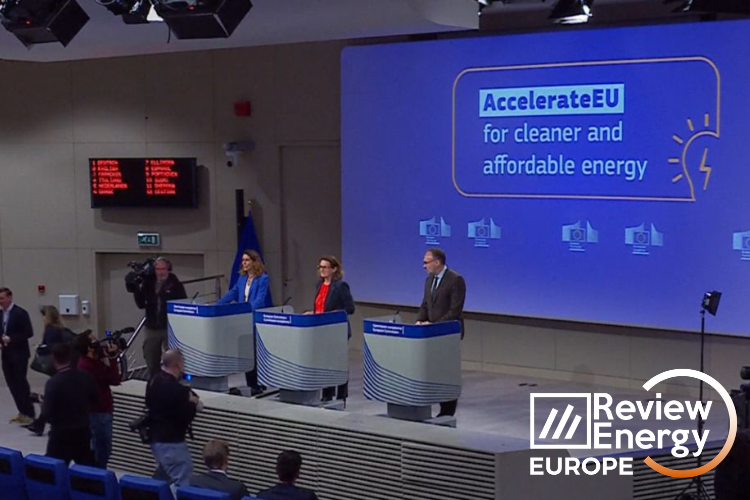


EU targets energy security with AccelerateEU plan to cut fossil fuel imports
The European Commission has unveiled its AccelerateEU strategy, a package of short-term and structural measures aimed at reducing the bloc’s dependence on imported fossil fuels while accelerating the deployment of clean, homegrown energy.
The initiative comes as rising geopolitical tensions have pushed up energy costs, with the EU spending an additional €24 billion on energy imports since the escalation of the conflict in the Middle East, without any increase in supply volumes. The Commission frames the current situation as a reminder of the economic and security risks linked to fossil fuel dependency.
"The choices we make today will shape our ability to face the challenges of today and the crises of tomorrow. Our AccelerateEU strategy will bring both immediate and more structural relief measures to European citizens and businesses. We must accelerate the shift to homegrown, clean energies. This will give us energy independence and security, and mean we are better able to weather geopolitical storms," Ursula von der Leyen, President of the European Commission, said.
AccelerateEU combines immediate relief measures for consumers and industry with longer-term actions to strengthen system resilience. On the short-term side, the Commission proposes targeted support mechanisms, including income support, energy vouchers and temporary tax reductions for vulnerable households, alongside a new State Aid Temporary Framework to allow governments to support exposed sectors.
At the system level, the plan emphasises coordination among Member States, particularly in the management of gas storage, oil stocks and emergency measures affecting fuel supply. A new Fuel Observatory will be established to monitor production, imports, exports and stock levels of transport fuels, with the aim of identifying potential shortages and ensuring balanced distribution across the EU.
A central pillar of the strategy is the acceleration of electrification to replace fossil fuels across industry, transport and buildings. The Commission is set to present an Electrification Action Plan by the summer, including targets and measures to remove barriers to electrification. The rollout of sustainable fuels in aviation and transport is also highlighted as a priority.
The plan also underscores the need to strengthen electricity grids to support higher levels of electrification. This includes faster implementation of existing legislation, progress on the European Grids Package and measures to maximise existing renewable capacity through repowering of wind farms and upgrades to hydropower assets. The Commission also plans to propose changes to network charges and taxation, including aligning taxation to favour electricity over fossil fuels.
On the investment side, the Commission points to existing EU funding instruments, including €219 billion available under the Recovery and Resilience Facility, but stresses that public funding alone will not be sufficient. The energy transition is estimated to require €660 billion in annual investment until 2030, making the mobilisation of private capital a key priority. In this context, the Commission will convene a Clean Energy Investment Summit to engage financial institutions, industrial players and project developers.
Teresa Ribera, Executive Vice-President for Clean, Just and Competitive Transition explained: "There is no alternative to the Green Deal when it comes to security and competitiveness. Once again, citizens and businesses are paying the price of our dependency. This communication aims at reinforcing EU coordination and protect the most vulnerable while accelerating deployment of homegrown clean energy and electrification to make a real and lasting difference."
Industry reactions highlight support for electrification and hydrogen, but caution on market design and intervention risks
Industry stakeholders broadly welcomed the Commission’s focus on electrification and domestic energy production, while calling for clearer frameworks and warning against unintended impacts on investment signals.
Jorgo Chatzimarkakis, CEO of Hydrogen Europe, said: “The ongoing crises have once again put a spotlight on Europe’s volatile and costly energy dependencies and reemphasised the importance of growing our own domestic fuels and fertiliser markets. Today’s AccelerateEU plan will help this objective, especially the planned Q2 review of the RED3 Delegated Acts, which will decrease hydrogen production costs and allow the industry to contribute to Europe’s resilience and sustainability goals.”
He added that “recognising hydrogen’s role in the solution will mean the sector can help mitigate the dire cost and supply issues for important products like jet fuel through the production of e-fuels.”
SolarPower Europe welcomed the electrification focus, with Deputy CEO Dries Acke stating: “Renewable-based electrification is the most effective way for Europe to cut its fossil fuel import dependence, and AccelerateEU rightly puts it at the centre of the EU’s crisis response. The Commission’s decision to set a single EU-wide electrification target provides a clear direction for reducing fossil fuel exposure.”
But he warned that “the Commission, however, fails to propose concrete measures to get to these levels of battery storage and other non-fossil flexibility,” calling for a “market-based ‘Non-Fossil Flexibility investment booster’ to secure electricity supply and lower wholesale electricity prices.”
WindEurope welcomed the Commission’s emphasis on electrification and renewables, stating that AccelerateEU makes clear that “any energy price relief measures must be underpinned by a faster transition to homegrown renewables and a more electrified economy.”
CEO Tinne van der Straeten said: “Electrification is a strategic imperative for Europe’s independence, security, and prosperity. It needs to happen immediately and at scale. We must make homegrown electricity the cheapest option. This means cutting VAT and taxes on heat pumps, electric vehicles and other electrification technologies.”
The association highlighted grid bottlenecks as a critical issue, noting that 400 GW of wind capacity is currently waiting for grid connections, and urging faster implementation of EU grid reforms.
However, WindEurope warned against renewed market interventions. It argued that allowing windfall taxes risks repeating past policy mistakes from the 2022 energy crisis, which it said led to investment uncertainty and weaker deployment.
Van der Straeten added: “We have seen this before, in 2022 market interventions ground wind energy investments to a halt. Wind investments hit their lowest since 2009. Turbine orders nosedived by 47% year on year. And in some cases, gas consumption even increased. Let’s not repeat past mistakes.”


Comentarios
Sé el primero en comentar...