
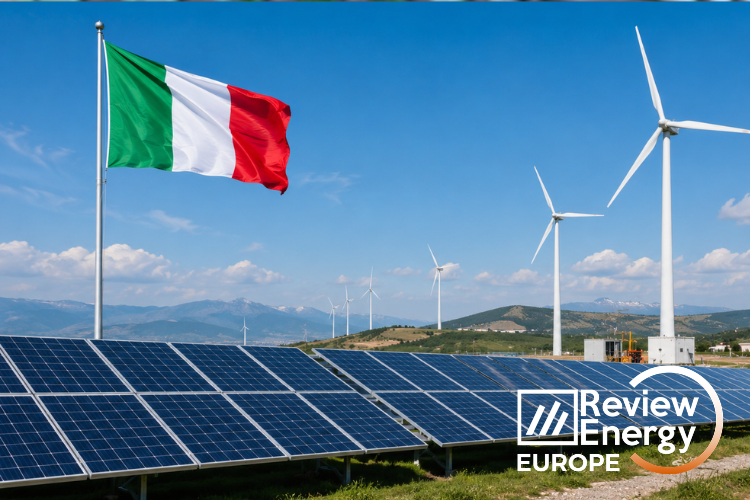


European Commission approves Italy's €23bn FER X renewable energy support scheme
The European Commission has approved Italy’s FER X support scheme, authorising up to €23 billion in state aid to accelerate the deployment of renewable electricity generation and support the country’s decarbonisation objectives.
Commenting on the decision, Executive Vice-President for Clean, Just and Competitive Transition Teresa Ribera said the scheme would help Italy expand renewable electricity generation while advancing the goals of the EU’s Clean Industrial Deal.
“With this €23 billion scheme, Italy will support the production of renewable electricity from various technologies, such as onshore wind, solar or hydropower, to reach the goals of the Clean Industrial Deal. The scheme will also help Italy reduce its dependence on fossil fuel imports and enhance its renewable energy share,” Ribera said.
Approved under the EU’s Clean Industrial Deal State Aid Framework (CISAF), the scheme will support the construction of new renewable energy installations using solar photovoltaic, onshore wind, hydropower and sewage gas technologies. The programme is expected to facilitate the deployment of 37.15 GW of new renewable capacity, equivalent to nearly half of Italy’s current installed renewable energy base.
The support mechanism is designed to help Italy achieve its target of sourcing 39.4% of gross final energy consumption from renewables by 2030, while strengthening energy security and reducing dependence on imported energy.
Support through CfDs and auctions
According to the European Commission, aid will be granted through two-way contracts for difference (CfDs) with a duration of 20 years. Under the mechanism, generators will receive payments when market electricity prices fall below an agreed strike price and will return revenues when prices exceed that level.
Support for projects above 1 MW will be allocated through competitive auctions based on the strike price required by developers to deliver each project. The scheme also includes a dedicated competitive process for solar and wind projects exceeding 1 MW, incorporating pre-qualification criteria aligned with the EU’s Net-Zero Industry Act.
Smaller installations with a capacity below 1 MW will be eligible for direct support without participating in auctions. In these cases, strike prices will be established administratively by Italy’s energy regulator, ARERA.
The Italian Ministry of Environment and Energy Security (MASE) described the Commission’s decision as a key milestone for the country’s renewable energy strategy. Environment and Energy Security Minister Gilberto Pichetto Fratin said the approval allows Italy to continue the rollout of mature renewable energy technologies while ensuring continuity between the transitional FER X mechanism introduced in 2025 and the long-term framework.
“This is a strategic instrument to strengthen the country’s energy autonomy, reduce dependence on foreign energy supplies and ensure continuity for the support mechanism introduced last year,” Pichetto said.
Under the FER X framework, 10 GW of the total capacity allocation will be reserved for plants with a capacity of up to 1 MW, while the remaining 27.15 GW will be dedicated to larger projects.
The ministry added that the decree will now be submitted to the Court of Auditors before being formally published. Officials said the European approval represents an important step in accelerating Italy’s energy transition by supporting investment, innovation and greater security of the national energy system.
While the scheme has been authorised with a budget of up to €23 billion, the European Commission noted that actual net support could be significantly lower depending on future electricity market prices, as revenues above the strike price will be returned to the state under the two-way CfD structure.
The approval marks one of the largest renewable energy support programmes authorised under the CISAF framework since its adoption in June 2025, reinforcing the role of competitive CfD-based schemes in delivering Europe’s clean energy transition.

Comentarios
Sé el primero en comentar...