


Five takeaways from the UK's coal-to-clean story: Ember
Ember's latest study looked at the process of moving away from coal in the UK and the transformation of the electricity system over the last decade. In 2010, the UK's power supply was heavily dominated by fossil fuels; however, in just over a decade, the UK’s power system has been transformed: coal now generates just over 2% of the UK's electricity.
Crucially, coal has not been replaced with other fossil fuels—gas generation fell from 46% of the electricity mix in 2010 to 39% in 2022—or even nuclear power which has remained mostly unchanged since 2010. Instead, the fall in coal power in the UK has been driven by a huge increase in wind (3–25% share of electricity) and solar (0–4% share of electricity) generation as well as a significant drop in electricity demand (-16%). The result has been a substantial fall in the carbon emissions of the UK power system from 160 MtCO2 in 2010 to 58 MtCO2 in 2022.
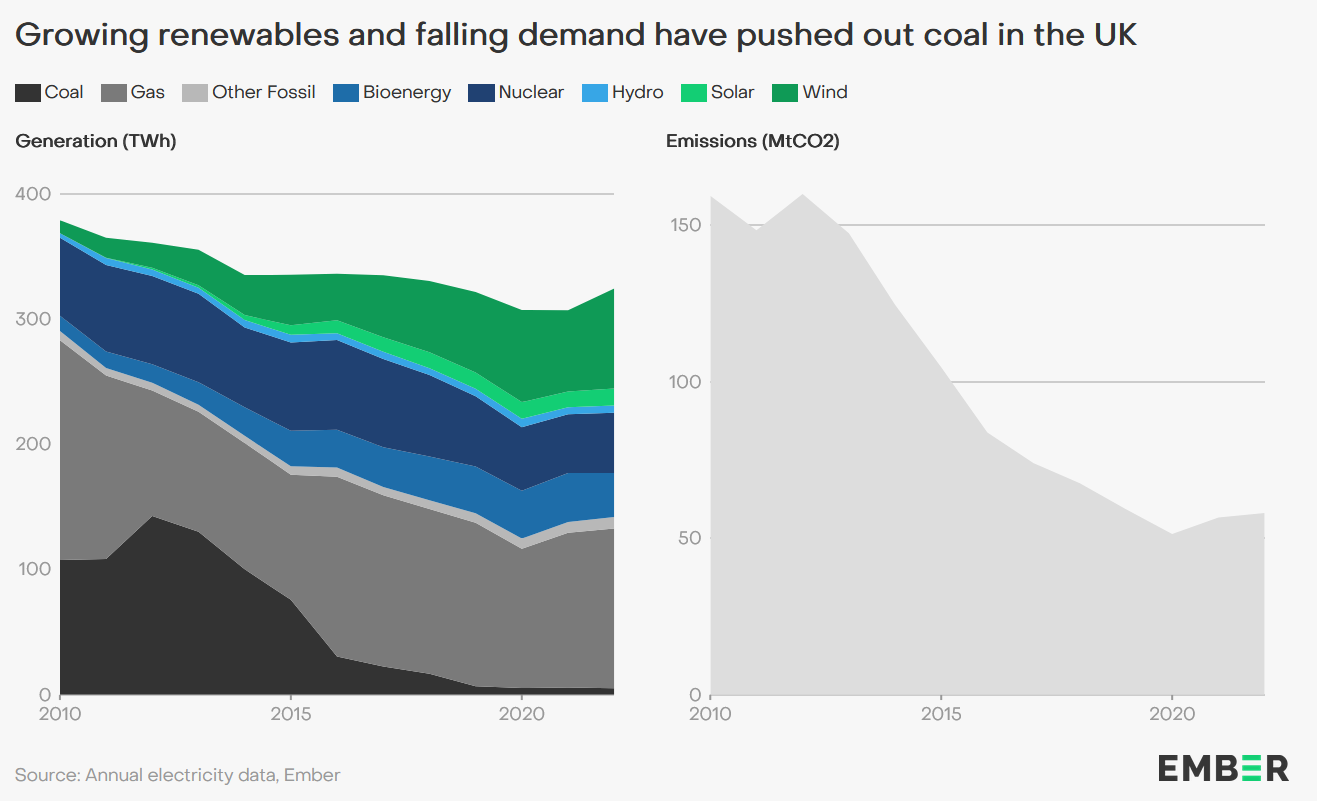
According to Ember, the UK is now aiming to achieve complete decarbonisation of the power sector by 2035—a world-leading target. This ambition is even more impressive given that power demand in the UK looks set to halt its decline and begin to rise rapidly—doubling by 2050—as more of the UK economy electrifies.
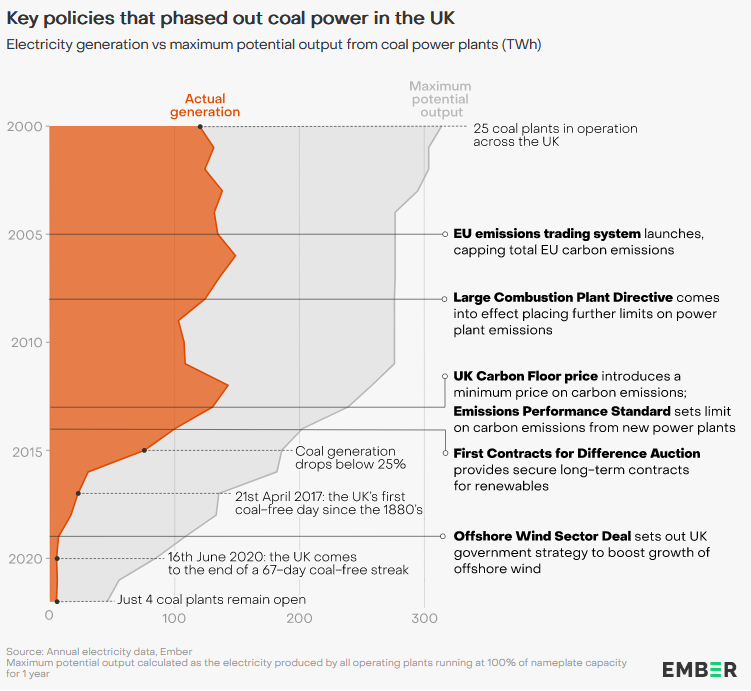
There is no single cause for the rapid decline of coal in the UK. Instead, the journey from fossil-fuel dependent to renewables champion can be attributed to five main factors: setting of ambitious short-term targets, the changing economics of coal, policy support for wind power, market reforms, and investments and innovations in the grid. Although it is difficult to individually quantify the impacts of any one of these five factors, their combined effect has seen coal capacity in the UK fall from 32 GW in 2010 to 4 GW today.
1. Ambitious short-term targets
Many governments have set mid-century targets, but the UK has ambitious and legally binding power sector goals that send clear signals on its direction of travel.
In 2008, the UK passed the world-leading Climate Change Act. This set into law a whole-economy, legally binding target of an 80% reduction in greenhouse gas emissions below 1990 levels by 2050. In 2019, in recognition of the 2015 UN Paris Agreement, the Act was revised to increase its ambition to economy-wide net zero emissions by 2050.
2. Revealing coal’s hidden costs
Critical to the UK’s rapid coal phase out were a series of measures that meant that coal was no longer economically viable.
The UK avoided subsidising coal or paying to close polluting plants because coal plants became uneconomic ahead of the phase-out target and closed of their own accord. The plummeting cost of renewables and ambitious power sector targets contributed to this. However, there were also other specific measures that limited coal’s profitability and discouraged construction of new coal plants. This included a high price on carbon sustained by a carbon price floor, as well as air pollution and emissions standards.
3. As wind grows rapidly, coal falls
Stable policy support for wind power allowed for astonishingly rapid growth. The UK is very rich in wind resources – both in terms of atmospheric factors (lots of wind) but also in terms of site availability; much of the UK coastline is shallow water making the construction of large scale wind farms relatively easy. On the other hand the UK does not receive high levels of consistent sunlight throughout the year meaning its solar power potential is lower than wind.
The more the UK embraced wind, the easier and cheaper it became to scale up quickly. Stable policy support led to enormous investment and rapidly collapsing prices for wind, as coal became increasingly uneconomic. The more wind turbines that have been built in the UK, the greater the support for them. In April 2022, 79% of the British public supported building further wind power.
The 2019 Offshore Wind Sector Deal identified offshore wind as one of the UK’s leading industries, and provided a roadmap for how government action would coordinate with and further support industry growth.
4. Market reforms
Changes to the market incentivised and de-risked investment in renewables, and ensured security of supply. Consistent policy support for renewables, and ambitious targets on power sector decarbonisation sent clear signals to the market on where to invest. But several reforms supported the transition from coal to clean electricity by reducing the risks of investing in renewables and ensuring that a shift to higher wind and solar penetration would not lead to difficulties in ‘keeping the lights on’.
The 2013 Energy Act also implemented the UK’s capacity market, designed to provide payments for dispatchable sources of power to ensure they remain available to deliver energy when needed. The capacity market has funded over 14GW of new capacity – some fossil gas, but also interconnectors, demand response and storage. This has ensured security of power supply as old coal power has come offline and the share of intermittent renewables in the power mix has increased.
5. Investment & innovation in the grid
Innovation in the grid has sped-up deployment of renewables and provided more certainty for generators of flexible sources of electricity. Prior to 2010, all transmission infrastructure works would have to be completed before a new power generator could come online. Lead times for large-scale transmission projects were around a decade which drastically limited the pace at which renewables could be built in the UK. However, in 2010 a new method of transmission project management was introduced which required only local transmission works to be put in place before a power generator could come online reducing lead times to just a few years and hugely increasing the pace of deployment.
Around the same time, the ‘Electricity Networks Strategy Group’ (ENSG) was formed. The ENSG brought together the stakeholders in electricity networks with the government and energy system regulator. The ENSG allowed these groups to collaborate and coordinate to overcome strategic grid issues such as identifying important grid reinforcements needed to allow more renewables to join the grid.
Since 2015, the UK’s National Grid Electricity Systems Operator has used a process called the Network Option Assessment (NOA) to set out which grid reinforcement projects should take place and when. The NOA is designed to ensure the UK grid is robust enough to deal with the future power system as demand increases and it transitions to renewables-based.



Comentarios
Sé el primero en comentar...