


Local communities at the heart of the US energy transition
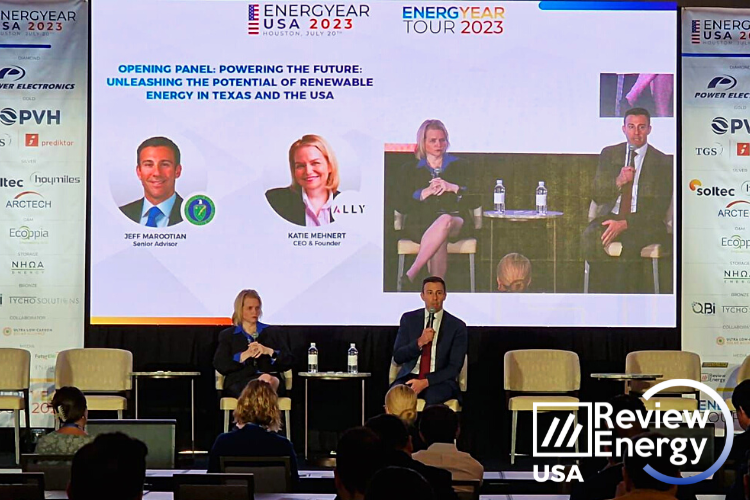
The top-rated renewable energy networking event inaugurated its first edition in the United States with more than 300 attendees. During the opening, Energyear USA was attended by Jeff Marootian, Senior Advisor at the U.S. Department of Energy (DOE) and Katie Mehnert, CEO and Founder of Ally Energy.
With a reiterated commitment to clean energy in the U.S. Marootian noted that the Department of Energy is doing everything possible to empower future generations to become active participants in renewables.
"We are empowering the future leaders of clean energy," Marootian said. According to him, the United States is living one of the most exciting moments regarding the energy transition and the government recognized the work that the industry is doing to reach a decarbonized economy.
During his participation in Energyear USA, the Senior Advisor also recognized the opportunities that have arisen since the beginning of the Inflation Reduction Act (IRA). The Joe Biden administration's new investment plans, he said, have also unlocked a huge potential for new clean technology opportunities in the country.
"Thanks to the IRA, we now see incredible momentum. It's very exciting to see how with all these investments we have great opportunities to create good jobs in the industry and reach net zero economy by 2050," he said.
Marootian also acknowledged that there has been significant public-private work and that the Biden administration is driving important actions toward working with local communities on opportunities that will help them from different angles to get closer and closer to renewable energy. We are always looking at different options to understand the needs of each community," he continued.
Another of Marootian's key points was sustainable transportation. With a previous experience in this sector, the expert argued that the country is also focusing its efforts not only on electrification actions but also on considering hydrogen or Sustainable Aviation Fuels as key players in the decarbonization path of this sector.
"We can use clean technologies in different ways to achieve sustainable transportation. We have a law in place, and we work very closely with states and municipalities to move large investment capitals towards sustainability in transportation," he remarked.
On the other hand, Katie Mehnert had the opportunity to highlight that the growth and change being seen in the country is exciting. "America was built by builders and it's time for them to transition. I see a lot of people changing and coming to the new technologies and the most interesting thing is to see that work between the government and the private sector," she explained during Energyear USA.
Mehnert also referred to those local communities that Marootian talked about. According to her, there is an important point in the transition process that must involve the communities, starting with talking more about what the industry is doing for change.
She said that it is necessary to reach this new generation, "the influencers are the ones who have the attention, and we have to change the message of energy and transform it to clean energy until it reaches them, and we have to tell our stories because that is what makes the world move".
A reliable grid and a close local community
Earlier in the day, Energyear USA's day also featured perspectives from other points of view. During the panel 'Renewables as the grid's shield: integration strategies of energy companies in embracing renewable energy into their business', moderated by Hector Rocha, Partner Sustainability, Strategy and Energy Transition at EY, experts analyzed what have been the most important challenges in the deployment of renewable energy in the United States.
Joaquín Castillo, Chief Executive Officer of Acciona Energy North America explained that, for his company, the country represents one of the largest and most interesting markets in the growth and expansion of clean energy.
However, he affirmed that the grid is the main challenge for the growth of renewables. And while he noted that more concrete actions must be created for the future and to achieve a reliable grid, there is also "a lot that can be done with the existing grid".
Castillo also mentioned importance of working with the community. He stressed that for a good exercise in renewable growth it is essential to have a local presence and interaction from the beginning of the projects. "We need an exact approach so that the people in the communities, who are going to see the companies there for a long time, feel accompanied. We have to understand their needs, which are different, in each region. Adapt and work with them," he said.
David Salvo, CEO of Power Electronics, agreed, acknowledging that the U.S. market has changed for the better but there is still a big challenge ahead. “What we can do best for communities is to create jobs for them. There are a lot of jobs coming from fossil fuel to renewables,” he explained and announced that in the next 2 years the company is going to create 500 manufacturing jobs.
Dave Carroll, Chief Renewables Officer, Senior VP, North America Region of ENGIE North America, also participated in the discussion. The expert acknowledged that North America is moving on a clean spectrum. But he warned that "we are using more energy than ever because everything is being electrified and so we need to invest more in the grid. We need federal policies to support transmission. It's a challenging market that requires us to work in networks, policies and also in local communities.
"It is very important for us to go out to the workers and communities in the areas where we work. People should not be left out of the transformation spectrum. There are a lot of groups against us on Facebook and we must work against that. We have to tell that story of what we are doing," he said.
Finally, Erika Bierschbach, Vice President, Energy Market Operations & Resource Planning at Austin Energy, explained that in the face of the grid challenge, it is necessary to see batteries as an important part of the solution. While regarding the work with communities she added that "it is our job to explain, educate and care. To talk about what is carbon free, renewables, energy transition, etcetera. But also, to educate our customers about everything we do".


Comentarios
Sé el primero en comentar...