


Organisation, regulatory framework and digitalisation: keys to Italy's energy transition
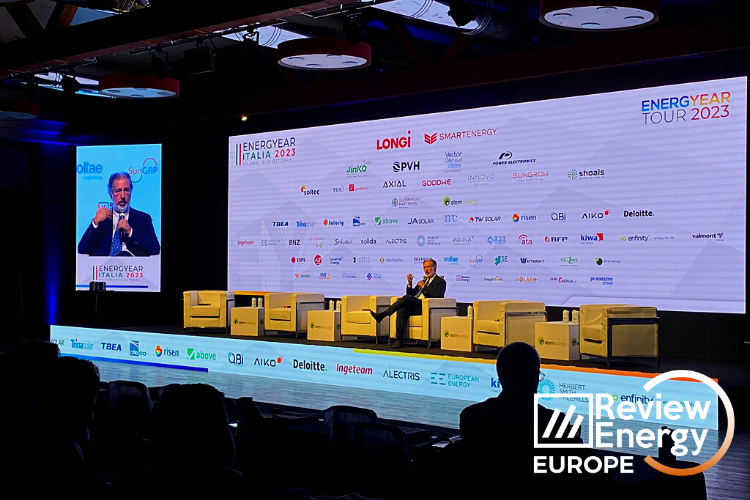
The industry's top-rated networking event, Energyear Italy 2023, continues to be the focus of the debate on the path taken by the public and private sectors to decarbonise the country. While the previous day analysed the points necessary for the development of renewable projects, especially in the field of photovoltaics, on this occasion the public sector was represented and gave the keys to the future in order to continue on the path towards the energy transition.
Massimiliano Atelli, Presidente delle Commissioni nazionali Via-Vas e Pnrr-Pniec, Ministero dell'Ambiente e della Sicurezza Energetica, said that it is necessary to ask where Italy is now in order to know where to go in the future. In doing so, he stressed the need for greater organisation, a clearer definition of regulatory frameworks and a commitment to the digitalisation of the sector. “The answer is quite complex, but it is also clear that we are not at the beginning, nor at the end of the process; we are in a transition phase,” he said.
Atelli highlighted some of the achievements during the year. For example, the creation of a second commission created specifically to work on the national resilience plan and the establishment of traditional commercial power. The commission's work on infrastructure development and permitting led to a target of 7.5 GW by 2022, an amount already surpassed by October 2023.
Atelli also spoke of the need for collaboration with European associations to reach global climate targets, as well as the need for more commissioners in the working groups to achieve better and better results.
The digitalisation and renewal of platforms is another key to the work to boost clean energy. Atelli assured that they have been working over the last year on new products and platforms, receiving support from public bodies, to make the necessary changes in the sector. “I am sure that we will exactly come to a massive change in our sector. We really need to get to a more modern area and move away from the old tools,” he said.
“I think we have to make a complete transition to digital, we want procedures to be faster and more digital, but at the same time, what is the objective here? Authorisation procedures in Italy are regulated by law in a very precise way, but there may be some elements missing in the granting of permits, qualitative or quantitative. The transition to digital is something we are working on, although we cannot be optimistic because there is still a lot to do,” Atelli explained.
Finally, Atelli highlighted the great challenges that are being undertaken in Italy and the work to choose new commissioners and more secure platforms with which to provide the necessary support for the development of projects. Employment is another major challenge he discussed, which is a key issue for the Italian economy. For Atelli, Italy is a big country with many opportunities that are there, and operators are needed to reach the highest level of efficiency and continue working to make Italy one of the key countries in the global energy transition.
Focus on new measures
Following this analysis of the Italian sector, the prospects for the transition to renewable energy were discussed, with representatives from the private sector speaking about the need to focus on regulatory measures and the need to create new options to facilitate the development of these renewable projects.
Luis Sabaté, President, Chairman of the Board of Matrix Renewables; Giorgio Tomassetti, CEO Italy of Octopus Energy; Maria Diez, Chief Technical Officer for Europe of Enfinity Global; Roberto Pierantoni, Head of Project Management of EDP Renewables; Massimo Bartocci, Country Manager Italy of ox2; and Francesca Morra, Partner of Herbert Smith Freehills participated in this discussion on how to shape a sustainable future.
Once again, the work that remains to be done was one of the keys to the debate, although some of the experts' opinions were positive towards the path that is being taken, highlighting the need to be willing to operate in a free market and the need for subsidies to do so.
Thus, they stressed that it is necessary to move towards more innovative models, with measures being implemented such as inflation protection in the short and medium term or overcoming fixed rates in new auctions. These are all positive measures and steps forward, but it is important to continue to stabilise investment at a time like the present, where energy prices are higher than agreed.


Comentarios
Sé el primero en comentar...