


Solar and wind to drive Netherlands’ renewable capacity growth to 111.7GW by 2035
The Netherlands is stepping up its clean energy transition with a strong surge in solar and wind development, supported by European-aligned climate policies and major grid reinforcement plans. According to the latest analysis from GlobalData, the country’s installed renewable power capacity is projected to grow from 41.6GW in 2024 to 111.7GW by 2035, reflecting an average annual growth rate of 9.4%.
The report, titled “Netherlands Power Market Trends and Analysis by Capacity, Generation, Transmission, Distribution, Regulations, Key Players and Forecast to 2035,” identifies solar photovoltaic and wind energy as the driving forces behind this expansion. Solar PV capacity alone is expected to almost triple—from 28.6GW in 2024 to 79.9GW in 2035—while onshore wind will rise from 7.0GW to 9.3GW. Offshore wind is forecast to jump from 4.7GW to 19.3GW, spurred by the Offshore Wind Roadmap, and biopower will expand from 1.3GW to 3.2GW over the same period.
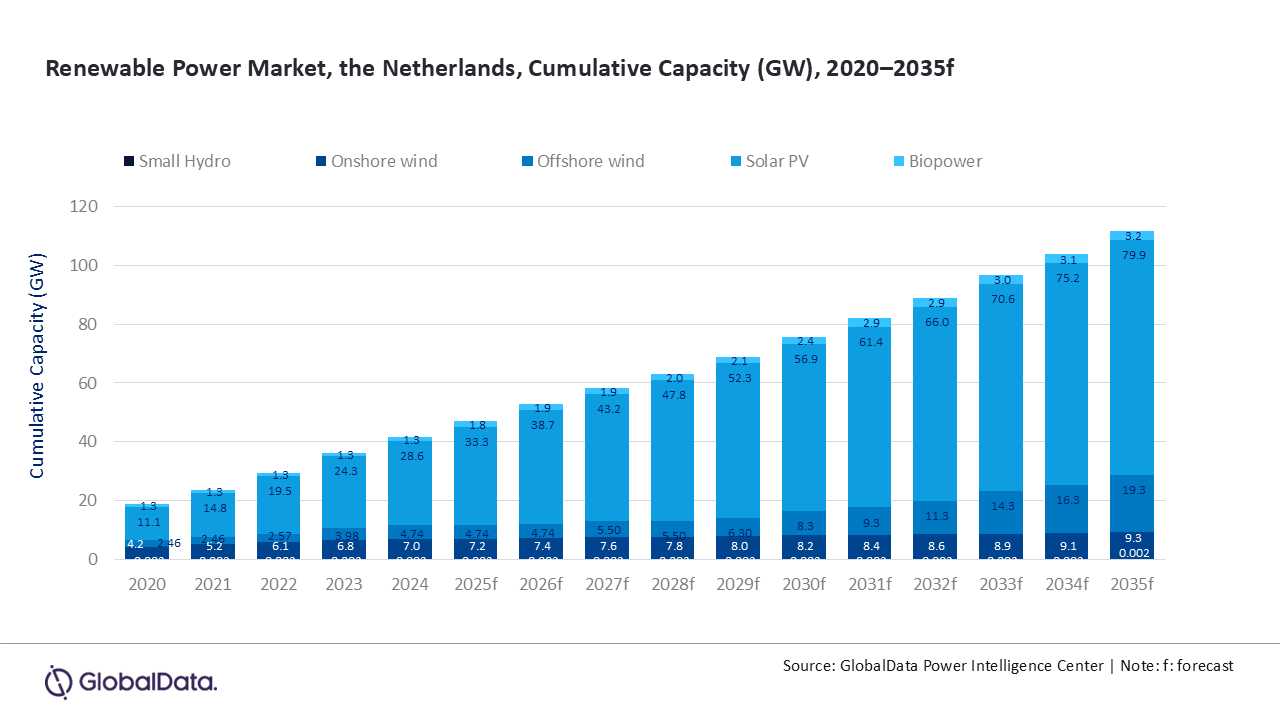
According to Mohammed Ziauddin, Power Analyst at GlobalData, “supportive instruments such as SDE++, the Offshore Wind Roadmap 2030–2050, and the National Energy and Climate Plan are catalyzing renewables growth in the country, while TenneT’s large-scale grid reinforcement program and the National Grid Congestion Action Programme are addressing bottlenecks in connecting new capacity. The government’s hydrogen strategy targeting 3–4GW of electrolysis by 2030 and emerging battery projects will further enhance system flexibility.”
On the conventional generation side, coal is being phased out, with capacity expected to fall to zero by 2028—two years ahead of the 2030 deadline. Natural gas will remain the primary balancing resource, maintaining roughly 20GW through 2035 to ensure reliability as variable renewables expand. Meanwhile, nuclear capacity will remain steady at 0.4GW (Borssele), with a possible life-extension under consideration and plans advancing for two new reactors as part of a longer-term low-carbon complement.
Despite this progress, the report highlights ongoing challenges, including grid congestion, curtailment risks, and rising network tariffs, as well as the need to accelerate energy storage deployment and improve spatial planning for new wind and solar developments.
“With solar PV expanding at record pace, steady growth in onshore wind, and a robust offshore pipeline, the Netherlands is on course to build a much stronger renewable base by 2035,” Ziauddin concluded. “Ongoing investment in grid modernization, system flexibility, and streamlined permitting will be vital to convert the current pipeline into operating capacity quickly.”




Comentarios
Sé el primero en comentar...