
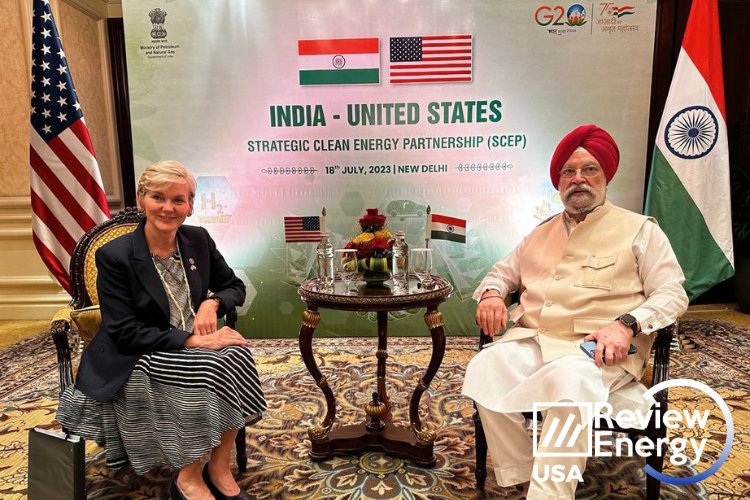


US and India stress joint action for renewable energy development
U.S. Secretary of Energy Jennifer M. Granholm and Indian Minister of Petroleum and Natural Gas Hardeep Singh Puri held the third ministerial meeting of the U.S.-India Strategic Clean Energy Partnership, launched in September 2021. During the meeting, the sides noted the growing importance of bilateral energy cooperation between the countries and underscored the critical importance of bilateral commitment to clean energy, energy security, creating opportunities for innovation and generating employment opportunities.
In this context, the sides welcomed the growing energy trade between the countries which has been consistently scaling new heights and welcomed the commercial partnerships facilitated by the U.S.-India Strategic Clean Energy Partnership (SCEP).
In addition, the two countries renewed their commitments to work towards a just, orderly, and sustainable energy transition, which prioritizes access to reliable, affordable, and clean energy supply. Highlighting that India and the US represent the largest democracies, and the largest and fastest growing economies in the world, the sides underscored the importance of joint action and collaboration not only for bilateral progress but also for navigating the global energy transition.
They also acknowledged that successfully achieving ambitious climate and clean energy aspirations necessitates coordinated efforts on development of energy transition roadmaps, capacity building, job skilling, and sharing of best practices at all levels of government. In that context, the sides agreed to work toward development of net zero villages in India to support the clean energy transition.
During the meeting, the Ministers discussed ways of advancing the positive agenda outlined by Prime Minister Modi and President Biden in their Joint Statement of June 22, 2023 which welcomed efforts under the SCEP to develop and deploy energy storage technologies, expand collaboration in support of their respective national hydrogen strategies and cost reduction goals, and accelerate cooperation on new and emerging renewable energy technologies. To that end, the Ministers welcomed:
- establishment of the public-private Energy Storage Task Force and related efforts to support large-scale integration of renewable energy needed to support the clean energy transition;
- deepened collaboration to scale and accelerate deployment of hydrogen technologies through the public-private Hydrogen Task Force and other efforts in support of their national hydrogen strategies, including a focus on common cost reduction goals;
- launch of the U.S.-India New and Emerging Renewable Energy Technologies Action Platform (RETAP) to accelerate development of key technologies to advance common ambitious clean energy goals.
The sides welcomed cooperation between India and the United States to advance research, development and commercialization of technologies in the emerging fuels arena, including bio-ethanol, renewable diesel, sustainable aviation fuels, and other advanced biofuels as a unique and valued asset to the transition to a cleaner energy future.
The sides also underscored the importance of a stable, sustainable, diversified, resilient, and globally responsible clean energy supply chain to enable energy transition pathways while minimizing risks and uncertainty and welcomed ongoing collaboration in such areas as:
- modernizing the power system to improve reliability, resilience, flexibility, affordability, and sustainability of cleaner energy systems;
- promoting energy efficiency and conservation, including in buildings, appliances, and the industrial sector;
- reducing emissions across the oil and gas sector, including through examining methane abatement and transfer and deployment of technologies under voluntary and mutually agreeable terms; and
- advancing emerging technologies to support electrification and decarbonization of hard-to-abate sectors.



Comentarios
Sé el primero en comentar...