


US biogas industry adds nearly 100 new projects in 2023
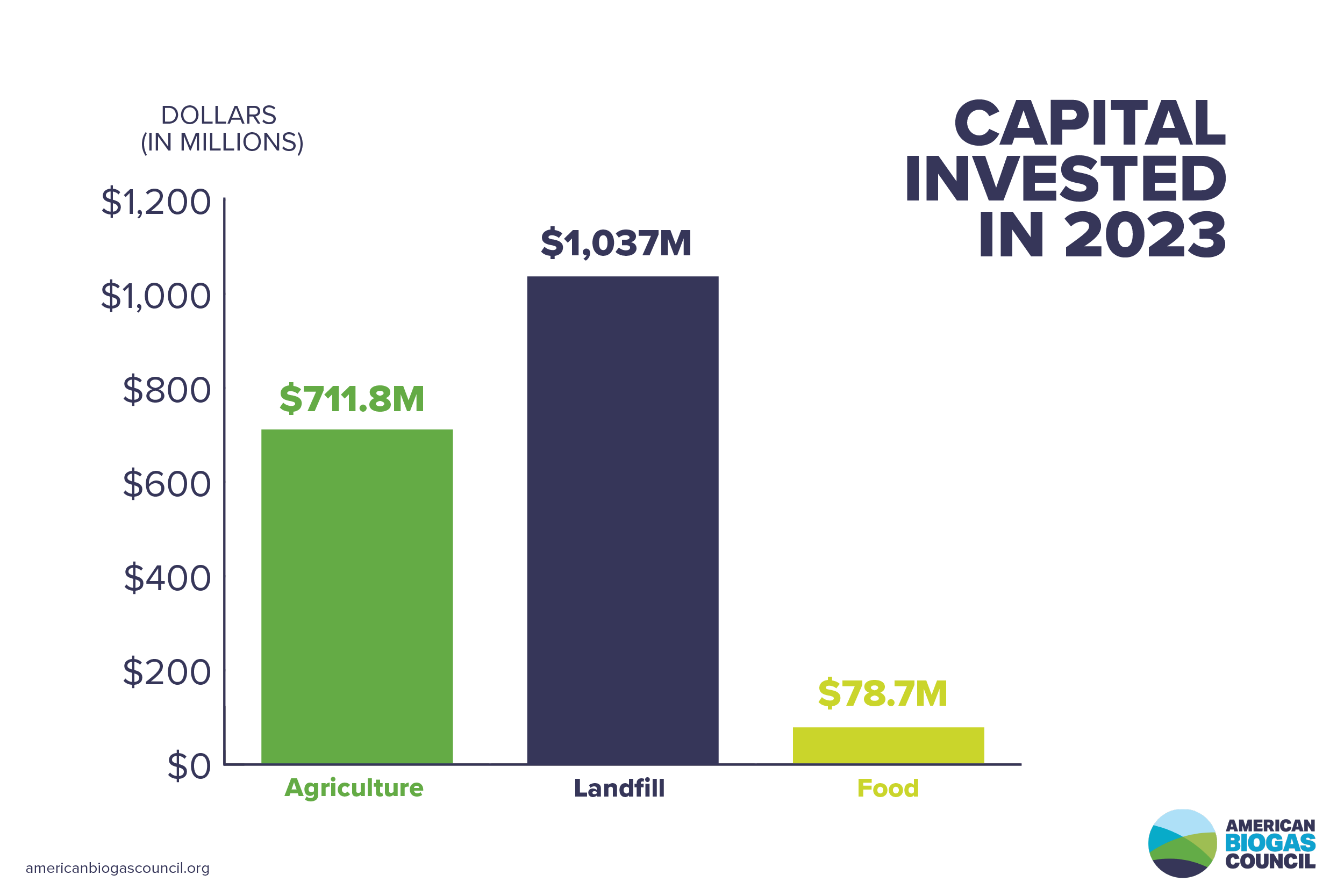
The biogas sector in the United States is surging ahead with remarkable strength, as revealed by newly-released data from the American Biogas Council (ABC). In 2023, the industry experienced its third consecutive year of record growth, with nearly 100 new projects coming online and representing a staggering $1.8 billion in capital investments.
Beyond boosting domestic investments and renewable energy production, the industry's expansion also plays a crucial role in curbing methane emissions and driving the development of recycling infrastructure, promising long-term benefits for Americans, ABC says.
In 2023, 96 new biogas projects became operational in the US, pushing the total number of active US biogas projects to 2,251, which represents $39 billion in capital investment. The new projects produce 66,000 standard cubic feet per minute (SCFM) of biogas—an electricity equivalent to 4,000 football fields of solar panels, to powering 600,000 homes or to eliminating 600,000 gasoline cars from the road.
“This is an exciting time of growth for a renewable energy sector that is directly responsible for methane emission reductions,” said Patrick Serfass, executive director of ABC. “As the biogas industry expands, so, too, does our capacity to capture methane emissions that would otherwise be emitted from organic waste. We can simultaneously use that captured methane to displace other emissions from fossil fuels that are used for energy and making fertilizer. It’s a win-win that often results in negative carbon emissions.”
“Most other renewables can only get to a carbon intensity of net zero. If a company buys renewable natural gas made from biogas with a carbon intensity six times lower than natural gas, it only must replace 1/6 of its gas usage to reduce all of its carbon emissions from that gas,” added Serfass.
LFG era
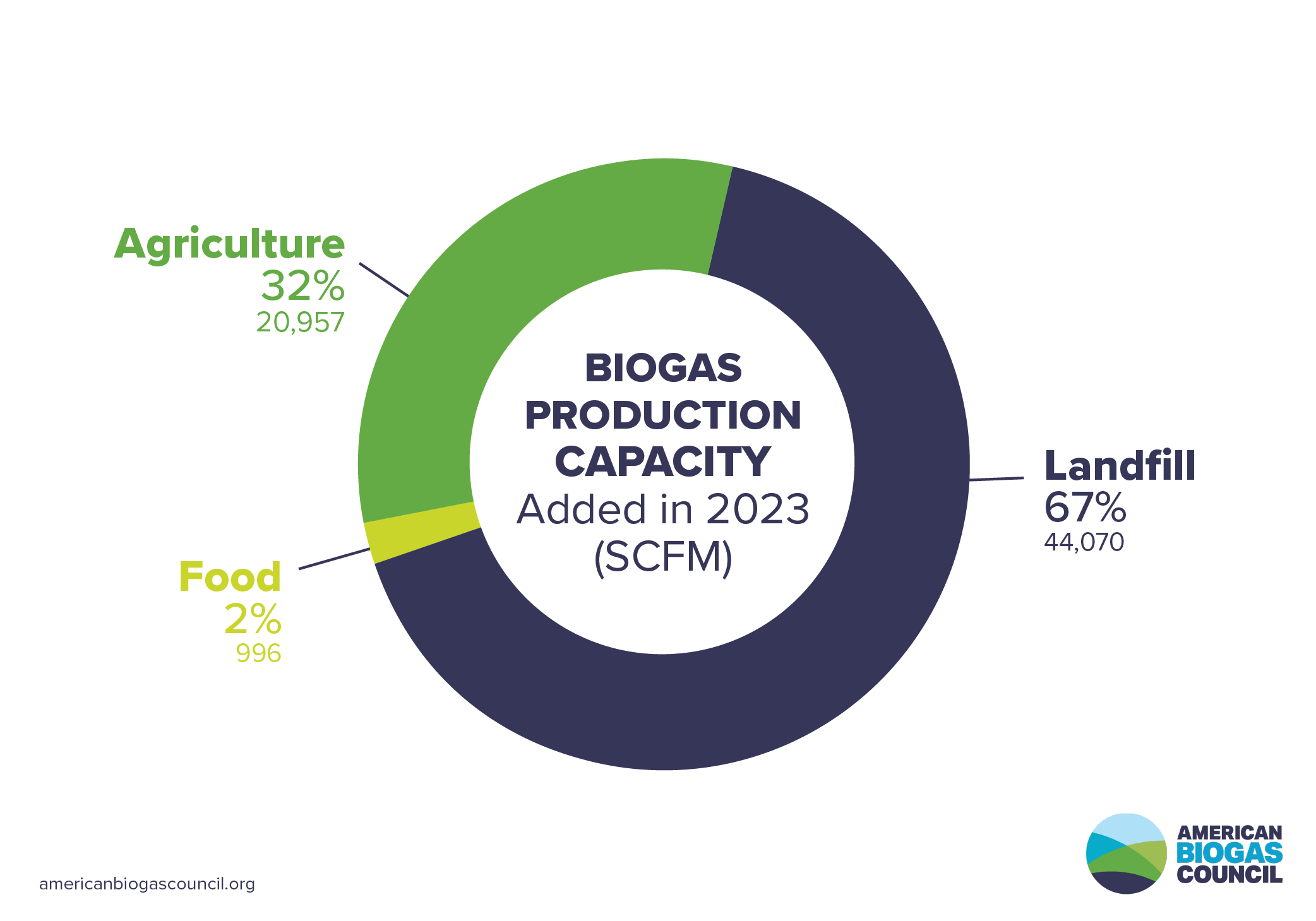
Landfill gas (LFG), the natural byproduct of the decomposition of organic material in landfills—also called biogas—continues to dominate in terms of both total investment and biogas output. Instead of allowing LFG to escape into the air, it can be captured, converted and used to displace fossil fuel emissions. According to ABC, the US currently has 566 LFG projects, including 23 new projects added in 2023. This growth accounts for 57% of 2023 capital investments and 67% of new biogas production capacity.
Significant gains in agriculture, food waste
While the growth of the landfill gas sector was voluminous in terms of both dollars and biogas, 2023 saw only 4-5% growth in that sector. In comparison, ABC explains that the growth in the agricultural sector was 13.4%, or nearly three times greater. Seventy new farm-based projects came online in 2023, contributing 21,000 SCFM of additional biogas output and resulting in capital investments exceeding $700 million.
Renewable natural gas (RNG) cluster projects contributed most to the growth and to lowering the cost per project. Cluster projects are generally characterized by multiple farms with at least one anaerobic digester linked together by one common, central gas processing and conditioning facility to turn the biogas into RNG. The lower per-project costs are also impacted by the fact that many cluster projects use lagoon-style biogas systems (a covered, in-ground, lined pit), which are more efficient and therefore less expensive than the more commonly used engineered tanks.
Significant growth continues in the food waste sector, on par with landfill sector growth. Three new stand-alone food waste biogas projects became operational in 2023, adding an extra capacity of 996 SCFM, with 10 more facilities scheduled to launch in 2024.
The growth is in RNG
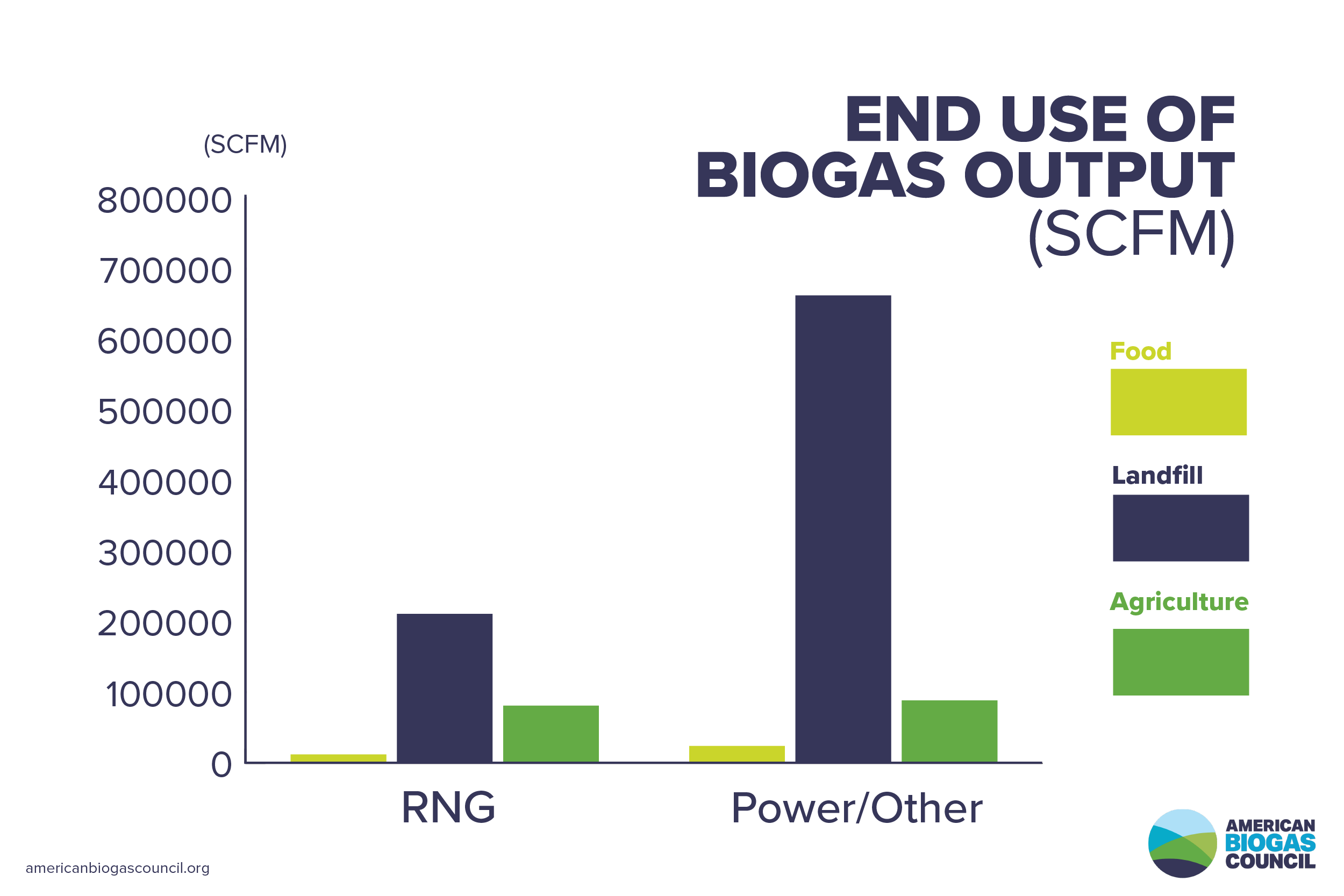
While power projects that make renewable electricity from biogas account for 69% of all biogas produced in the U.S, biogas RNG projects represented 91% of all new projects that came online in 2023. This mainly stems from policies such as the federal Renewable Fuel Standard (RFS) and the California Low Carbon Fuel Standard (LCFS), which promote using renewable fuels to replace fossil transportation fuels and to eliminate emissions.
Currently, it’s often easier to develop profitable RNG projects in the country because the US Environmental Protection Agency (EPA) is suppressing participation of biogas systems in the RFS when systems provide electricity to battery electric vehicles or hydrogen to fuel cell electric vehicles.
While impressive growth in the US biogas industry continues, only roughly 20% of possible projects have been built. ABC counts at least 15,000 new systems that could be built—compared to 2,251 operational today, based on the millions of tons of organic material in the US produced annually by humans and animals. As the biogas industry continues to expand, significant economic, environmental and energy advantages are unlocked.




Comentarios
Sé el primero en comentar...