
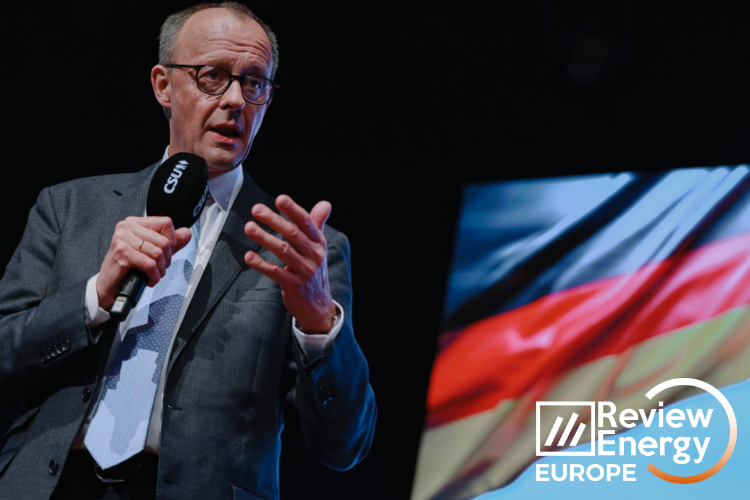


What path will Germany's energy future follow under Merz's leadership?
The conservative bloc formed by the Christian Democratic Union (CDU) and led by Friedrich Merz, along with its Bavarian wing, the Christian Social Union (CSU), won the largest share of votes, with over 28%. With this political shift to the right, the question arises about the future of renewable energy in Europe’s largest economy.
As the second political force, the far-right party Alternative for Germany (AfD) enters the scene, having reached 20.7% of the vote, more than double the result from the 2021 elections. This is concerning due to the party’s climate change denial, as their government program includes proposals to end the decarbonization project through the "Great Transformation" and repeal the Federal Government’s "Climate Protection Plan 2050".
Additionally, the party blames wind energy, solar energy, and grid expansion for the high electricity prices. On the other hand, their policy aligns with Merz’s in supporting nuclear energy, as they do not want to close existing nuclear plants before the end of their operational life. According to the AfD, Germany will also not be able to do without modern gas and coal power plants in the near future.
Merz has firmly rejected any coalition with the AfD, stating, "They want the opposite of what we want, and therefore it is not possible to govern with them." However, if such an alliance were to materialize, it would become a major obstacle for renewable energy.
The role of nuclear energy and gas in Germany's energy future
In his government plan, Merz has expressed his support for renewable energy, with particular focus on nuclear and gas, but without pushing too hard for unconventional sources.
The plan asserts that nuclear energy and gas must continue to play an important role in Germany’s energy mix. According to the conservative leader, nuclear energy is crucial to ensuring the stability of the energy system, especially during high demand periods or when solar and wind energy cannot meet the demand. He also proposes improving energy efficiency and long-term energy storage as measures to ensure a stable supply.
Merz’s approach fits within a broader vision of a "market economy" for climate protection, aiming to foster the use of innovative technologies for decarbonization without ruling out diverse technological options. Emission trading and incentives for green technologies would be part of this approach, always from a pragmatic and open perspective.
This shift to the right, which questions the acceleration of the energy transition towards unconventional renewable sources, raises concerns about the future of clean energy in Europe’s largest economy.
Position of the Bundesverband Erneuerbare Energie e.V.
According to the President of the Bundesverband Erneuerbare Energie e.V. (BEE), Simone Peter, the first projections for the 2025 federal elections indicate a change of government in Germany. With urgent challenges such as the energy transition and ensuring a climate-neutral location, it is crucial to form a stable and effective government that drives the expansion of renewable energy across all sectors. This approach is also essential for strengthening Europe in the context of tensions with the U.S. and the war in Ukraine. The energy transition must continue clearly to consolidate Germany as an innovative leader in renewable energy.
Although climate protection was not the central issue of the campaign, it remains crucial for the country's economic future. Businesses need planning security to meet national goals and stay competitive in climate technologies. The industry is ready to move forward, but the government must create a clear framework to drive this transition, including the reform of the electricity market and energy price reduction. In light of the rise of the far right, it is essential for democratic parties to unite around a common path towards a climate-neutral future, with a focus on cooperation and sustainable solutions.


Comentarios
Sé el primero en comentar...