
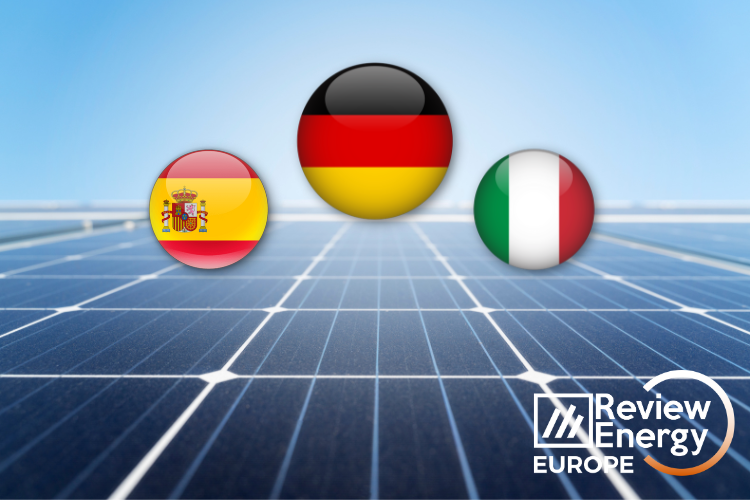


Germany is the most attractive European market for solar developers, followed by Spain and Italy
Germany, Spain, and Italy are Europe’s top three solar markets in terms of attractiveness for investors. Market size is a key criterion: the three countries will account for 58% of Europe’s total installed solar PV capacity by 2030 and 83% of the investment required between 2023 and 2030 to achieve the projected growth in installations, Aurora Energy Research forecasts in its first dedicated European Solar Market Attractiveness Report. Other factors at play include available policy support and project economics.
Installed solar photovoltaic (PV) capacity is on track to rise to 475 GW by 2030, more than double the 221 GW installed today, says Aurora. This growth reflects a cumulative investment opportunity of 148bn €, Aurora finds. Competition to attract this investment is ramping up—action to boost market attractiveness will be crucial to realising Europe’s solar ambitions and speeding up the region’s energy transition.
Top 3
Germany’s pole position reflects a combination of its superior size and policy support; the 2023 Renewable Energy Sources Act (EEG) set a target of 215 GW installed solar capacity by 2030—more than one third of the EU’s total solar installation target—and established a framework for auctioning 75 GW of utility-scale solar capacity by 2030.
Spain benefits from optimum solar project economics, delivering the highest returns for investors for unsubsidised projects commissioned in 2030, Aurora calculates. Developers benefit from higher irradiation levels than in most other European markets, which preserve the profitability of projects in spite of the rapid growth in installations in recent years that is reducing the prices those projects can realise.
And Italy scores highly across the three categories assessed—installed capacity is forecast to grow rapidly between now and 2030, for example—but ranks third due to limited procurement targets.
According to Aurora, Europe can boost solar market attractiveness by expanding support schemes. Government support is the biggest driver of buildout across the region, enabling roughly 80% of total installed solar capacity to date. Around 144 GW of solar PV is set to be procured through auctions by 2030, comprising almost 60% of forecast installations. Contracts for Difference (CfDs) are the most popular support scheme—nine of the fifteen countries assessed with support available for solar developers use this financing method, with others relying on Feed-in/Premium tariffs. Despite widespread opportunities to access support for projects, however, a lack of clarity or certainty surrounding subsidy availability may stall deployment in Europe. Only eight of the 24 countries assessed by Aurora have clearly defined solar auction procurement schedules.
Unsubsidised projects will become more attractive to investors as solar buildout accelerates—the average cost of building a solar PV plant in Europe falls by over 40% between 2023 and 2050, Aurora calculates. Governments can improve project economics by encouraging prospective solar developers to utilise innovative business models, such as co-location with battery storage systems. Co-location enables cost savings, such as through sharing grid connections, and provides solar developers with additional revenue streams—power that would otherwise be curtailed3 can be redirected to the battery. However, regulation that facilitates co-location is lacking: Aurora considers only five of the countries assessed4 to be attractive for co-location at present.
Ryan Alexander, Research Lead, European Power Markets, Aurora Energy Research, commented that "policy remains a key driver of solar photovoltaic buildout in Europe, so policy needs to support rather than hold back investment. The EU Commission’s proposal to adopt two-sided CfDs across Europe would reduce opportunities for solar projects to benefit from high market prices in some countries, but governments could offset this by taking steps to better facilitate innovative business models, such as corporate power purchase agreements, or co-location with batteries."
Finally, Anu Omojola, Research Associate, European Power Markets, Aurora Energy Research, said that "European solar market attractiveness is not set in stone—the EU’s response to the US’ Inflation Reduction Act could have huge impact on project economics, for example. The European Commission may force national solar tenders to de-prioritise bids that rely on technology manufactured in certain countries, disrupting established supply chains, potentially increasing costs for developers and reducing profitability."


Comentarios
Sé el primero en comentar...