
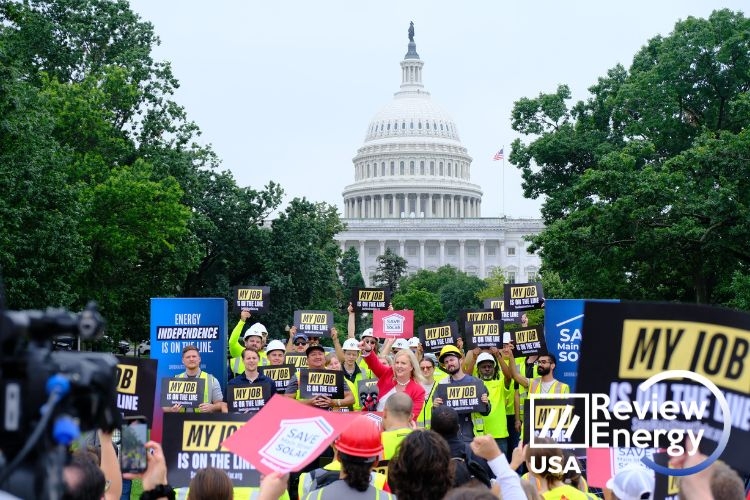


Hundreds rally on Capitol Hill to defend solar jobs and clean energy tax credits
Hundreds of solar workers, small business owners, and clean energy advocates rallied on Capitol Hill in protest of a new Senate Republican tax proposal that, they warn, would gut key incentives for residential solar and energy storage — threatening thousands of jobs and billions in private investment.
The demonstration, organized under the banner “Save Main Street Solar,” was a direct response to the release of the long-awaited tax package by the Senate Finance Committee, led by Chairman Mike Crapo (R-Idaho). The bill, presented as a plan to make permanent the 2017 Trump-era tax cuts, also aims to stimulate economic growth through corporate tax relief, bonus depreciation, and deregulation. However, it proposes a sharp rollback of clean energy tax credits, particularly those benefiting rooftop solar and storage.
What’s in the Senate Republican tax plan?
The bill — which Crapo describes as a “pro-growth, pro-family tax relief package” — would:
-
Permanently extend corporate tax breaks, including full expensing for factories and R&D investments;
-
Make the 20% deduction for small business income permanent;
-
Repeal taxes on tips and overtime pay, and increase deductions for seniors;
-
But critically, it would eliminate the residential solar investment tax credit (ITC) by gradually phasing it out: reducing it to 60% in 2026, 20% in 2027, and ending it completely in 2028.
While the bill preserves or expands incentives for carbon capture, nuclear energy, and other centralized clean energy sources, it removes support for decentralized, consumer-driven technologies like rooftop solar — a move advocates say is short-sighted and harmful to energy independence.
Solar industry pushes back: “This bill threatens our future”
“This isn’t just bad policy — it’s dangerous,” said Abigail Ross Hopper, president and CEO of the Solar Energy Industries Association (SEIA), speaking at the rally. “It strips away the ability of millions of American families to choose solar and storage for their homes — and threatens hundreds of thousands of jobs across the country.”
She emphasized that many of those jobs are in working-class, rural, and Republican-leaning communities that have embraced rooftop solar for its cost savings and resilience. “If the Senate doesn’t fix this, we can’t ensure an affordable, reliable, and secure energy system,” Hopper added.
Among the speakers was Dan Conant, founder and CEO of Solar Holler, based in West Virginia — a state traditionally known for coal, but which has recently seen a surge in solar projects. “We’re building solar on schools, churches, even steel mills — with panels from Georgia and racking from Ohio. This bill kicks the legs out from an industry that’s creating jobs and cheap power in places that desperately need it,” he said.
Veteran and Tampa Bay Solar founder Steve Rutherford warned that the impact would be immediate and personal: “Thirty percent of my employees are veterans. If this passes, thousands of us lose our jobs. Florida ranks third in solar — this isn’t a niche issue. This is about real families.”
Marco Krapels, vice president of business development at Enphase Energy, highlighted the risk to manufacturing: “We moved our factories back to the U.S., created 5,000 jobs, did everything the government asked. This bill rewards big utilities but punishes innovation and local businesses. We need a glide path — not a cliff.”
While Senate Republicans say their bill will boost long-term growth and reduce the deficit through spending cuts and tax certainty, critics argue it tilts the playing field against technologies that empower households, small businesses, and communities. More than $100 billion in solar-related private investment has flowed into the U.S. in the past two years, much of it to conservative districts — a fact not lost on rally organizers.
The rally concluded with a call to action for lawmakers in both parties: fix the bill, restore the credits, and protect the thousands of small businesses and workers whose livelihoods now hang in the balance.





Comentarios
Sé el primero en comentar...