
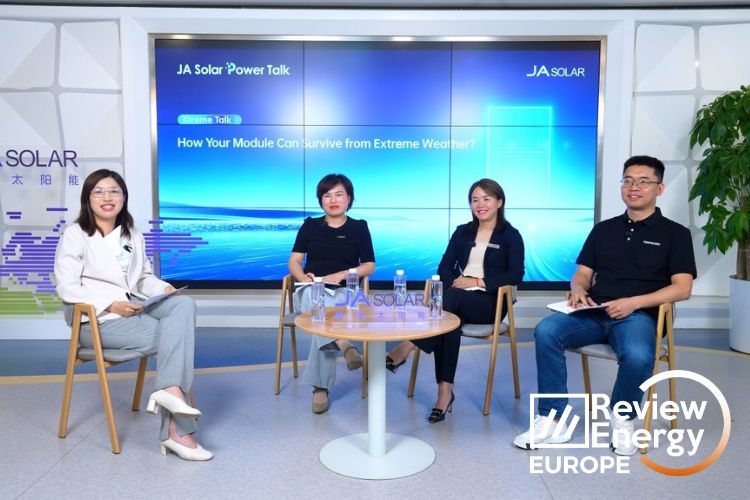


JA SOLAR launches “Power Talk” webinar series to explore key challenges and innovations in the solar industry
In response to the rapidly evolving solar industry and growing concerns about extreme weather impacts on photovoltaic (PV) modules, JA SOLAR has introduced a new global webinar series titled “Power Talk”. This platform will bring together experts across the solar value chain to share insights on diverse topics—from emerging PV technologies and certification updates to scenario-specific applications—helping industry stakeholders stay ahead of market and environmental challenges.
The first episode, held on June 30, focused on a critical question: “How Your Modules Can Survive Extreme Weather.” As PV installations expand beyond traditional land-based settings to deserts, offshore, high-altitude, and cold regions, ensuring long-term module reliability under harsh conditions has become paramount.
Expert perspectives on module performance and certification for extreme environments
The webinar kicked off with Roger Miao, General Manager of PV at TÜV NORD China, who provided a detailed overview from a third-party certification perspective.
He emphasized the rapidly expanding scope of PV applications and the need for evolving certification standards: “PV power generation has developed significantly due to the ongoing cost reductions and incentive programs worldwide. At the same time, application scenarios have expanded—from surface-mounted ground installations to offshore, desert, high-altitude, and extreme cold regions. The question is: how to ensure PV modules' reliability and durability under such diverse conditions and guarantee investment returns in PV projects?”
Roger highlighted recent advances in IEC technical specifications addressing these challenges, such as IEC TS 63397 on hail resistance and IEC TS 63126 on elevated temperature performance—standards designed to capture long-term invisible damages caused by micro-friction and thermo-mechanical stresses, which traditional tests do not fully cover.
Finally, he explained that “lab testing must keep pace with real-world applications. TÜV NORD simulates extreme environments - deserts, high altitudes, offshore - to ensure PV modules go beyond IEC benchmarks and meet real durability expectations.”
R&D challenges: Designing modules tailored for specific harsh environments
Next, Dr. Helen Zhou, Head of Module R&D at JA SOLAR, shared the product development perspective, explaining the technical and certification hurdles when designing modules to withstand varied extreme scenarios: “The main challenge is identifying the differences between standard modules and modules designed for specific environments. For example, for modules installed in desert environments, four key factors must be carefully considered. First, the module must have strong sand resistance. Second, it must withstand significant temperature fluctuations typical of sandy regions. Third, high solar irradiation can lead to increased power loss. Lastly, dust buildup can reduce performance by causing shading and hot spots.”
Helen detailed how JA Solar is upgrading module materials—frames, encapsulants, junction boxes—and incorporating anti-reflective coatings to support less dust accumulation on the module surface. These improvements help enhance thermal stress resistance and optimize the temperature coefficient, supporting stable performance even after years of outdoor exposure.
She also noted the gap between certification standards and real-world applications, calling for faster evaluation systems that closely link lab tests with field performance. From her experience, “one product can't fit every scenario. Customization is the future. PV modules face vastly different stresses, from sand and dust to the UV and thermal fluctuation. Adapting materials and coatings to each environment is key to ensuring long-term reliability.”
Innovations in Component Materials to Enhance Module Durability
Finally, Betty Zhu, Vice President of Jiangsu Worldlight New Material Co., discussed the breakthroughs in composite frame materials engineered to outperform traditional aluminum frames in harsh climates.
“Our composite frames are four times stronger than aluminum, expand and contract at similar rates to glass to prevent breakage in extreme temperature swings, and are five times more resistant to corrosion and salt spray—ideal for coastal and desert projects,” she said.
Betty also emphasized these materials’ insulation properties help prevent potential-induced degradation (PID) common in hot, humid environments, thus extending module lifespan and reliability. “No compromise on quality-innovation breaks the cost triangle. Worldlight's composite frames outperform aluminum in salt, snow, heat, and storm. Tasted with JA SOLAR across deserts, coasts, and cold zones. Built for what's next,” she concluded.
A dynamic forum for solar industry innovation
The Power Talk webinar series is poised to continue addressing a broad range of topics vital to the solar sector’s sustainable growth—from multi-scenario module design and certification to policy trends and energy storage integration. JA SOLAR aims to foster ongoing collaboration among manufacturers, certification bodies, material suppliers, and project developers to accelerate the deployment of robust, high-performance solar solutions worldwide.

Comentarios
Sé el primero en comentar...