
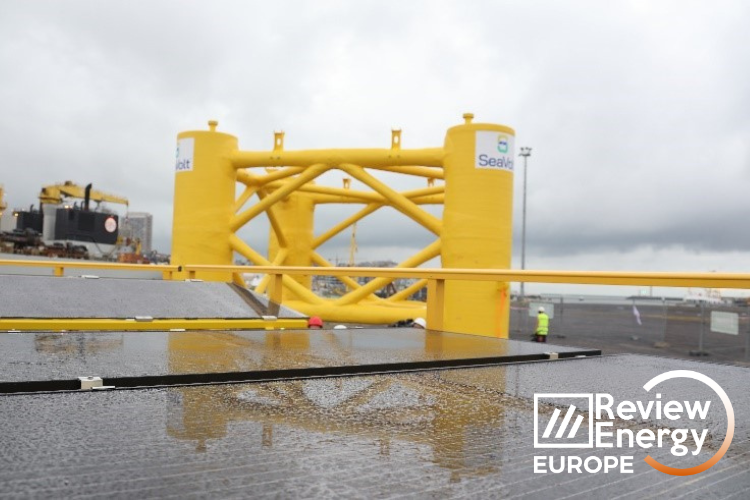


SeaVolt to launch its first offshore floating solar power test platform
SeaVolt, a collaboration between Tractebel, DEME, and Jan De Nul, gets ready for its first floating solar energy test platform to be installed offshore. The platform floatation system is currently located in the port of Ostend, on the Belgian North Sea coast, where main contractor Equans is finalizing assembly.
The test platform will be the first installation in the Belgian North Sea aimed at the large-scale development of offshore solar energy and is scheduled to be towed offshore, anchored, and put into operation to gather data for at least a year starting in August.
Solar panels
Under the framework of the Blue Cluster funded research project MPVAQUA and additional support from the federal government via BELSPO, the partners within SeaVolt together with Ghent University (UGENT) are ready to conduct a year-round open-sea testing inside the POM-West Vlaanderen owned ‘Blue Accelerator offshore test zone’. This proof of concept installation will gather crucial data on the impact of waves, rain and salt sprays on various solar panels with different PV panel configurations. In addition, the impact of varying inclinations, caused by waves and wind, on the energy output will be closely monitored. The test aims to determine the level of protection required to shield the solar panels from seawater and bird droppings.
The floater
Amongst other materials suitable for this floating technology, SeaVolt has chosen to use novel light-weight fiber material in this test installation. This material presents potential benefits for offshore use however is not often used in such harsh marine conditions yet.
Optical embedded fibers and sensors attached to the structure will assess if the structural integrity (vibrations/fatigue) of the material is in line with the numerical models and results obtained from the ocean wave tank and wind tunnel tests. Since the floating structure and solar panels are driving the cost, these measurements are indispensable for further financial assessment.
The ecological impact
In addition to technical tests, the SeaVolt test installation will also address ecological aspects. Various materials will be evaluated based on prevention of adverse effects on the marine environment. The test results will determine the selection of materials for further development. It is important not only to minimize the attachment of excessive marine growth to the floater to maintain its buoyancy. Lastly, specific tests will be conducted to assess combining the floater systems with mussel cultivation and oyster farming, which present specific challenges.
Vincent Van Quickenborne, Minister of the North Sea, said that "the North Sea is becoming the powerhouse of our energy independence. These floating solar panels have the potential to generate 1 GW of additional green power in wind farms, which is the equivalent of a nuclear power plant. With this test project, which is like a solar lab at sea, we are taking a unique lead in a new sector. Our companies are once again pioneering this technology, contributing to green economic growth and creating more jobs. We do this in a way that takes into account the impact on the marine environment. In this way we show that economy and ecology can go hand in hand."
For his part, Thomas Dermine, Secretary of State, added that "solar energy in the North Sea has the potential to become just as important as our wind farms when it comes to green power generation. To accelerate the development of offshore solar energy, we are investing in technology and know-how among Belgian players through our recovery plan. In this way we are addressing three crucial challenges simultaneously: the fight against climate change, greater independence from energy imports, and the development of technological expertise in Belgium that creates new jobs and exports."
Finally, Philippe Van Troeye, CEO Tractebel, explained that "while we are convinced that offshore solar has an important role to play in the accelerated energy transition, technological development is often seen as a bottleneck for unlocking the full potential of this exciting market. With SeaVolt, and more specifically with this cutting-edge test nearing completion, we’ll be able to observe how such an installation behaves under real-life conditions, providing us with the necessary knowledge to mature and mitigate risks for future developments."


Comentarios
Sé el primero en comentar...