
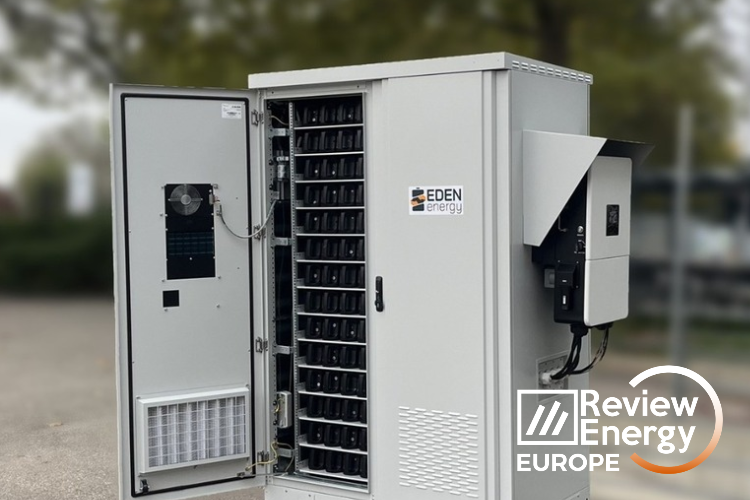


A second life for e-scooter batteries in Germany's energy storage market
Around one million high-performance batteries from e-bikes and electric scooters are prematurely discarded in Germany every year, despite often retaining a significant proportion of their original capacity. Freiburg-based startup EDENenergy aims to turn this untapped resource into industrial energy storage, developing modular systems that reuse batteries from micromobility applications.
Founded by former researchers from the Fraunhofer Institute for Solar Energy Systems ISE, the company has developed a technology that combines different battery modules through flexible power electronics, enabling heterogeneous batteries to be integrated into stationary storage systems safely and efficiently.
The startup has recently reached an important commercial milestone: in mid-October 2026, it delivered its first industrial storage system to a customer. The installation has a capacity of 70 kilowatt-hours (kWh) and integrates 112 second-life e-scooter batteries.
Power electronics overcome the challenge of battery diversity
Although second-life applications have already demonstrated their potential in the electric vehicle sector, the reuse of batteries from e-bikes and e-scooters remains largely untapped. One of the main obstacles is the wide variety of battery designs, cell technologies, battery management systems and communication protocols, which makes standardised integration difficult.
EDENenergy addresses this challenge through power electronics developed at Fraunhofer ISE. The technology allows different storage units to be interconnected and communicate with the system without requiring the batteries to be dismantled.
Florian Bierwirth, co-founder of EDENenergy, explains that this approach makes it possible to integrate different battery modules into a single stationary storage system. Bierwirth previously worked in the Power Electronics Department at Fraunhofer ISE, alongside fellow co-founders Daniel Seeger and Hannes Kurzmann.
For its initial market entry, the company is focusing on 70 kWh industrial storage systems aimed primarily at medium-sized businesses that already operate photovoltaic installations but do not yet have battery storage.
The technology could also serve municipal utilities, providing applications such as increasing self-consumption of locally generated electricity, reducing peak loads and participating in electricity trading.
Used batteries retain more capacity than expected
The initial assessment of the batteries has produced encouraging results. Of the first 350 batteries tested by EDENenergy, their remaining capacity was significantly higher than the company had initially anticipated.
The startup had estimated that second-life batteries would retain around 80% of their original capacity, measured through their State of Health (SoH). However, the tested batteries showed average remaining capacity levels that, in some cases, were well above 90%.
According to the company, this makes them particularly suitable for stationary storage applications. Unlike their first life in e-bikes and e-scooters, where they are exposed to vibrations and temperature fluctuations, stationary batteries operate under conditions involving fewer mechanical stresses and temperature variations. This can allow them to remain in service for several additional years.
To ensure safe and reliable operation, EDENenergy remotely monitors its battery modules through a dedicated monitoring system. When individual modules reach the end of their useful life, they can be replaced separately, even while the overall storage system remains operational.
Batteries that eventually reach the end of their service life are sent for recycling through partner companies.
Modular replacement aims to maintain storage capacity over time
The company’s modular approach is also intended to address one of the main challenges associated with battery degradation: the gradual loss of storage capacity over time.
By replacing individual battery modules as they deteriorate, EDENenergy aims to maintain the system’s nominal capacity at 70 kWh even after ten years of operation.
The company contrasts this approach with conventional energy storage systems, whose manufacturers typically guarantee 80% of their original capacity after ten years, reflecting the impact of battery degradation.
EDENenergy therefore seeks to turn the variability and ageing of second-life batteries into a technical advantage through individual module replacement rather than requiring the entire storage system to be replaced.
Expansion plans target 300 kWh storage systems
Following the delivery of its first industrial installation, EDENenergy plans to expand its storage capacity to up to 300 kWh.
The startup is also seeking additional pilot customers among regional businesses. Potential customers can receive funding covering 50% of the storage system’s cost through the Baden-Württemberg state programme Mittelstand trifft Start-ups, which has already been approved.
The company currently has three founders and employs an additional three part-time staff members.
Its development is supported by funding from the Center of Excellence for Sustainability and the Baden-Württemberg innovation startup programme BW Pre-Seed. Ulrich Prediger, founder of JobRad, is EDENenergy’s first investor.
In the longer term, the company identifies two important conditions for scaling up second-life battery storage: standardised communication protocols for battery storage systems and legislation establishing clear rules for the use of batteries originally designed for mobile applications in stationary energy storage.
By combining battery reuse, modular power electronics and industrial-scale storage, EDENenergy is seeking to establish a new route for extending battery lifetimes while making stationary energy storage more resource-efficient and cost-effective.

Comentarios
Sé el primero en comentar...