
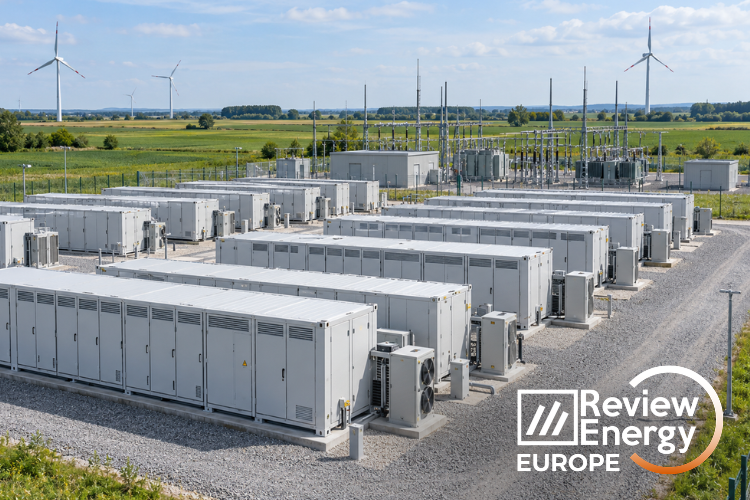


Germany’s battery storage additions jump 91% as large-scale deployment accelerates
Germany commissioned more than half a million new battery storage systems, with a combined capacity of approximately 8.2 GWh, during the first nine months of 2026. Newly installed storage capacity increased 91% compared with the same period in 2025, according to an analysis of Federal Network Agency data by the German Solar Industry Association, BSW-Solar.
Large-scale battery storage led the expansion, with additions more than quadrupling to around 3.8 GWh. The segment grew approximately 350%, accounting for roughly half of the capacity installed during the period, according to BSW-Solar’s announcement.
Smaller systems also recorded growth. Newly installed residential storage capacity rose 20% to 3.2 GWh, while commercial storage additions increased 67% to around 0.7 GWh. Very small systems added approximately 0.5 GWh, up 33%.
The figures are based on Germany’s market master data register as of 12 October 2026. BSW-Solar noted that subsequent registrations could increase the totals.
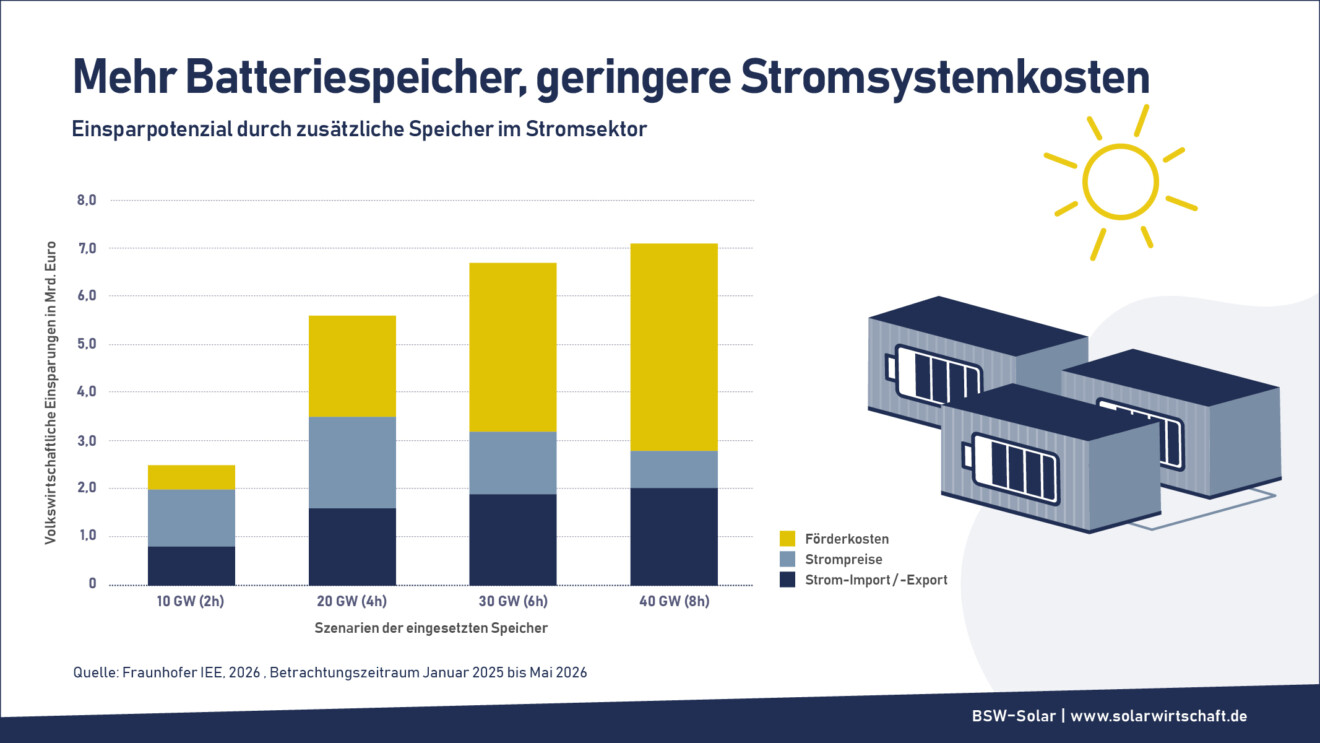 Source: BSW-Solar.
Annual additions expected to exceed 10 GWh
BSW-Solar expects Germany to add well over 10 GWh of storage capacity in 2026. However, the association says deployment must accelerate further to support the expansion of renewable generation.
Batteries can absorb surplus solar and wind electricity and release it when needed, helping to ease pressure on electricity networks and reduce system costs.
The association cites calculations by the Fraunhofer Institute for Energy Economics and Energy System Technology (IEE) indicating that an additional 80 GWh of battery storage capacity could have reduced costs for consumers and the federal budget by almost €4 billion in the previous year. This represents estimated potential savings, rather than savings already achieved.
Fifteen reforms to accelerate deployment
Alongside the market figures, BSW-Solar published a position paper containing 15 reform proposals aimed at removing investment barriers, improving the use of existing grids and avoiding unnecessary costs.
A central proposal is to make it easier to operate batteries alongside solar and wind installations and at electricity consumption sites. The association is calling for an enforceable right to fair and flexible grid connection agreements.
BSW-Solar also wants distribution system operators to be required to tender for battery storage at substations where it can support grid operation, reducing congestion and making better use of available network capacity.
A third priority concerns redispatch, the adjustment of electricity generation and operation to manage grid congestion. The association proposes managing installations at the grid connection point rather than controlling each generating plant individually. This would allow surplus solar electricity to be stored during temporary network constraints instead of curtailing production.
BSW-Solar is urging the federal government and parliament to incorporate the proposals into upcoming grid legislation and reforms to the Renewable Energy Sources Act (EEG).
Using existing networks to connect more renewables
The association is also calling for clear institutional responsibilities, binding deployment targets and a coordinated national storage strategy.
It points to a separate Fraunhofer IEE study examining how batteries at substations could unlock unused network capacity. Under the conditions studied, this could enable substantially more solar installations to connect to existing distribution grids, potentially allowing installed photovoltaic capacity to double.
BSW-Solar managing director Carsten Körnig argues that regulatory changes must accompany market growth so batteries can help lower electricity system costs and integrate more renewable generation.



Comentarios
Sé el primero en comentar...