


Maxxen Day 2026: Inside the factory shaping Europe’s battery storage ambitions
In Aydin, Türkiye, it almost never rains. Except the day before Maxxen Day. Perhaps it was good luck, because the sun was shining over the Maxxen factory as more than 300 people from around the world gathered in the city for an event that would prove to be a successful day for the company and the European energy storage community.
Review Energy was on the ground in Aydyn for Maxxen Day 2026, where engineers, manufacturers, investors, energy professionals and members of the European energy community came together to discuss a question that is becoming increasingly important for Europe: how to build the batteries it needs, and how much of that manufacturing should take place within the region.
The event combined presentations and discussions on the European storage market with a visit to Maxxen’s manufacturing facilities. Review Energy also spoke with members of the company’s team about its strategy and ambitions.
From manufacturing ambition to 5 GWh
Ruben Valiente, Managing Director at Maxxen, opened the event by setting out the company’s manufacturing ambitions and its position in the European battery storage market.
The central message was clear: Europe needs batteries, and those batteries need to be manufactured in the region.
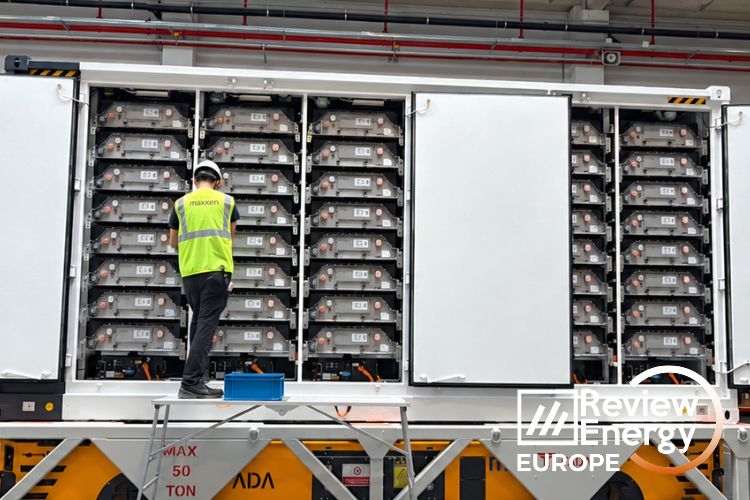
That argument was also reflected in the scale of the site itself. Maxxen’s manufacturing plant in Aydin covers 20,000 square metres and has a production capacity of 5 GWh. The company manufactures BESS solutions including DC Box, 5 MWh systems and MV Box solutions in 2.5 MW, 5 MW and 10 MW configurations.
Valiente described the Aydyn site as “one of the most advanced factories in Europe”, pointing to the range of certifications achieved by Maxxen, including TÜV accreditation, LEED certification and ISO 27001. The factory is powered by solar energy and its production model is designed to be self-sustained.
Beyond its 5 GWh annual production capacity, Maxxen is also using the site as a platform to scale its commercial activity. The company said it had sold 644 MWh across 21 projects in Europe between January and September 2026.
For Valiente, the industrial push is part of a broader equation linking manufacturing with the energy transition. “Energy needs batteries, and batteries need to be manufactured,” he told attendees, while also stressing that the transition requires investment in the grid.
The speed of development has been another defining feature of the project. Valiente recalled that in 2025 the factory was still an empty building, followed by months of intensive work before its inauguration in December and the rapid expansion of operations that followed.
That momentum is now feeding into Maxxen’s commercial ambitions. “We need to sell,” Valiente said, describing the company as having started 2026 “strong” and “faster than ever”. His conclusion was unequivocal: “This is only the beginning.”
Why Europe needs to make its own batteries
Walburga Hemetsberger, CEO of SolarPower Europe, placed the discussion in a broader European context, arguing that the continent’s challenge is no longer simply about deploying batteries, but about developing the ability to produce them.
The geopolitical environment has made supply chains a central issue for the energy transition. For Europe, building manufacturing capabilities is increasingly linked to reducing dependence on external supply chains and strengthening the resilience of its energy system.
“We need to be resilient,” Hemetsberger said, linking that resilience directly to Europe’s ability to manufacture the technologies it needs. She also pointed to the development of the “Made in Europe” framework, arguing that Türkiye has a role to play in that definition of European manufacturing.
The discussion reflected a wider shift in the European energy sector: storage is becoming not only a question of how much capacity can be deployed, but also of where the technologies behind that capacity are manufactured.
A closer look at the European BESS market
Rory McCarthy, VP and Head of Power & Renewables Consulting EMEA at Wood Mackenzie, examined the changing role of battery storage across European power markets, with a particular focus on co-location.
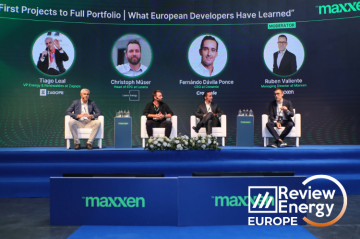
McCarthy presented a “pyramid” illustrating the competitive landscape for the industry, describing it as a kind of “Champions League” for the sector and showing where Maxxen sees itself within that landscape.

Rubén Valiente, Managing Director at Maxxen
He also discussed the development of co-location across European markets. While early adoption was driven largely by regulation, grid scarcity and declining capture prices for wind and solar are increasingly influencing the business case for combining renewable generation with battery storage.
The pace of adoption, however, differs between countries, reflecting variations in regulatory frameworks, grid conditions and renewable generation profiles.
The role of BESS is therefore changing. Rather than simply being an add-on to renewable generation, batteries are increasingly becoming part of project design in systems where grid constraints and market conditions demand greater flexibility.
Where are the revenues?
Salomé Perperot, Analyst at Clean Horizon, provided a closer look at the revenue opportunities emerging for battery storage across European markets.
According to her analysis, year-to-date revenues for two-hour BESS systems have ranged from approximately €100,000 to €600,000 per MW per year, with significant differences between countries.
Perperot also highlighted the growing importance of intraday markets. Romania, Denmark, Poland, Lithuania and Finland are among the markets gaining traction, while annual traded volumes on continuous intraday markets increased significantly between 2022 and 2025.
The figures underline the increasingly complex revenue landscape for BESS projects, where market participation and national conditions can have a significant impact on the value that storage systems can capture.
Review Energy speaks with Maxxen
Alongside the event programme, Review Energy interviewed Pablo Muñoz, Business Development Director at Maxxen, about the company’s decision to manufacture in Türkiye and its focus on the European market.
“The idea of coming to manufacture in Türkiye is to be close to Europe,” Muñoz explained, adding that proximity is not the only consideration, with support and service also playing an important role in the company’s approach to the European market.
The comments underline one of the central themes running through Maxxen Day: the importance of geographical proximity, manufacturing capacity and the ability to provide support and service to the European market.
Inside Maxxen’s factory: Battery production in operation
Once the presentations were over, we followed the Maxxen team onto the factory floor. The atmosphere changed immediately: instead of slides and figures, there were cells being sorted, modules being assembled and AGVs moving components along the production lines. The factory was not simply being shown to visitors, it was operating around us, offering a first-hand look at how a battery storage system takes shape, from the individual cell to the finished BESS container.
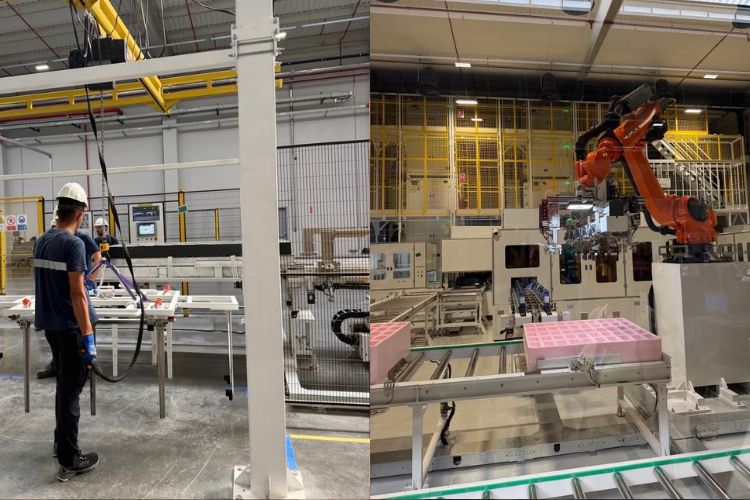
The process begins with automated stations for cell pre-charging and sorting, before moving through the automated module assembly line. From there, the cells are assembled into packs on a semi-automated line, with AGVs supporting the production flow, before the process continues to the semi-automated container assembly line.
The different stages are arranged in an S-shaped production layout and follow a “One Piece Flow” approach, with traceability and controls incorporated throughout the process. The plant also includes an environmentally controlled room where temperature and humidity can be regulated during production.
The final stages include electrical and functional testing, with every unit undergoing factory testing before being shipped. The combination of automation, robotics, AGV-supported logistics and specialised work is designed to maintain a continuous production flow from cell to module, pack and ultimately the complete BESS container.
For Valiente, this industrial infrastructure is part of a much broader objective. “The energy transition needs not only batteries, but also the grid,” he said during the event. “We are here to accompany that transition.”
The Aydyn site is therefore both a manufacturing operation and a statement of intent for Maxxen: to expand battery production capacity close to the European market at a time when storage is becoming increasingly central to the continent’s energy transition.

Comentarios
Sé el primero en comentar...