
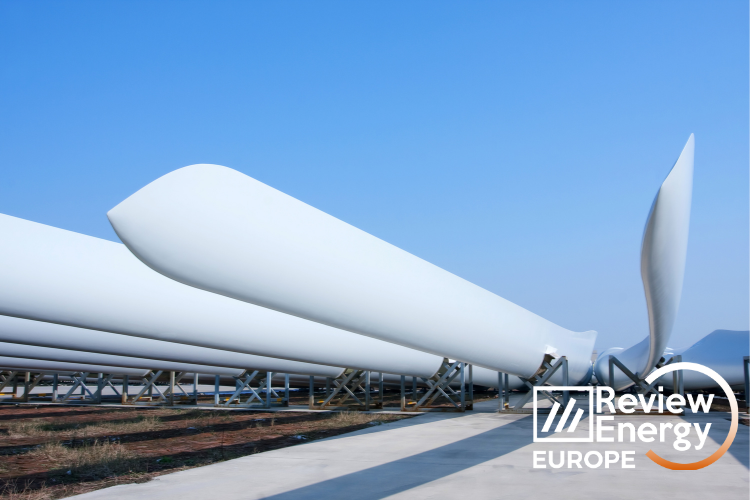


Europe faces critical crossroads in wind turbine blade recycling
The European wind energy sector is stepping up efforts to ensure that 100% of decommissioned turbine blades are reused, recovered or recycled. Despite notable progress, the path to full circularity still faces significant challenges, including the lack of harmonised EU regulations, unclear waste classifications, and the high cost of recycling technologies.
According to WindEurope, the organisation representing Europe’s wind industry, sustainability is embedded in the industry’s DNA. Currently, up to 90% of a wind turbine’s mass is recyclable through established processes. However, recycling turbine blades, which are made from complex composite materials, remains a major hurdle.
On 2 July, WindEurope CEO Giles Dickson took part in the European Commission’s Clean Industrial Dialogue on Circularity. The event, tied to the EU Clean Industrial Deal, was co-hosted by senior EU officials including Teresa Ribera and Stéphane Séjourné, and aims to make Europe the world leader in circular economy by 2030.
Technology, innovation, and reuse
Since 2021, when the industry committed to recycling all decommissioned blades, there have been significant advances. New technologies now enable the transformation of blade composites into market-quality products. Cross-sector collaborations are also emerging to pilot these solutions, though economic competitiveness remains a challenge.
Cement co-processing is emerging as an effective alternative. It allows the recovery of composite materials while reducing fossil fuel consumption, avoiding up to one tonne of CO? for every tonne of waste processed.
Creative reuse projects are also gaining ground. In Ireland, BladeBridge turns old blades into pedestrian bridges; in the Netherlands, BladeMade repurposes them into playgrounds and public furniture; in Sweden, blades are integrated into car parks; and in Spain, Acciona is using blade materials in hybrid wind-solar farms.
A growing challenge
By 2030, over 14,000 blades are expected to be decommissioned across Europe, generating between 40,000 and 60,000 tonnes of waste. Germany will lead with 23,300 tonnes, followed by Spain (16,000) and Italy (2,300). While this remains a small fraction of Europe’s total waste stream, new facilities are being developed to manage it.
Companies like Business in Wind are opening large new sites in the Netherlands; Caremag is investing €216 million in a rare earth recycling plant in France; and EnergyLOOP is launching a dedicated blade recycling plant in Spain.
Urgent need for clearer regulation
One of the major issues identified by WindEurope is the lack of specific waste codes for turbine materials under current EU rules. This uncertainty in classification makes it harder to trace and recycle components. WindEurope is urging policymakers to turn EU directives into binding regulations to ensure uniform application across all Member States.
In the meantime, WindEurope has launched a voluntary reporting system to collect annual data on blade waste volumes, decommissioned turbines, and methods of disposal—particularly how much waste is diverted from landfill.
Towards a circular future
The wind industry is not waiting for regulation to catch up—it is taking action. Through investment, partnerships and the sharing of best practices, circularity is becoming a defining feature of Europe’s clean energy transition.
This commitment will be a key theme at the upcoming WindEurope EoLIS conference, taking place on 20–21 November in Lisbon. There, WindEurope will unveil a new sustainability campaign highlighting the latest innovations in turbine blade circularity.
Europe is already making strong progress towards a more circular energy system, and tackling wind turbine blade waste is an essential part of that journey.

Comentarios
Sé el primero en comentar...