


Solar and storage lower residential electricity generation costs in Texas and California, SEIA finds
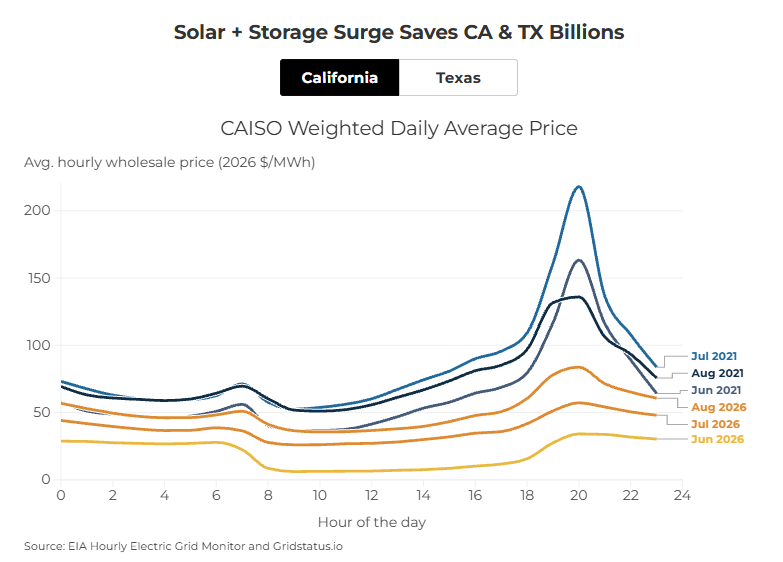
The expansion of solar energy and battery storage has contributed to lower wholesale electricity prices in Texas and California over the past five years, according to a new analysis by the Solar Energy Industries Association (SEIA). Between the summers of 2021 and 2026, average wholesale electricity prices fell by 42% in Texas and 51% in California, despite increasing electricity demand in both markets.
The study compares weighted average hourly wholesale electricity prices from June through August 2021 with those recorded during the same period in 2026 across the ERCOT market in Texas and the CAISO market in California, using inflation-adjusted 2026 dollars.
Over the five-year period, solar generation increased by 421% in Texas and 90% in California, while battery storage capacity grew more than 26-fold in Texas and nearly sevenfold in California.
According to SEIA, the expansion of both technologies helped reduce electricity generation costs and put downward pressure on wholesale prices, even as electricity consumption continued to rise.
Texas and California record more than $6 billion in estimated savings
According to SEIA's estimates, the expansion of solar energy and battery storage helped generate approximately $3.55 billion in savings in Texas and $2.5 billion in California between June and August 2026, compared with the same period in 2021.
In Texas, electricity demand increased by 30% over the five-year period, while the average wholesale electricity price declined from $54.97/MWh to $31.77/MWh.
Meanwhile, California recorded a 2.5% increase in electricity consumption, accompanied by a reduction in average wholesale prices from $77.54/MWh to $38.32/MWh, after adjusting for inflation.
According to the association, these results demonstrate the contribution of solar installations and energy storage systems to reducing electricity generation costs in both states.
Residential generation costs decline despite higher electricity bills
The analysis also highlights differences between wholesale electricity price trends and the final amounts paid by residential consumers.
Between the summers of 2021 and 2026, residential electricity generation costs declined by 4% in Texas and 10% in California, supported by the expansion of solar energy and battery storage.
However, these reductions did not translate into lower overall electricity bills. During the same period, residential electricity bills increased by 3% in Texas and 22% in California, as other components of electricity supply became more expensive, particularly transmission and distribution costs.
SEIA emphasised that the growth of solar and storage technologies has helped contain energy costs, although other factors continue to put upward pressure on household electricity expenses.
SEIA highlights solar and storage's role in electricity affordability
The analysis comes as energy affordability takes centre stage in the United States ahead of the midterm elections.
Tim Pawlenty, CEO of SEIA, said that delivering affordable and reliable electricity is a priority that transcends political divisions, pointing to Texas and California as examples of how solar and storage deployment can help reduce electricity prices.
The study highlights that both markets experienced significant declines in wholesale electricity prices while electricity demand, solar generation and battery storage capacity increased.
The findings are based on a comparison of the summer periods of 2021 and 2026, using inflation-adjusted wholesale electricity prices. While SEIA attributes part of the decline to the deployment of solar and storage technologies, the comparison alone does not isolate their contribution from other factors influencing electricity markets.



Comentarios
Sé el primero en comentar...