




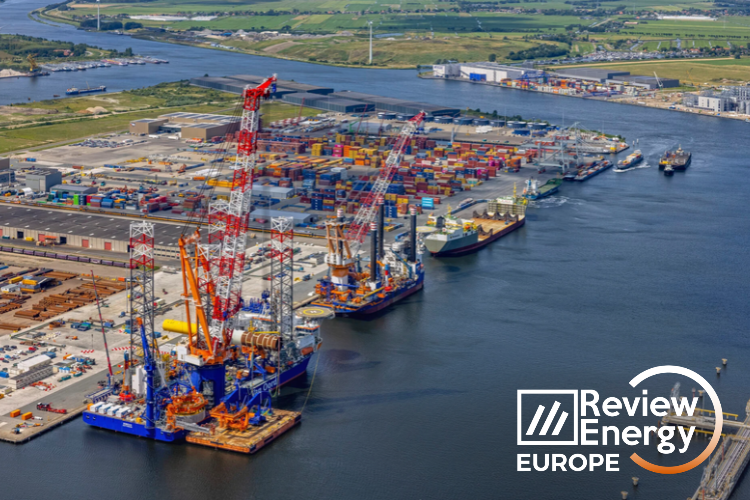


Europe’s offshore wind expansion will require an additional €2.4 billion in port infrastructure investment
European ports will require approximately €2.4 billion in additional investment to expand their capacity and support offshore wind deployment after 2030, according to WindEurope. The association warns that offshore wind development is beginning to outpace the adaptation of the port infrastructure required to manufacture, handle and install increasingly large turbine components.
A recent study cited by WindEurope projects that demand for port infrastructure will exceed available supply early in the next decade, just as offshore wind deployment is expected to accelerate. The increasing size and weight of wind turbines require ports to provide high-load quays, deeper berths and sufficient space for storing, handling and assembling components.
WindEurope notes that port infrastructure projects typically take six to ten years from permitting to commissioning, meaning investments must be made well before offshore wind farms reach the construction stage. However, delays in offshore wind auctions, shifting project schedules and difficulties reaching final investment decisions are reducing the certainty port operators need to commit capital.
WindEurope calls for predictable auction schedules and project volumes
WindEurope is urging governments to establish firm offshore wind auction schedules and sufficient project volumes to justify investments in port infrastructure. According to the association, political targets alone cannot provide the certainty needed to finance facilities that will serve wind farms developed several years in the future.
This was the central message of the latest WindEurope Offshore Wind Ports Platform meeting, held on 27–28 October at the ports of Den Helder and Amsterdam in the Netherlands. The event brought together 31 participants, including representatives from eight European ports.
Erik Bertholet, Chair of WindEurope's Offshore Wind Ports Platform, stressed that ports and the wider offshore wind supply chain require greater certainty across the North Seas Energy Cooperation region.
He warned that positive deployment forecasts are insufficient when final investment decisions continue to be postponed, making it difficult for infrastructure operators to plan long-term investments.
EU Ports Strategy and cross-border coordination
The EU Ports Strategy recognises the evolving strategic role of European ports and calls for stronger coordination of infrastructure investments. WindEurope argues that Member States must now implement this approach, particularly as offshore wind supply chains operate across national borders, with ports in one country regularly supporting offshore wind farms in another.
The association considers coordination at sea-basin level essential to identifying future infrastructure requirements and avoiding capacity shortages.
In this context, North Sea Energy Ministers have committed to jointly assessing port capacity expansion needs by the second quarter of 2027.
Meanwhile, the European Parliament's Committee on Transport and Tourism (TRAN) is examining a new own-initiative report on the implementation of the EU Ports Strategy.
WindEurope is calling for offshore wind infrastructure requirements to be firmly included in these discussions and for port financing to be more closely linked to Europe's offshore wind deployment pipeline.
The association also argues that policymakers should move beyond assessing ports primarily through cargo tonnage and container handling.
European ports increasingly serve as industrial and energy infrastructure, supporting the manufacturing, storage and assembly of offshore wind components. They are also expected to develop into renewable energy hubs, integrating renewable electricity, hydrogen, alternative fuels and energy storage while contributing to the decarbonisation of nearby industrial clusters.
WindEurope maintains that recognising this strategic role should translate into financing mechanisms aligned with Europe's offshore wind deployment targets and broader energy and industrial priorities.

Comentarios
Sé el primero en comentar...