


North America attracts $1.7 billion in geothermal funding in first quarter of 2025
Geothermal energy is entering a new era in North America, as next-generation technologies unlock vast untapped resources and drive a record-breaking surge in investment. According to a new report by Wood Mackenzie, public funding for geothermal projectshttps://www.review-energy.com/otras-fuentes/new-budget-bill-in-the-us-could-discourage-the-development-of-renewable-energy-projects soared to $1.7 billion in Q1 2025—an 85% increase compared to the entire 2024 total.
This wave of investment is being fueled by enhanced geothermal systems (EGS), advanced geothermal systems (AGS), and super-hot rock technologies, which are revolutionizing the sector by enabling energy production from previously inaccessible hot dry rock formations—far beyond traditional volcanic zones.
"Next-generation geothermal technologies are fundamentally changing the energy landscape by making this reliable, 24/7 clean power source available almost anywhere," said Annick Adjei, senior research analyst at Wood Mackenzie.
Technology driving the shift
Three core technologies are overcoming traditional barriers:
-
Enhanced Geothermal Systems (EGS): Use hydraulic fracturing to tap hot dry rock.
-
Advanced Geothermal Systems (AGS): Use closed-loop circulation systems without fluid extraction.
-
Super-Hot Rock: Target ultra-deep resources at temperatures over 374°C.
These advancements reduce reliance on rare geological conditions and dramatically lower development costs.
Breakthroughs prove commercial viability
The first quarter of 2025 saw a dramatic 80% year-on-year jump in well announcements, with 47 new geothermal wells planned. Leading the way are the U.S. and Turkey, which together account for nearly half of all planned developments.
A key milestone: Fervo Energy’s 500 MW Cape Station in Utah, which is delivering power at $79 per megawatt-hour without subsidies—putting geothermal squarely in competition with traditional power sources.
A 500 GW opportunity in the U.S.
Though geothermal currently supplies less than 1% of global electricity, Wood Mackenzie estimates it could generate up to 15% of global power by 2050. The U.S., already the world leader in geothermal production, has just 4 GW of installed capacity—a fraction of the 500 GW total potential, especially in high-heat western states.
Canada also holds strong promise, with high-potential regions in British Columbia, Alberta, Saskatchewan, Yukon, and Nova Scotia. Key developments include a partnership between Deep Earth Energy and SLB on Canada’s first next-gen geothermal project in Saskatchewan.
Investment confidence has strengthened significantly, with 41% of the sector's nearly US$2 billion total investment raised in 2024 alone. Major partnerships have emerged, including Canadian Deep Earth Energy's collaboration with SLB on Canada's first next-generation project in Saskatchewan.
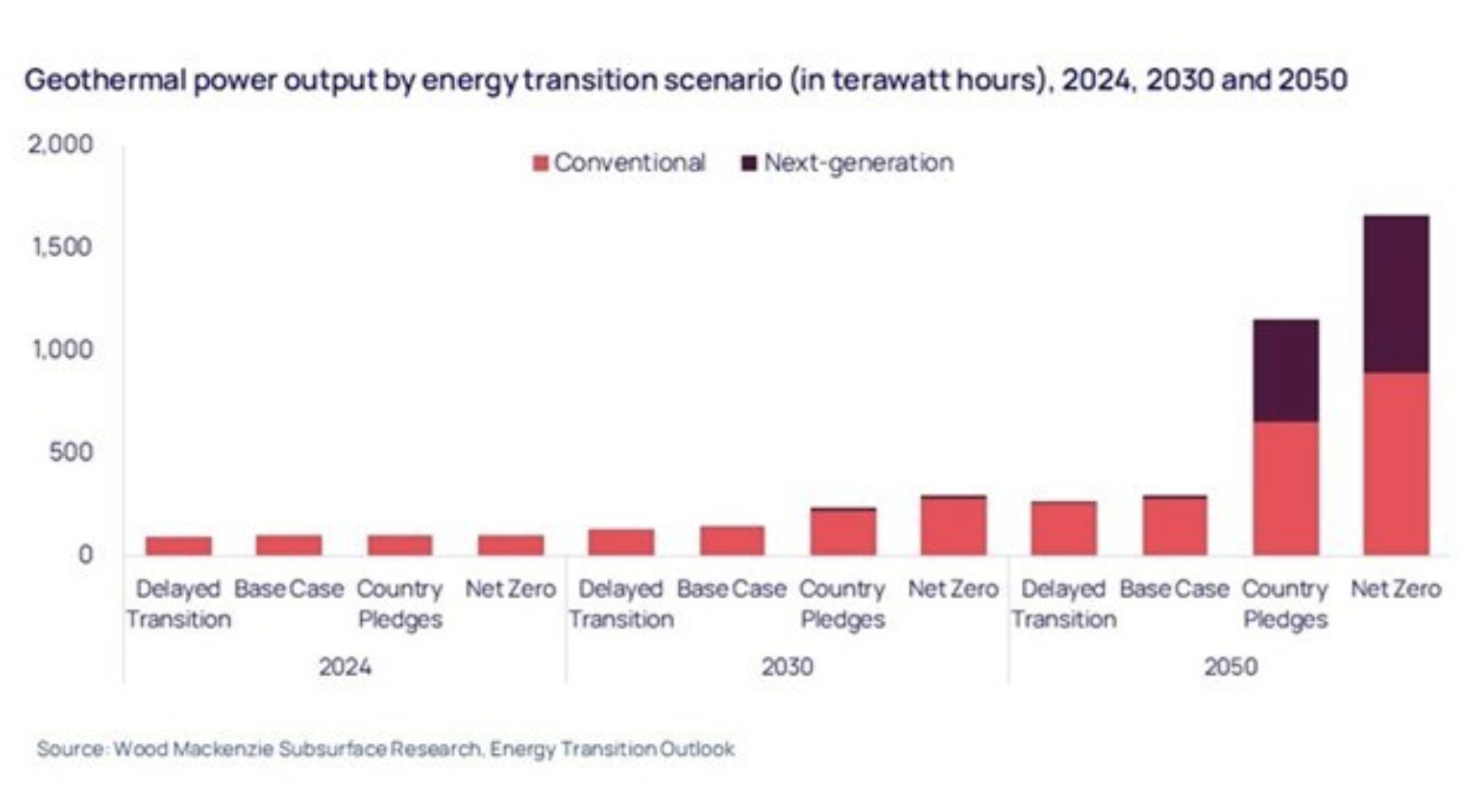
Under a net-zero scenario, we estimate these next generation technologies could account for 46% of total geothermal output by 2050 (see chart below).
Government support and market momentum
Federal backing is accelerating the sector’s expansion. The U.S. Department of Energy recently announced a $1.36 billion conditional commitment to Project ATLiS, targeting lithium extraction from geothermal brines.
Exploration is scaling rapidly, with new lease awards across Chile, Alaska, and Utah covering over 100,000 acres. Meanwhile, Colorado, Nevada, Utah, and North Dakota are emerging as state-level leaders, and Canada committed over CA$50 million in geothermal funding in 2024.
“With over 500 GW of potential in the U.S. alone and only 4 GW currently installed, we're looking at a market opportunity that could rival the scale of traditional oil and gas,” Adjei added.
A cornerstone of clean energy
As geothermal costs fall and scalability improves, the technology is shifting from niche to mainstream. Its round-the-clock generation, minimal land use, and grid compatibility make it a crucial part of North America’s clean energy transition.
With strong momentum in 2025, geothermal energy is now poised to play a major role in delivering the reliable, low-carbon power needed to stabilize grids and meet long-term climate goals.


Comentarios
Sé el primero en comentar...