


Onshore wind in Europe is expected to drive manufacturing expansion needs, especially on the turbine side: Rystad
A new report published by Rystad Energy, which addresses the needs for Europe's supply chain to meet its wind energy ambitions, reveals the differences between the future of offshore and onshore wind. The outset of the analysis has been WindEurope’s 2030 Targets Scenario presented in its report “Wind energy in Europe 2022 – Statistics and the outlook for 2023-2027” published in February 2023.
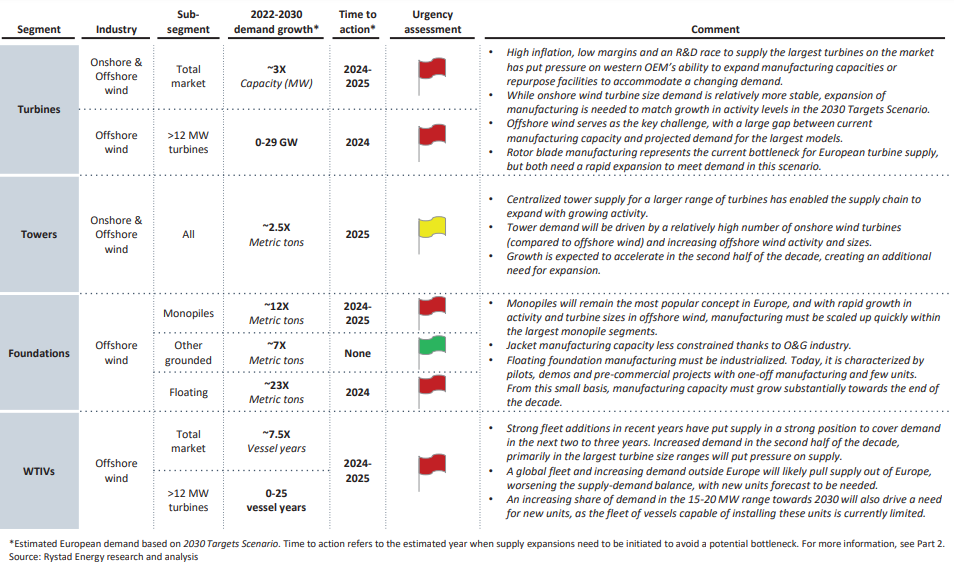
In ‘The State of the European Wind Energy Supply Chain – April 2023’, Rystad reveals the estimated supply-demand balance shows that for wind energy capacity targets to be met by 2030, there would be a need to rapidly expand capacities across the supply chain unique to wind, including turbines, towers, foundations, wind turbine installation vessels (WTIVs), and more.
According to the research, while the ambitious wind energy capacity targets would require nearly all parts of the European wind supply chain to be ramped-up, the analysis shows that those related to offshore wind would be most critical. Compared to onshore wind, where activity levels need to be ramped up from already high levels and with limited growth in turbine sizes, offshore wind is forecast to see a steeper increase towards 2030, with turbine sizes expected to grow rapidly. This is expected to put significant pressure on the manufacturing of turbines larger than 12 MW, large-diameter monopiles, and floating foundations.
For the same reason, Rystad says expansions are expected to be required for next-generation WTIVs. These expansions are extremely time-sensitive as an undersupply is expected around mid-decade, with expansions in need of being initiated as early as 2023- 2024 due to lead-times. Onshore wind is also expected to drive manufacturing expansion needs, especially on the turbine side, driven by the sheer activity increase required to reach targets.
"Several other parts of the wider supply chain would be pressured if targets are to be reached: transmission and grid infrastructure is expected to be squeezed by an increase in wind, in addition to a growth in renewables, and a general electrification of the energy system; skilled labor may serve as a bottleneck for specialized parts of the wind supply chain; other vessel segments such as foundation and cable installation, service operation vessels (SOVs) and anchor handling tug supply (AHTS) vessels for floating wind are expected to need fleet expansions; ports need upgrading to support the large-scale build-out of offshore wind and the industrialization of floating wind; and floating wind would require mooring line manufacturing to be ramped up significantly", said Alexander Dobrowen Fløtre, Head of Offshore Wind Research of Rystad Energy.
Material demand is expected to grow nearly four-fold towards 2030 if targets are to be reached. Assessed according to their relative importance in wind, the expected growth trajectory towards 2030 and relative score on reliability, affordability and sustainability, steel, copper and rare earth minerals are seen as most strategically important. The latter two are assessed as at most risk, due to their rapid demand growth, Europe’s relatively high import reliance for these materials, and their critical role in cables and turbines, respectively.
The trilemma between reliability, affordability and sustainability
Rystad also confirmed that it will be necessary to find a balance between the often competing challenges of ensuring energy reliability, affordability and sustainability.
According to the report, reliability refers to whether a country or entity has an uninterrupted availability of e.g., energy. Short term, this could mean an energy system that can deliver energy to sudden changes in demand or part of the supply. Long term, this means energy security in terms of energy resources.
Affordability means affordable energy that is accessible to everyone. And sustainability refers to energy production that does not have a negative effect on the planet for future generations, both in terms of emissions and human encroachment. The elements in the energy trilemma are universal and will be relevant for the development of other commodities as well.
"The affordability, sustainability and reliability of a component, service or material decides their respective relevance. If a part of the supply chain is not balanced across the elements of the trilemma, it is likely it will be replaced as new technologies, components and materials are introduced to the market", says Rystad.
Future: Wind manufacturing facilities in Europe
Europe is one of the regions in the world with the largest manufacturing capacity for wind power components, explains the report. The region has an interconnected supply chain, as the European Union Free Trade Agreement helps the movement of goods across member states’ borders.
Noteworthy European countries in the wind supply chain include Germany, Spain and Denmark, all of which have significant activity linked to producing the main components of wind turbines – blades, nacelles, and towers. In recent years, France has also emerged as one of the key countries, with new blade and nacelle manufacturing plants.
For offshore wind foundations, Rystad says key producers include the Netherlands, Germany, and Denmark. "Unsurprisingly, these countries are also among the leaders in terms of installed capacity for offshore wind in Europe. Most of these facilities are in port cities, facilitating sea transport. We expect this trend to continue as more manufacturing facilities producing offshore wind components will be added", Rystad confirms.


Comentarios
Sé el primero en comentar...