




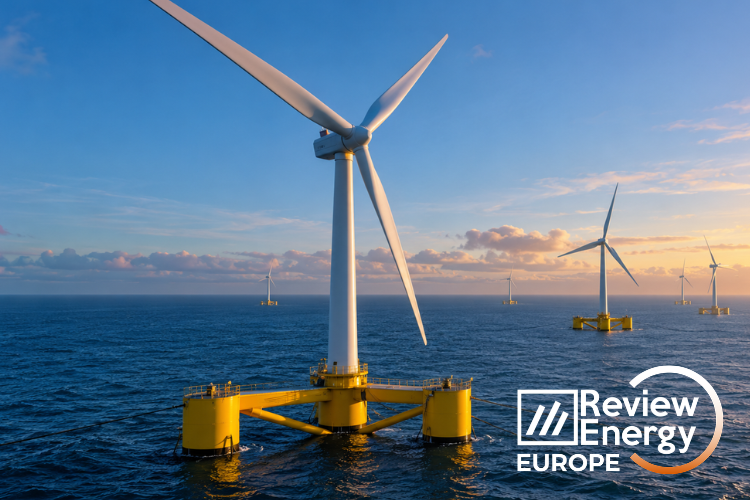


UK floating offshore wind costs could fall sharply through finance, standardisation and innovation
The Offshore Renewable Energy Catapult (ORE Catapult) has identified 21 cost-reduction levers for floating offshore wind in the UK, aimed at improving the technology’s competitiveness against other low-carbon power generation sources.
The analysis is part of the report Floating Wind Cost Reduction: A Cost Reduction Monitoring Framework Methodology Report, published in October 2026, and sets out a methodology to assess how costs could evolve as the technology moves towards large-scale commercial deployment.
The study notes that floating offshore wind is still at an early commercial stage and remains more expensive than other large-scale low-carbon technologies. To assess potential cost reductions, ORE Catapult modelled seven scenarios across three UK regions: the Celtic Sea, North Sea and Shetland, using reference projects of 900 MW and 15 MW turbines.
Financing can account for up to 60% of LCOE
One of the study’s key findings is the significant impact of financing on the final cost of electricity.
Across the seven scenarios assessed, under an assumed weighted average cost of capital (WACC) of 12%, financing costs can account for up to 60% of total LCOE for a floating offshore wind project.
The remaining 40% is linked to project expenditure. Within that share, CAPEX accounts for approximately 60%, while OPEX contributes around 32%. Development and decommissioning expenditure make up the remainder.
ORE Catapult identifies the cost of capital as the single most powerful lever for reducing LCOE.
The analysis estimates that reducing WACC from 12% to around 8%, a level already achieved by fixed-bottom offshore wind projects, could deliver an average LCOE reduction of 19.3%.
According to the report, achieving this reduction would depend not only on lower interest rates, but also on greater investor confidence, stronger supply chains, increased operational experience and greater technology standardisation.
Standardisation and innovation could also deliver significant savings
The report groups the 21 cost-reduction levers across several areas, including development, assets, transport and installation, operations and maintenance, finance and energy production.
ORE Catapult concludes that cost reduction is unlikely to come from a single breakthrough, but rather from a progressive combination of standardisation, automation, technology innovation and industrialisation.
Standardisation and optimisation of designs and processes could deliver an average LCOE reduction of around 17%, by reducing complexity, improving repeatability and accelerating manufacturing and installation processes.
Meanwhile, automation, including robotics, advanced manufacturing and industrialised processes, could reduce LCOE by an average of 8.6%.
Technology innovation shows one of the strongest potentials, with an estimated average reduction of 17.6%, supported by improvements in turbine reliability, upsizing and higher energy yields.
Industrialisation, through increased manufacturing scale, larger order volumes and economies of scale, could contribute a further 5.4% average reduction in LCOE.
Competition could deliver up to a further 8.7% reduction
The study also identifies competition within the supply chain as another important route to lower costs.
As the floating offshore wind market expands and the number of suppliers increases, ORE Catapult estimates that greater competitive pressure could deliver an average LCOE reduction of up to 8.7% across the sites assessed.
However, the organisation warns that these gains will depend heavily on the existence of a stable and sustained project pipeline, capable of providing sufficient confidence to mobilise investment in ports, factories and supply chains.
Sustained deployment will be key to long-term cost reductions
In the near term, ORE Catapult sees the greatest opportunity in reducing technical uncertainty and strengthening confidence across the value chain, which could help lower financing costs even before the sector reaches large-scale deployment.
Over the longer term, further cost reductions will depend on sustained deployment that allows standardisation, automation, innovation and industrialisation to develop sequentially and at scale.
The report also notes that fiscal, trade and energy policy can materially affect project economics, meaning that greater regulatory stability and clear signals on future market growth will be critical to improving the competitiveness of floating offshore wind.
The next step will be the full development of the Cost Reduction Monitoring Framework (CRMF), designed as a tool to track cost trends, support investment decisions, assess the impact of public policy and identify which measures are effectively reducing the technology’s LCOE.




Comentarios
Sé el primero en comentar...