


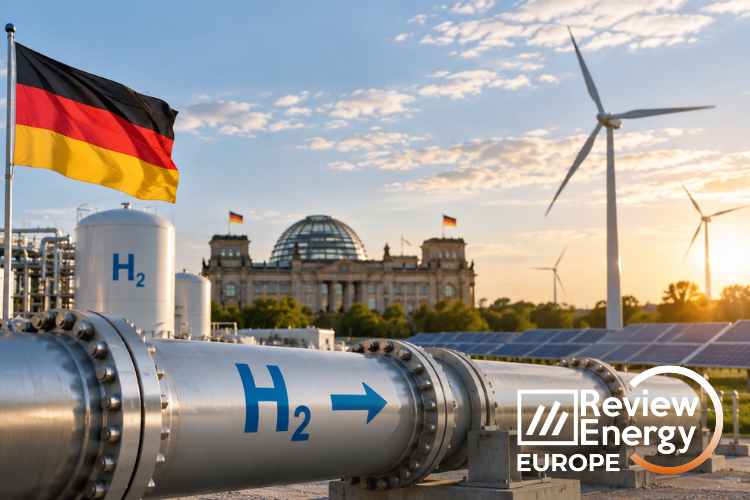


Germany outlines ten measures to address hydrogen costs, industrial demand and infrastructure development
Germany's Federal Ministry for Economic Affairs and Energy (BMWE) has approved a package of ten measures aimed at accelerating the development of the hydrogen market, focusing on improving competitiveness, expanding infrastructure, stimulating industrial demand and supporting technological development.
Announced on 19 October 2026, the initiative addresses challenges facing hydrogen deployment in Germany, where production costs remain higher than the prices many potential consumers are willing to pay, delaying market development.
The ministry has organised the measures around four areas: hydrogen competitiveness, demand-driven infrastructure development, demand stimulation and cost reduction, and stronger governance and technological development.
Germany plans at least €1.5 billion to stimulate industrial hydrogen demand
One of the main measures involves establishing a new hydrogen support scheme under the Carbon Contracts for Difference (CCfD) programme, targeting industrial companies seeking to integrate hydrogen into their production processes.
The German government plans to allocate at least €1.5 billion to this mechanism, which is designed to narrow the cost gap between conventional technologies and lower-emission industrial alternatives.
Hydrogen projects will also be eligible to participate in the broader Carbon Contracts for Difference programme, for which up to €8.7 billion has been earmarked.
This amount applies to the overall programme and does not represent additional funding exclusively allocated to hydrogen projects.
Through these instruments, the ministry aims to improve the economic conditions for industrial companies to adopt hydrogen in processes where its use remains more expensive than conventional alternatives.
Incentives to adapt 4 GW of power plants for hydrogen use
Another measure involves developing incentives for the technical conversion of power plants with a combined capacity of 4 GW, enabling their potential future operation using hydrogen.
The initiative forms part of the planned German legislation on electricity supply security and generation capacity, known as the Strom-Versorgungssicherheits- und Kapazitätengesetz (StromVKG).
The ministry has clarified that the legislative framework required to introduce these incentives is still being developed.
Therefore, the 4 GW refers to generation capacity that Germany intends to support for technical adaptation, rather than power plants whose conversion has already been awarded or completed.
The initiative seeks to incorporate hydrogen into the future operation of the electricity system and facilitate its use in generation facilities capable of contributing to security of supply.
Hydrogen transmission networks, storage and imports
The package also includes measures to develop the infrastructure required to transport, store and supply hydrogen in line with demand growth.
The BMWE plans to continue developing Germany's hydrogen core network (Wasserstoff-Kernnetz), alongside international import corridors and storage facilities.
It also intends to facilitate the conversion of certain distribution networks through implementation of the European legislative package governing the internal markets for gas and hydrogen.
The ministry considers that infrastructure development should reflect actual consumption requirements and follow principles of economic efficiency.
Regarding supply, Germany aims to combine domestic hydrogen production with imports from different countries, seeking to improve availability and reduce supply costs.
The government also intends to promote adjustments to European requirements for renewable hydrogen and establish predictable conditions for electricity grid access charges.
These measures are intended to support both domestic production and the entry of imported hydrogen into the German market.
New requirements for steel used in offshore wind farms
In the industrial sector, Germany also plans to establish a lead market for low-emission steel, aiming to stimulate the use of renewable and low-emission hydrogen in steel production.
According to the ministry, offshore wind installations will be subject to requirements concerning the use of steel produced through processes involving renewable or low-emission hydrogen, in accordance with Germany's Offshore Wind Energy Act (Windenergie-auf-See-Gesetz, WindSeeG).
The measure seeks to create hydrogen demand in the steel industry, one of the sectors where hydrogen is being considered as an alternative for reducing emissions from industrial production.
The development of this market complements the financial incentives planned for industrial transformation and aims to encourage hydrogen adoption in supply chains linked to the renewable energy sector.
Germany to strengthen hydrogen planning and technological development
The fourth area of the package focuses on changes to institutional coordination and technology planning.
The ministry will continue implementing the reform of the National Hydrogen Council, approved in June 2026, to align its advisory functions with the federal government's needs and evolving market conditions.
It will also develop a hydrogen technology roadmap, integrated into Germany's high-tech innovation agenda, to guide technological development across the sector.
Through these initiatives, Germany aims to address challenges relating to production costs, industrial demand, infrastructure and technology availability.
Although the ministry has approved a package of ten measures, implementation includes instruments that still require legislative development and further action, particularly the incentives for adapting power plants to hydrogen use.
The initiative places demand stimulation and cost reduction among the main mechanisms for advancing Germany's hydrogen market development.

Comentarios
Sé el primero en comentar...