


New atlas identifies locations for green hydrogen production in Germany
The Fraunhofer Institute for Solar Energy Systems ISE has released a new Hydrogen Potential Atlas, developed under the project “PoWerD,” which identifies the most suitable locations across Germany for the production of green hydrogen via electrolysis. The atlas, now available online and free of charge, serves as a strategic planning tool for project developers, energy providers, municipalities, and public authorities.
The atlas evaluates optimal sites under various scenarios and business models, taking into account not only hydrogen demand from sectors such as chemical and steel industries or public transport (e.g., buses and trains), but also the regional availability of renewable energy, integration into the power grid, and the potential reuse of by-products like oxygen and waste heat. “This tool offers a robust foundation for holistic project planning by combining regional renewable potential, infrastructure, and hydrogen application opportunities,” said Kim Kanitz, project engineer at Green Planet Energy.
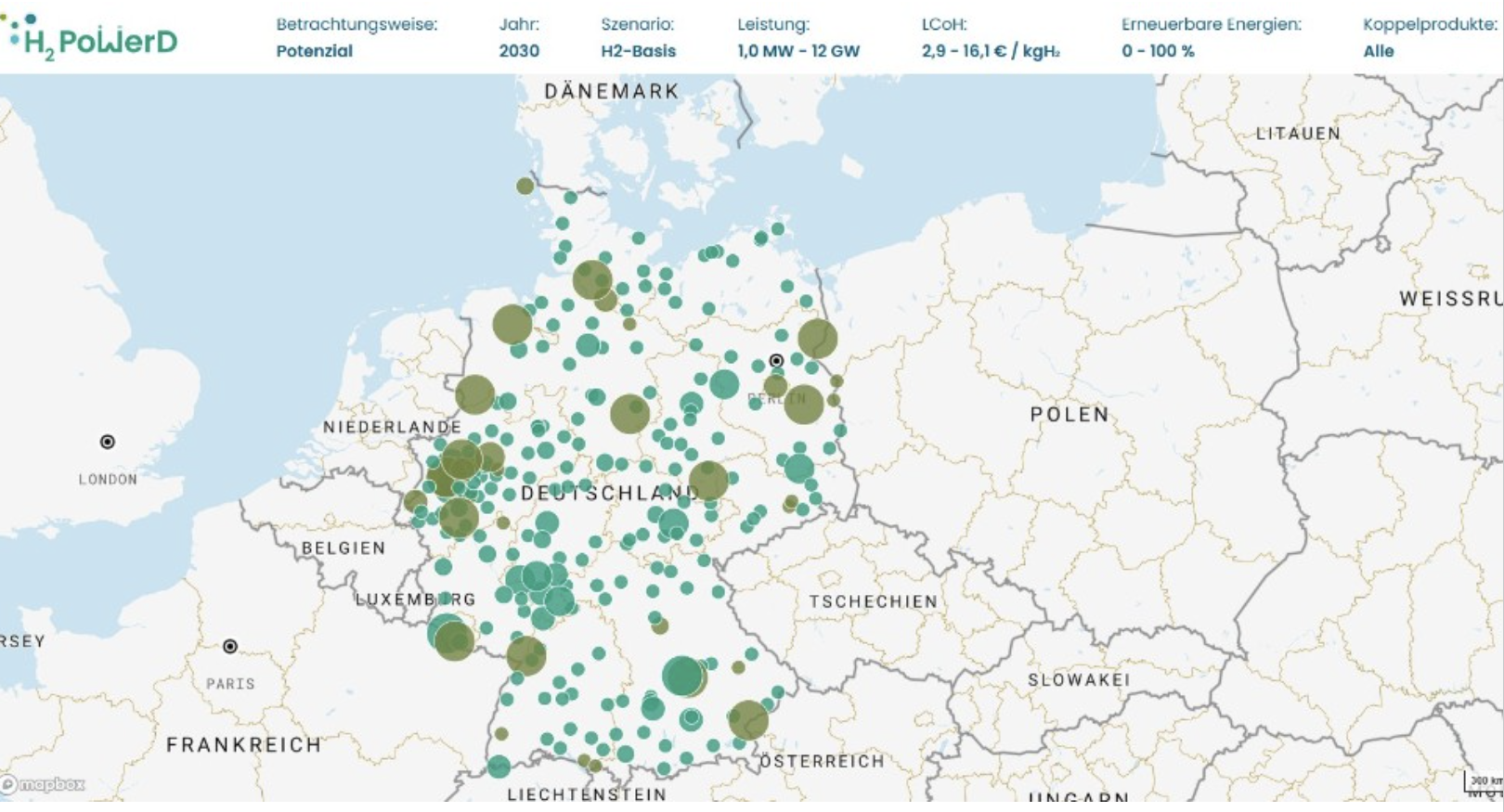
The Hydrogen Atlas spatially identifies suitable locations for the production and use of hydrogen and its by-products, oxygen and heat.
Source: Fraunhofer ISE
One of the key findings highlights the advantages of northern Germany, where abundant wind energy, particularly near offshore grid connection points, provides significant cost benefits for large-scale electrolyzers. The atlas also considers the impact of future hydrogen pipeline infrastructure, which could replace or reduce truck-based transport. “The use of by-products such as oxygen in wastewater treatment or the integration of waste heat into district heating networks can enhance sustainability and lower costs, although they are not decisive for site selection,” noted Professor Heidrun Steinmetz from the Rhineland-Palatinate Technical University.
The atlas also shows that former fossil fuel plant sites or industrial parks offer ideal conditions for electrolyzers due to their well-developed infrastructure. According to Jochen Behrens, project leader at Fraunhofer ISE, these locations strike the right balance between grid accessibility, existing facilities, and proximity to hydrogen consumers.
The PoWerD project was funded by the German Federal Ministry for Economic Affairs and Climate Action (BMWK) with nearly €2.5 million and involved key partners such as the Flensburg University of Applied Sciences, RPTU Kaiserslautern-Landau, the German Hydrogen Association, PLANET engineering, Green Planet Energy, and the start-up greenventory, a spin-off from Fraunhofer ISE and the Karlsruhe Institute of Technology.
With this atlas, Germany takes an important step toward the efficient rollout of green hydrogen as a crucial energy carrier in the energy transition, supporting the EU hydrogen strategy goal of 40 GW of electrolyzer capacity by 2030.

Comentarios
Sé el primero en comentar...