
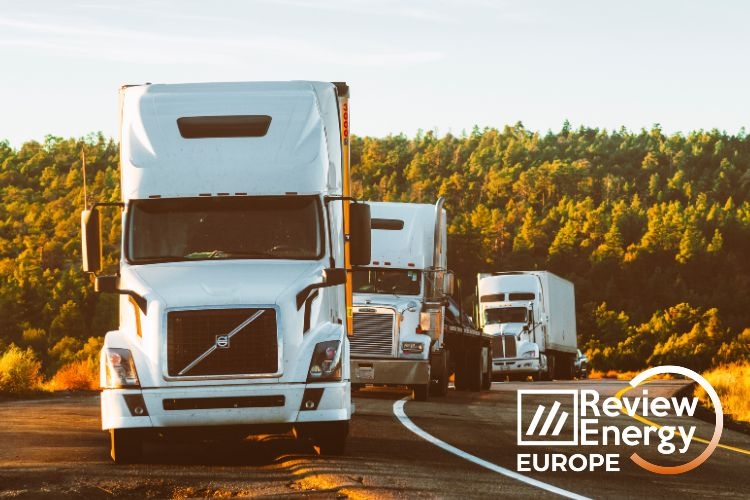


Charging, grids and costs: Europe’s truckmakers call for action to speed up the zero-emission shift
Europe’s seven leading truck and bus manufacturers are calling for the EU to delay the 2030 CO2 compliance timeline for heavy-duty vehicles by three years, arguing that the charging infrastructure, grid connections, energy costs and policy conditions needed to support the transition to zero-emission trucks are at least three years behind schedule.
The call was made by the CEOs of the seven manufacturers at the IAA Transportation in Hanover on 14 September, according to the European Automobile Manufacturers’ Association (ACEA). The manufacturers said they remain committed to the EU’s CO2 reduction targets and have already invested in developing a broad range of zero-emission vehicles covering major transport applications.
However, market uptake remains low. Zero-emission trucks account for just 2.4% of new heavy-duty truck registrations in Europe, while the share is below 1% in Poland, Spain and Italy. In Germany and France, the two largest truck markets in Europe, zero-emission trucks represent 4.3% and 2.4% of new registrations, respectively.
With 45 months remaining before the 2030 CO2 targets apply, ACEA said the gap between current market uptake and the pace required for the transition remains substantial. According to the association, zero-emission trucks need to make economic sense for transport operators, which depends on factors largely outside manufacturers’ control, including charging infrastructure and grid access, energy costs, CO2-based road tolls and a coherent policy framework.
Manufacturers face penalties as enabling conditions lag
The EU requires manufacturers to reduce the CO2 emissions of new heavy-duty vehicles by 43% by 2030, 64% by 2035 and 90% by 2040. Failure to meet the targets can result in penalties of €4,250 per gram of CO2 per vehicle. ACEA estimates that missing the 2030 target by just three percentage points would result in approximately €2.2 billion in penalties.
ACEA argues that manufacturers’ responsibility for meeting the targets is not matched by their control over the conditions required for market uptake. If sales of zero-emission trucks remain too low for manufacturers to meet their obligations, the association said that penalties would not increase the number of zero-emission trucks on European roads. Instead, they could divert billions of euros away from technologies and production capacity needed for the transition, while weakening European manufacturers as global competition intensifies.
“We are fully committed to sustainable transport – the investments have been made, and a wide range of CO2-free vehicles is available today,” said Karin Rådström, President and CEO of Daimler Truck and Chair of ACEA’s Commercial Vehicle Board. She added that the wider ecosystem required to make these vehicles commercially viable at scale is delayed and called for both faster development of enabling conditions and a three-year delay to the 2030 compliance timeline.
Charging and grid connections remain key barriers
ACEA identified several conditions that it says need to improve substantially to support the transition.
The association said that fewer than 2,000 public chargers suitable for trucks are currently available across Europe, while at least 700 additional truck chargers would be needed every month. Hydrogen refuelling infrastructure is even less developed, with fewer than a dozen operational stations, according to ACEA, and those stations are facing major operational constraints.
Grid connections are another bottleneck. ACEA said connecting new charging sites to the electricity grid can take several years, delaying the deployment of infrastructure even when operators and charging providers are ready to invest.
The association also called for a more consistent policy framework across EU member states. According to ACEA, CO2-based road charging is effectively in place in only four member states, while changes to the EU’s Weights & Dimensions rules needed to address the payload disadvantage of zero-emission trucks have yet to be adopted.
Energy and carbon-pricing policies are also part of the manufacturers’ concerns. ACEA pointed to the delay of the ETS2 to 2028 and said energy costs remain a critical factor in determining whether zero-emission trucks can be operated competitively. The association called for revenues from ETS2 and road charging to be reinvested in infrastructure and vehicle uptake.
Commission flexibility has not resolved the structural gap
Earlier in 2026, the European Commission introduced a targeted amendment to the CO2 regulation providing additional flexibility in the calculation of emission credits for the 2025–2029 period. ACEA described the adjustment as a necessary correction to reflect the slow development of critical enabling conditions, while stressing that it does not change the binding CO2 reduction targets or non-compliance penalties.
The mechanism has defined limits: it applies only to credit generation during 2025–2029, does not automatically award credits, and requires manufacturers to reduce their actual fleet emissions below the relevant benchmark.
For ACEA, however, the measure does not address the underlying delivery gap. Manufacturers can develop and market zero-emission vehicles, but cannot independently provide the charging and refuelling infrastructure, grid connections, competitive energy prices and operating conditions required for transport operators to adopt them at scale.
The seven CEOs participating in the Hanover press conference were Jim Walenczak, President of DAF Trucks; Karin Rådström, Chairwoman of the Board of Management of Daimler Truck and Chairperson of the ACEA Commercial Vehicle Board; Güven Özyurt, CEO of Ford Otosan; Olof Persson, CEO of Iveco Group; Alexander Vlaskamp, CEO of MAN Truck & Bus; Christian Levin, President and CEO of Scania Group and TRATON GROUP; and Martin Lundstedt, President and CEO of Volvo Group.





Comentarios
Sé el primero en comentar...