
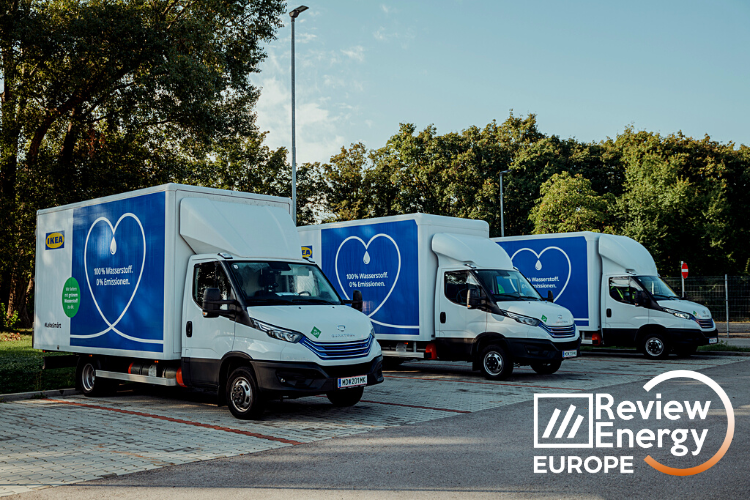


IKEA Austria introduces hydrogen-powered delivery vehicles
For the past two years, IKEA Austria has been supplying the majority of its customers in urban areas with electric vehicles and thus emission-free. With immediate effect, IKEA Austria is expanding its zero-emission delivery with hydrogen-powered vehicles, thus taking a further step towards making all deliveries throughout Austria zero-emission by 2025. Austria is the first IKEA store worldwide to use hydrogen trucks.
The emission of greenhouse gases along the supply chains is a problem with a serious impact on the climate - which is why IKEA Austria is taking further measures to make all deliveries emission-free by 2025. “By introducing hydrogen trucks - as the first IKEA store in the world - we are taking a big step in implementing environmentally friendly processes in Austria. As a pioneer in the field of sustainable logistics, we want to show that a transformation to emission-free delivery is already possible today,” said Alpaslan Deliloglu, CEO and Chief Sustainability Officer at IKEA Austria.
According to IKEA, while IKEA Austria has already been supplying its customers in urban areas with EV (Electric Vehicle) trucks for two years, the introduction of the hydrogen trucks, which are now on the road in Austria, extends the reach of zero-emission delivery. “Our EV trucks are perfect for carrying out multi-stop routes in urban areas. However, since we also want to deliver emission-free to customers in more remote areas of Austria, we had to find a solution with vehicles that can manage a longer range: This is exactly what hydrogen fuel cell technology offers. And without having to compromise on payload weight,” explained Melanie Eltzner, Customer Fulfillment Manager at IKEA Austria.
Long-range trucks with hydrogen as an energy storage medium
The vehicles used are trucks that have been converted to hydrogen fuel cell technology in cooperation with the German zero-emissions solution provider Quantron AG. Quantron provides IKEA with compact trucks that are perfect for urban road transport, but also excellent for longer distances - for example, the hydrogen trucks impress with a range of almost 400 kilometres per tank filling.
“We are delighted that our long-standing cooperation with IKEA has reached another level with the launch of a new generation of innovative QUANTRON products. The QLI FCEV is the first H2 vehicle in the fuel cell commercial vehicle segment up to 7.5 t in Europe and the market leader in fuel cell technology in this class. Since August 2021, we have been accompanying IKEA Austria in its mission to decarbonise. IKEA Austria has 45 QLI BEV trucks in operation in the greater Vienna area and a further 11 in other Austrian cities,” said Andreas Haller, founder and CEO of Quantron AG.
“Hydrogen has a lot of potential in heavy-duty transport and is therefore a key element for the climate change. It is crucial that the hydrogen is produced from renewable sources. This is exactly what we are currently working on with the construction of our first electrolysis plant. We will also soon be putting another H2 filling station into operation. We are pleased that we can accompany IKEA Austria on its way to emission-free delivery with our hydrogen infrastructure,” said Linda Kirchberger, Head of Decarbonisation and New Technologies at Wien Energie.
Support from the Ministry of Climate Protection (BMK)
IKEA already saves around 450 tonnes of CO2 per year by using its EV trucks in urban areas. The widespread use of zero-emission transport technologies such as hydrogen fuel cell technology is expected to save a further 1,500 tonnes of CO2 annually. For its transformation to zero-emission delivery, IKEA is receiving almost 4.8 million euros in funding for 40 hydrogen vehicles as part of the BMK's "ENIN - Emission-free Commercial Vehicles and Infrastructure" support programme. This has also received recognition from Climate Protection Minister Leonore Gewessler: “An important lever for climate protection lies in the energy transition in transport: IKEA Austria is making an important contribution to the mobility transition in the logistics sector and to climate protection with the introduction of emission-free vehicles”.

Comentarios
Sé el primero en comentar...