


Only 0.6% of EU aviation fuel was sustainable in 2024
The European Union has taken its initial steps toward greener skies, according to the first ReFuelEU Annual Technical Report published by the European Union Aviation Safety Agency (EASA). The report presents data from 2024, the first year of reporting under the ReFuelEU Aviation Regulation (RFEUA), establishing a crucial baseline for future monitoring and compliance.
Although the primary obligations of RFEUA only came into effect on January 1, 2025, aviation fuel suppliers and aircraft operators were required to report 2024 data as part of the first annual reporting exercise. The exercise functioned as a “dry run,” providing valuable insights into stakeholder preparedness and highlighting areas for further clarification and coordination.
Aviation Fuel Suppliers
In 2024, 83 out of 123 obligated aviation fuel suppliers (67%) submitted reports. Suppliers reported delivering 32.1 million metric tonnes of aviation fuel to EU airports, of which 192,700 tonnes (or 0.6%) was sustainable aviation fuel (SAF). This early SAF supply avoided approximately 714,000 tonnes of CO2 emissions, achieving a 91% reduction compared to conventional aviation fuel.
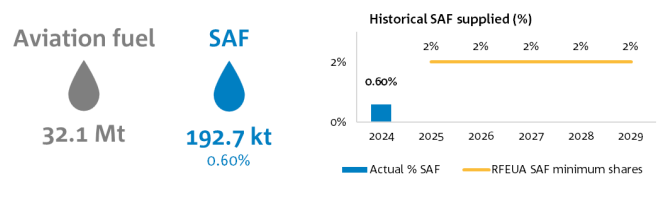
Most SAF supplied in 2024 was classified as “aviation biofuels” (98%), with 81% derived from used cooking oil and 17% from waste animal fats. Despite these achievements, fewer than ten suppliers provided 80% of SAF, and five Member States—France, the Netherlands, Spain, Sweden, and Germany—accounted for 99% of the total supply, highlighting the early and concentrated stage of the EU SAF market.
Aircraft operators demonstrated a 74% compliance rate with reporting obligations, with 262 out of 351 operators submitting acceptable reports. Operators uplifted 38.8 million tonnes of aviation fuel at EU airports in 2024, exceeding the 90% refuelling threshold at Union level. However, only 61% of airports individually achieved this threshold, indicating uneven implementation across Member States.
Operators purchased approximately 358,000 tonnes of SAF in 2024, 0.81% of total fuel uplifted. Of this, 96.5% was classified as aviation biofuels, 1% as other aviation biofuels, 0.2% as advanced aviation biofuels, and 2.7% unallocated. SAF purchases were claimed under various market-based measures, including the EU ETS and other national schemes.
State and Development of the EU SAF Market
EASA’s assessment found that SAF production is increasing across the EU, with 17 Member States hosting production activity in 2024, up from 12 in 2023. Projections to 2030 outline three scenarios for production capacity:
-
Operating scenario: 1.4 million tonnes of SAF from currently operating facilities.
-
Realistic scenario: 3.6 million tonnes, including facilities under construction.
-
Optimistic scenario: 5.2 million tonnes of SAF plus 0.7 million tonnes of synthetic aviation fuels from high-credibility announced projects.
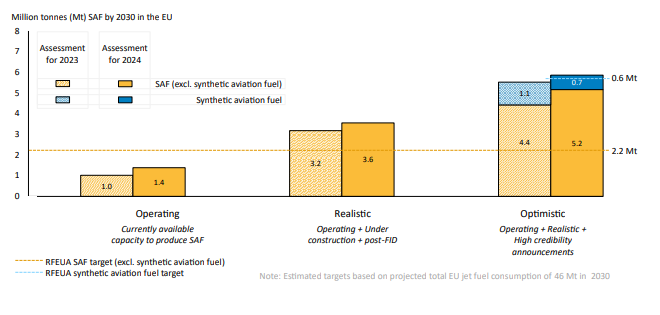
While EU SAF capacities are expected to meet the 2030 minimum SAF shares under RFEUA, synthetic aviation fuel production lags behind. No synthetic fuel facilities have reached final investment decisions, putting the 2030 synthetic target at risk.
In 2024, 69% of SAF feedstock originated from outside the EU, mainly China (38%) and Malaysia (12%), with Finland contributing 10% of domestic supply. Imports remained significant, with 80,000 tonnes—over 40% of total SAF supply—sourced from outside the EU.
SAF Reference Prices
EASA determined 2024 reference prices for SAF and conventional aviation fuels. Aviation biofuels were priced at €2,085 per tonne, while conventional aviation fuel cost €734 per tonne, reflecting the economic challenges of scaling SAF deployment.
The first ReFuelEU report sets a vital baseline for future EU sustainability efforts in aviation. It demonstrates early progress in SAF supply and emissions reduction while highlighting market concentration, dependence on imports, and the need for continued investment in synthetic fuels. As the EU moves toward mandatory 2% SAF use in 2025 and ambitious 2030 and 2035 targets, this initial assessment provides key insights for regulators, operators, and fuel suppliers.






Comentarios
Sé el primero en comentar...