
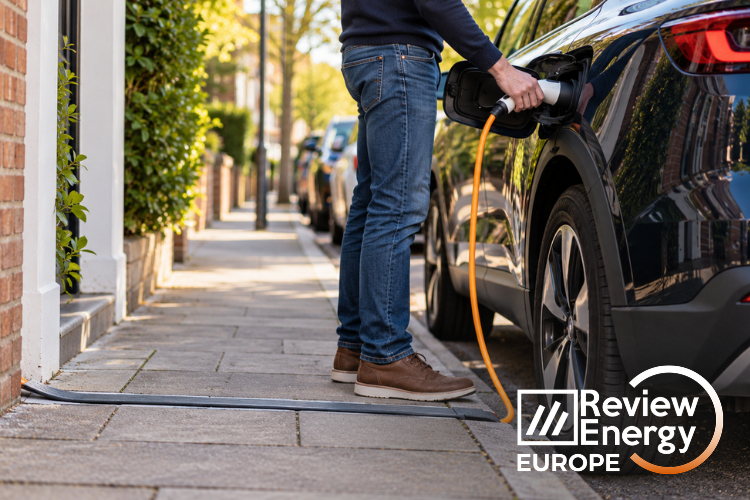


UK removes planning permission for cross-pavement EV chargers, saving drivers up to £300
The UK government has removed planning permission requirements for certain electric vehicle charging installations that cross public pavements, effective from 21 October 2026, in a move aimed at reducing installation costs and improving access to home charging for drivers without private parking.
According to the Department for Transport (DfT), the regulatory change could save drivers up to £300 in installation costs and provide access to domestic electricity tariffs that can bring charging costs down to as little as 2 pence per mile.
The measure applies to cross-pavement charging solutions, which allow electric vehicles parked on public roads to connect to a home's electricity supply through a cable channel installed across the pavement.
The aim is to make home charging more accessible to residents who park on the street, provided that installations meet the applicable requirements and obtain any necessary authorizations from the relevant authorities for work affecting public spaces.
Potential savings of up to £1,750 in vehicle running costs
The Department for Transport estimates that access to domestic electricity tariffs could allow electric vehicle owners to save up to £1,750 in running costs, reducing their reliance on public charging infrastructure, where electricity prices can be higher.
Removing the planning permission requirement is intended to reduce administrative expenses and the time needed to install these systems.
However, the exemption does not mean that drivers can install charging cables across public pavements without restrictions. Installations must comply with applicable technical requirements and, where necessary, obtain authorization from the authority responsible for the highway.
Changes to permitted development rights will also make it quicker and cheaper for charging point operators to install larger, higher-powered public EV charging hubs, simplifying certain planning procedures.
The government is therefore seeking to improve access to both domestic charging and public charging infrastructure.
Electric vehicle sales increased by 36% in September
The announcement comes amid continued growth in electric vehicle sales across the UK.
According to government figures, electric car sales increased by 36% year-on-year in September 2026, with nearly 100,000 electric cars sold during the month.
The government links part of this growth to its Electric Car Grant (ECG) programme, which provides financial support for the purchase of eligible new electric vehicles.
The Department for Transport reports that more than 190,000 drivers have benefited from the scheme, which offers discounts of up to £3,750 on qualifying electric cars.
Buses and Local Transport Minister Simon Lightwood said removing planning requirements would reduce the cost of installing home charging solutions by up to £300.
He also highlighted the 36% annual increase in electric vehicle sales and the number of drivers who have received support through the purchase grant programme.
Further measures proposed for tenants and residents without private parking
Alongside the regulatory change taking effect on 21 October, the UK government has launched two public consultations examining further measures to improve access to electric vehicle charging.
The first consultation focuses on making home charging more accessible to tenants and leaseholders.
The government is considering clearer guidance to help landlords and property managers process charging point installation requests more consistently and efficiently.
It is also examining potential mandatory requirements that would make it harder for landlords and freeholders to refuse installation applications without sufficient justification.
Vicky Edmonds, CEO of EVA England, said removing planning permission requirements could support electric vehicle adoption among households without off-street parking.
According to research conducted by the association, 60% of petrol and diesel drivers without off-street parking say they would never consider purchasing an electric vehicle.
Edmonds noted that enabling drivers to connect vehicles parked on public roads to domestic electricity supplies could help address this barrier, although implementation will also depend on local authorities and landlords.
UK considers charging requirements for new and refurbished covered car parks
The second public consultation examines potential changes to building regulations aimed at expanding electric vehicle charging infrastructure.
Among the proposals are updated requirements for new and refurbished covered car parks, which could require the installation of electric vehicle charging points.
These proposals remain under consultation and are not part of the regulatory changes that entered into force on 21 October.
The consultations will remain open until 16 December 2026, allowing individuals, businesses and organizations to submit feedback on the proposed measures.
Through the removal of certain planning permission requirements and the consideration of additional rules for buildings and residential properties, the UK government aims to reduce electric vehicle charging costs and expand access to charging infrastructure at homes and public locations.






Comentarios
Sé el primero en comentar...