



Italy adds 5.3 GW of renewables in nine months as electricity demand grows 5.2%
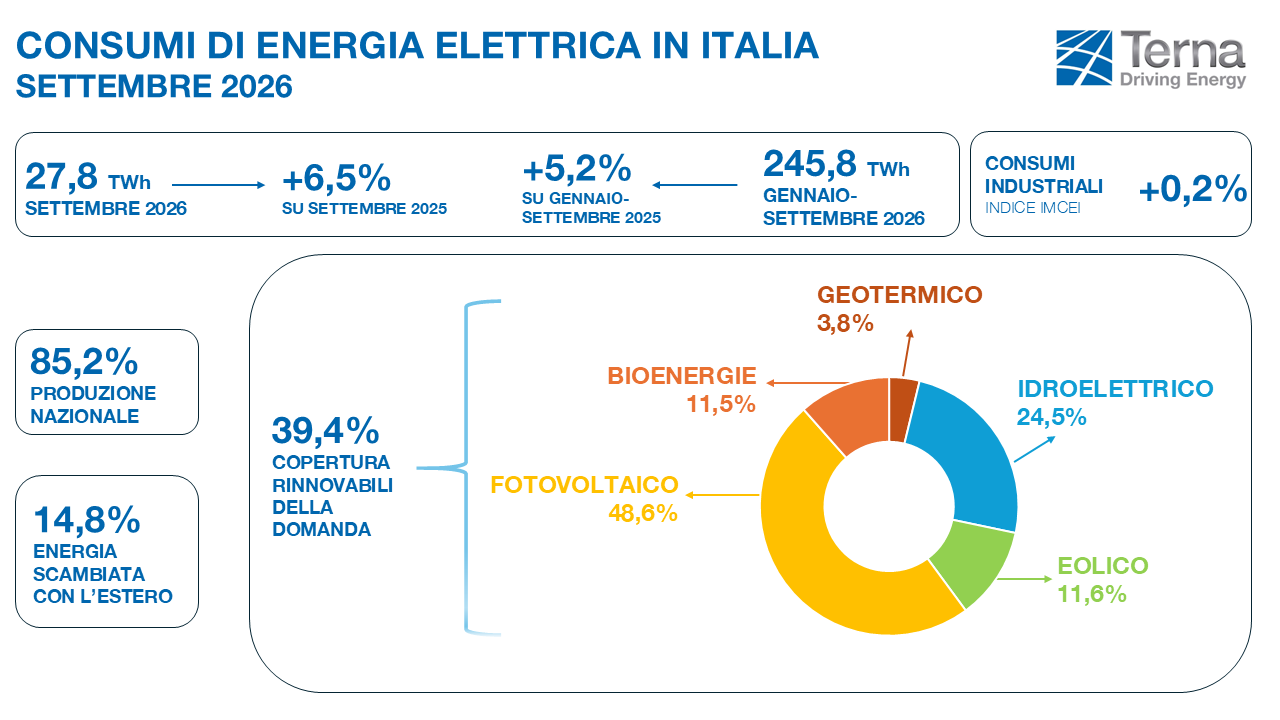
Italy's electricity demand reached 27.8 TWh in September 2026, up 6.5% compared with the same month last year, according to data published by Terna, the country's electricity transmission system operator. This represents the highest electricity consumption recorded for September since 2014 and marks the thirteenth consecutive month of growth in Italian electricity demand.
The increase comes amid continued expansion of renewable electricity generation and new capacity additions. During September, Italy installed 675 MW of additional renewable energy capacity, bringing total installed renewable capacity to 88.8 GW, including 48.3 GW of solar and 14 GW of wind power.
According to Terna, electricity demand was partly influenced by average temperatures approximately 2°C higher than those recorded in September 2025. However, even after adjusting for the temperature effect, electricity demand increased by 4.6% year-on-year.
Electricity demand increases by 5.2% between January and September
During the first nine months of 2026, Italy's electricity demand reached 245.8 TWh, representing a 5.2% increase compared with the same period in 2025, equivalent to approximately 12 TWh of additional consumption.
Growth was recorded across all regions of the country in September, although regional differences emerged. Electricity demand increased by 5.3% in northern Italy, 7.7% in central regions and 8.3% in southern Italy and the islands.
Regarding industrial activity, Terna's IMCEI index, which monitors electricity consumption among approximately 1,000 energy-intensive companies, recorded a year-on-year increase of 0.2% in September.
However, over the January–September period, industrial electricity consumption increased by 3.3%, according to the transmission system operator's measurements.
 Source: Terna
Italy adds 5.3 GW of renewable capacity in nine months
Renewable capacity expansion continued in September, with 675 MW of new installed capacity.
Solar photovoltaic technology accounted for most additions, with 657 MW, followed by wind power with 18 MW. The figures also include smaller additions of hydropower and bioenergy capacity.
With these installations, Italy's cumulative renewable capacity reached 88,792 MW at the end of September, up 9.9% compared with the same month in 2025.
By technology, installed capacity was distributed as follows:
-
Solar photovoltaic: 48,347 MW.
-
Hydropower: 21,350 MW.
-
Wind power: 14,050 MW.
-
Bioenergy: 4,091 MW.
-
Geothermal: 955 MW.
Between January and September 2026, Italy added a total of 5,263 MW of renewable capacity, including 4,834 MW of solar photovoltaic capacity and 421 MW of wind power.
Solar electricity generation increases by 27.1% in September
Electricity generation from renewable sources reached 10.9 TWh in September, covering 39.4% of national electricity demand.
Total renewable generation increased by 0.6% compared with September 2025, although individual technologies recorded different trends.
Solar photovoltaic generation rose by 27.1%, reaching 5.3 TWh, while wind generation increased by 0.8% and bioenergy production grew by approximately 3.3%.
By contrast, hydropower generation declined by 29.2%, while geothermal production fell by 2.6%, limiting overall renewable generation growth.
During the first nine months of the year, renewable electricity generation reached 103.4 TWh, up 1.1% compared with 2025, accounting for 42.1% of Italy's electricity demand.
Over the same period, solar generation increased by 20.5% and wind generation by 7%, while hydropower output declined by 20.2%.
Electrochemical energy storage capacity reaches 20 GWh
Terna's report also provides updated figures on electrochemical energy storage systems installed across the country.
At the end of September 2026, Italy had 20 GWh of electrochemical energy storage capacity and a combined nominal power rating of 8.3 GW.
These figures represent the total installed storage capacity recorded by the transmission system operator. However, the statement does not specify how much capacity was added during September or provide a breakdown of new installations by storage system type.
Energy storage technologies contribute to managing renewable electricity generation and providing flexibility to the power system, particularly as solar and wind penetration increases.
Thermal generation and electricity imports rise to meet demand
In September, domestic electricity production covered 85.2% of Italy's electricity demand, while the remaining 14.8% was supplied through the net balance of electricity exchanges with other countries.
Net domestic electricity generation reached 24 TWh, an increase of 6.5% compared with September 2025, equivalent to approximately 1.5 TWh of additional production.
To meet higher electricity demand, imports increased by 7.7%, while thermal electricity generation also rose.
Terna noted that thermal generation helped meet peak electricity demand, which increased by 14.7% year-on-year, reaching 56.1 GW.
Meanwhile, the services sector electricity consumption index for July, the latest available reading, registered a year-on-year increase of 6.5%, the highest value recorded for that month since measurements began in 2019.
With September's results, Italy has recorded thirteen consecutive months of electricity demand growth, alongside continued renewable capacity additions and expansion of its energy storage infrastructure.
Terna's data show that, despite rising solar generation, lower hydropower output and increasing electricity consumption contributed to greater reliance on thermal generation and imports to meet the country's electricity demand.



Comentarios
Sé el primero en comentar...