



BESS bankability: it starts long before financial close
Battery energy storage is rapidly becoming an essential part of the energy transition. Yet, while technology itself has developed significantly, the financing of Battery Energy Storage System (BESS) projects is still evolving, particularly in markets where storage is relatively new.
In my experience, one of the main challenges is not necessarily the maturity of the technology itself, but the level of understanding of what a BESS project really involves from a financing perspective.
As the European BESS market scales, the next challenge is increasingly important: enabling these assets to access bank financing and project finance structures. A bank is not simply financing a battery. It is financing an asset expected to generate revenues and perform reliably for many years. Therefore, bankability needs to be considered much earlier than financial close.
Bankability should start at the design stage
One of my strongest recommendations to developers is to start discussing financing requirements with lenders while the project is still being designed. Too often, financing is considered after the technology has been selected and the main supply contracts are already substantially negotiated. By then, changing certain contractual or technical conditions can be difficult and expensive.
The project should begin with a robust financial model and a clear understanding of the expected return on investment and revenue structure. At this stage, developers should already be engaging not only with potential lenders, but also with financial and technical advisers and key technology partners. Understanding what lenders will require can influence technology selection, contractual structures, guarantees, operating strategy and even project design. In other words, bankability should be designed into the project rather than tested at the end of it.
Revenue certainty remains fundamental
A technically excellent BESS project without a credible revenue model will remain difficult to finance. This is one of the major differences between storage markets today.
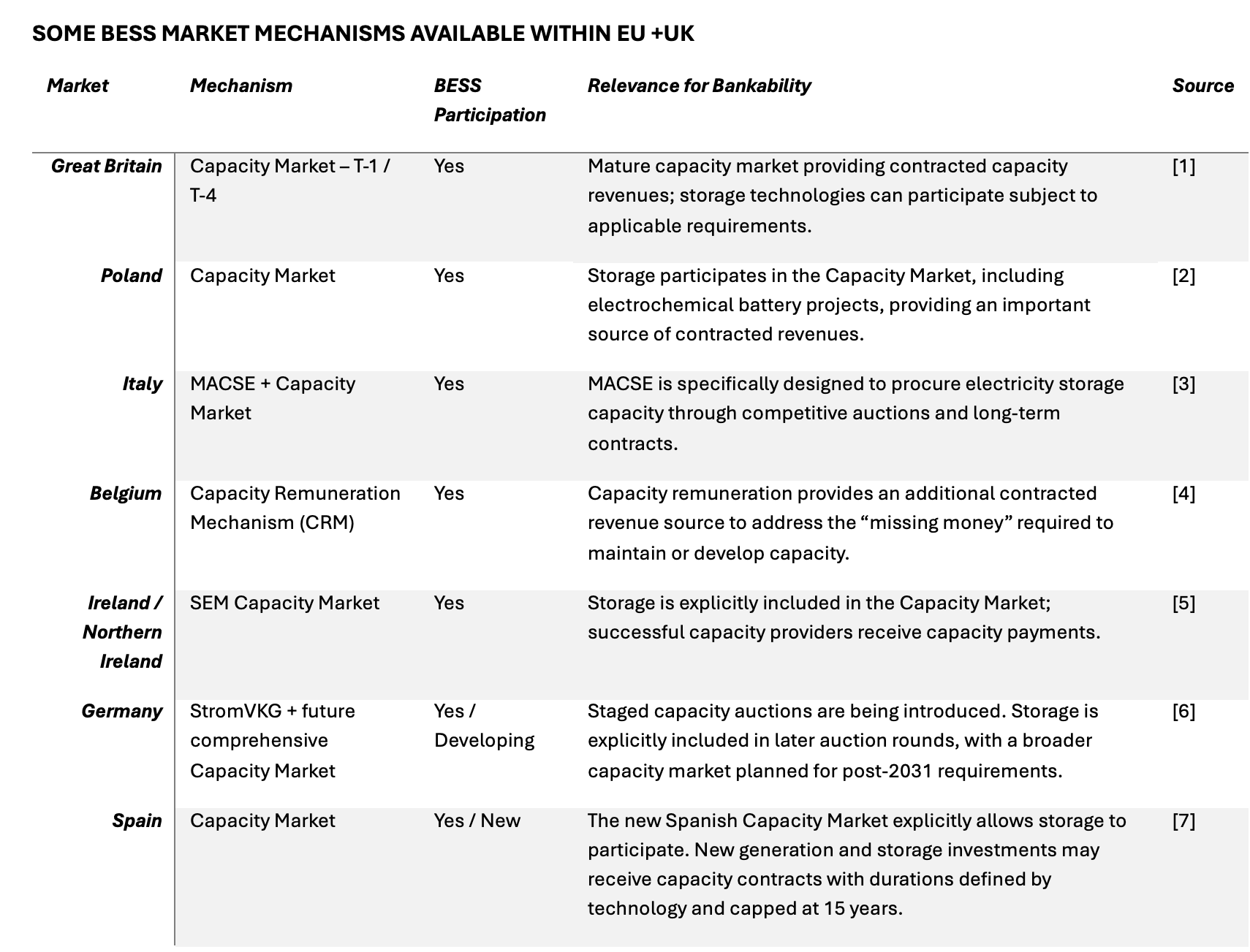
There is already considerable experience in more mature European storage markets, particularly in Great Britain, Poland, Belgium and Italy, where capacity mechanisms or dedicated storage procurement schemes provide BESS projects with access to contracted revenue streams. Italy's MACSE, for example, represents a particularly interesting development as a mechanism specifically designed to procure electricity storage capacity.
Other markets, including Spain, are now developing their own capacity mechanisms and moving towards a framework in which storage can increasingly access long-term contracted revenues.
Where this type of framework is not available, developers need to build credible alternatives. Depending on the market, these may include tolling or swap agreements (including revenue-floor structures), PPAs or other offtake arrangements designed to reduce merchant exposure and provide greater revenue certainty.
Batteries have the advantage of being able to access multiple revenue streams, but flexibility should not be confused with certainty. From a lender's perspective, the question is not simply how many markets a battery can participate in, but how predictable those revenues are throughout the financing period.
There is also an important connection between revenue and technology: the operating profile assumed by the financial model must remain compatible with the technical capabilities and warranty conditions of the BESS.
The bankability of the supplier matters too
Technology selection is obviously important, but lenders look beyond technical specifications. They need confidence in the company standing behind the technology. Supplier financial strength, manufacturing capability, track record, supply-chain resilience and the ability to provide long-term technical support all become part of the risk assessment.
The same applies to the complete system architecture. Batteries, PCS, EMS and other critical components need to comply with applicable technical requirements, certifications and grid codes. Traceability of materials and components, quality control, manufacturing procedures and regulatory project documentation are increasingly relevant parts of technical due diligence.
For an asset expected to operate for 15 or 20 years, the question is therefore not simply whether the technology performs today. The lender also needs confidence that the supplier and service structure can support that performance over time.
Ultimately, bankability becomes contractual
This is perhaps one of the areas that is sometimes underestimated. When lenders and their advisers analyse a BESS project, many technical and financial assumptions eventually need to be translated into contractual protections. Payment milestones, Advance Payment Bonds, Performance Bonds, Warranty Bonds, letters of credit and their corresponding wording can all be subject to review.
The lender will want to understand what protects the investment from the first payment through delivery, commissioning and long-term operation. This extends to delivery obligations, transfer of title and risk, delay liquidated damages, performance liquidated damages, acceptance procedures, commissioning requirements, warranties, liability limits and available remedies.
The objective is not to eliminate every project risk; that would be impossible, but to understand who carries each risk and what happens if the underlying assumptions are not achieved.
Performance guarantees must match the financial model
Degradation is a good example of where technical, commercial and financial assumptions meet. A financial model may assume a certain available capacity or energy throughput over 10, 15 or 20 years. The lender therefore needs confidence that these assumptions are technically realistic and appropriately supported. Performance warranties should consequently be assessed alongside expected cycling, depth of discharge, C-rate, temperature conditions, state of charge and the degradation curve.
Availability is equally important. An attractive availability percentage in a contract means little unless there is an operational structure capable of supporting it. Response times, preventive maintenance, spare-parts availability, remote monitoring and local service capabilities all contribute to whether the asset can actually achieve its expected availability. Long-term service or technical service agreements can consequently become an important component of the financing structure.
The financial model, performance guarantees and operational strategy should ultimately tell the same story.
Bankability goes beyond financial and technical performance
Another important aspect is that lenders' due diligence increasingly extends beyond technology and revenues. Projects and suppliers may be required to demonstrate compliance with anti-bribery and anti-corruption policies, environmental and social requirements, quality assurance and control procedures, and health and safety standards. However, material and component traceability, risk-management procedures, manufacturing controls and regulatory documentation may also form part of the assessment.
These requirements should not be treated as administrative items to address immediately before financial close. They increasingly form part of the overall risk framework against which a project and its contractual structure are evaluated.
Bankability is a lifecycle concept
Ultimately, I believe we need to stop thinking about BESS bankability as something achieved when a bank approves financing. Financial close is only the beginning. A BESS project may operate, for instance, 15 or 20 years. During that period, the battery will degrade, components may need replacement, markets will evolve and operating strategies may change.
True bankability therefore comes from aligning the financial model, revenue strategy, technology, supplier, performance guarantees, contractual protections and long-term service strategy from the beginning.
My main recommendation to developers is therefore simple: “do not wait until procurement or financial close to start discussing bankability with lenders.” Bring banks, technical advisers, financial advisers and key technology partners into the conversation while the project is still being designed. Because ultimately, a bankable BESS project is not simply a battery with strong technical specifications. It is a project where the risks are understood, allocated and managed and where the technical, contractual and financial assumptions remain aligned throughout the lifetime of the asset.






Comentarios
Sé el primero en comentar...