


AI, storage and policy shifts: what RatedPower’s Pulse 2025 revealed about the future of energy
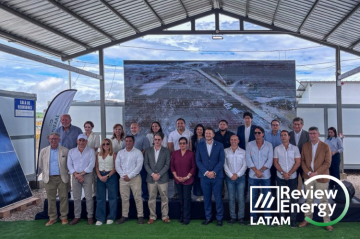
Nearly 200 renewable energy professionals gathered at the Official College of Architects of Madrid for Pulse 2025, the annual flagship event hosted by RatedPower. Over two days filled with insights, innovation, and debate, industry leaders, engineers, technologists, and analysts tackled the key challenges and opportunities shaping the global energy transition.
The opening message set the tone: "The energy future cannot be built in isolation". Colin Westmoreland, Chief Innovation Officer at Enverus, led the inaugural session, titled "Powering the Global Quality of Life Together." Through compelling data and a global perspective, Westmoreland emphasized the urgent need for collective, innovative solutions to create a cleaner and more equitable energy system.
He also highlighted the crucial role of technologies like artificial intelligence and data analytics in optimizing energy use and improving global well-being. According to shared projections, AI could account for 10% of global electricity consumption by 2030—underlining the importance of integrating it as part of the solution.
Energy Storage: A pillar of renewable stability
One of the most anticipated panels, “Unlocking the Potential of Energy Storage: The Key to Renewable Stability,” featured industry voices including Diego Laffon (Alten Energy), Ghada Alafranji (RatedPower), Elena Marabini (Alantra), and Kim Keats (K4K).
Diego Laffon highlighted the technical and logistical complexity behind storage projects—from site selection to modeling charging and discharging patterns.
“One of the most important targets we think about when we try to install storage is to prevent containment (...) we probably need to get advice by a good advisor like my fellow colleagues and try to analyze that part before starting the project,” he advised.
He also called for stronger public planning to direct development toward high-demand zones, avoiding grid congestion and underused capacity.
Elena Marabini added: “More market participants will come to play, and the role of applicators here will become crucial (...) policies need to allow for the adoption on a large scale, and also to support financially this type of technologies.”
From an investor’s lens, Kim Keats remarked: “The question is what policies need to be implemented for us to make an advance on the deployment of additional VAERS, whilst the situation is actually not very favourable from an investment perspective.” He also addressed the lack of capacity markets and fast frequency response systems in Spain—commonplace in other European nations.
Solar module volatility and supply chain resilience
Another highlight came from Cris Vincent Alidon, VP of Engineering at Aboitiz, who led a discussion on the fragility of the solar supply chain amid rising price volatility. His team faced cost surges of up to 40% during project execution—pushing them to adopt security mechanisms like performance bonds and stand-by letters of credit.
“What we have imposed on the manufacturers is a performance ratio guarantee that’s backed by a warranty bond of about 10%,” he explained, referencing safeguards put in place to ensure panel output meets expectations.
The opening of the second day of Pulse 2025 was led by Juan Romero, co-founder of RatedPower, who shared an economic analysis on the most efficient renewable energy combinations. According to Romero, the integration of solar, wind, and storage proves to be more effective than just solar and wind. Additionally, in an environment of fluctuating electricity prices, he emphasized the importance of understanding both the financial and technical benefits of these configurations to optimize energy resources.
AI and Data: Smarter tools for smarter systems
The second day was also focused on the intersection of AI, big data, and renewable infrastructure. In the panel “AI and Big Data: Optimizing the Renewable Power Landscape,” experts discussed how new technologies are reshaping system planning and operations.
José Franquelo from Isotrol, summed it up simply: “You need a battery for a more sustainable system, but you need artificial intelligence to manage that.” However, he warned that not all AI is effective—solutions must respond to real-world operational needs, not just theoretical models.
Ángela del Carmen Fuentes, CEO of Imageryst, echoed that sentiment, emphasizing real-time data: “Having information that is not the one that we need to use for the current situation (...) doesn’t make sense and the result is not going to be useful actually for the companies and for the industry.”
For his part, Florian Strunck, COO and co-founder of Amperecloud, offered a technical look at predictive systems: “We believe that this will be a significant step towards, one day really, having predictive maintenance solutions in place.”
The road ahead: Opportunity meets uncertainty
The event concluded with a panel titled “Market Drivers in 2025 and Beyond: Demand and Energy Evolution,” led by Bernadette Johnson, General Manager of Energy and Renewables at Enverus. Her message was cautiously optimistic: the energy future holds promise—but is far from guaranteed.
Referencing IEA data, she revealed that 80% of countries are expected to miss their 2030 renewable targets. Only 17 are on track, with 10 just within reach, while over 50 will fall short by wide margins. Despite that, renewable deployment continues at pace—the expansion is real, if uneven.
The conversation circled back to surging electricity demand, fueled largely by AI and data center growth. As noted earlier in the event, tools like ChatGPT are already reshaping energy consumption patterns, particularly in Big Tech regions.
Johnson warned that grid modernization must catch up with new generation realities: distributed, intermittent, and decentralized power flows. Yet, grid reform remains one of the sector’s most stubborn challenges.
Politics, policy, and the “Trump Effect”
Before saying goodbye to Pulse 2025, the conversation took a more geopolitical turn—as the “Trump effect” gained analytical weight during the final moments of the event. Johnson pointed out that political uncertainty in the United States is not only shaping national energy policies but also influencing global investment strategies.
Some companies are already relocating operations to Europe in anticipation of possible policy reversals. The specter of a less climate-committed U.S. administration has introduced new questions about the pace and consistency of the global energy transition.
“The road ahead is promising but uncertain”, Johnson concluded. From price volatility and rising demand to shifting political winds, the coming years will test the sector’s ability to stay on course—and to adapt at speed.




Comentarios
Sé el primero en comentar...