


China’s clean energy expansion starts to displace fossil fuels across the economy
China’s clean electricity expansion is beginning to replace fossil fuel use across an increasing share of the economy, as coal generation has stopped growing in 17 of the country’s 26 provinces and regions and fossil fuel use has passed its peak in eight of 11 industrial sectors, according to a new analysis by global energy think tank Ember.
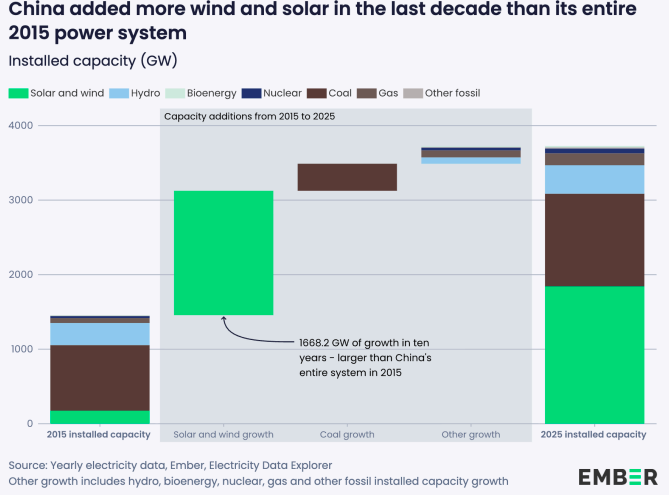
The findings point to a shift in China’s energy transition. After a decade in which the country built clean power alongside a growing fossil fuel system, Ember argues that China has now entered a more challenging phase in which clean energy is increasingly displacing existing fossil fuel demand.
China has described its previous approach as “building before breaking”. The new analysis suggests the country is now moving towards “building while breaking”, requiring the decline of the existing fossil fuel system to be managed while clean energy continues to expand.
Coal generation falls despite rising electricity demand
The power sector is where this transition is most visible. Thermal power generation, most of which comes from coal, fell 0.7% in 2025 even as electricity demand increased by 5%.
Coal generation has declined before, but the last comparable fall came in 2015, when electricity demand grew by only 0.5%. Ember argues that the combination of falling thermal generation and strong demand growth in 2025 is significant because it indicates that clean electricity is expanding quickly enough to meet new demand while also replacing some coal generation.
The trend also appears to extend beyond a single year. Coal generation has remained flat on a 12-month rolling average since early 2024.
The 17 provinces and regions where coal generation has stopped growing include established industrial centres such as Shandong and Hunan. Together, these regions account for more than half of China’s thermal power capacity.
Batteries are taking on a larger flexibility role
The shift is also affecting the role traditionally played by fossil fuel generation in balancing the power system.
Battery storage overtook pumped hydro in installed capacity at the end of 2024 and expanded by a further 84% in 2025. At the same time, the average utilisation of China’s storage fleet roughly doubled between 2022 and 2025, indicating that the batteries are increasingly being dispatched rather than simply being added to the system.
Ember describes this as part of a broader expansion in the strength and scope of China’s clean electricity system, while the fossil fuel system is beginning to register the effects of that growth.
Electrification spreads across industry
The transition is not limited to power generation. Ember’s analysis finds that fossil fuel use has already passed its peak in eight of the 11 industrial sectors tracked, with most of those peaks occurring since 2018.
The declines include a 26% reduction in fossil fuel use in food and beverages, 52% in transport equipment and 71% in fossil fuel extraction.
Electrification is driving much of the change. In light manufacturing sectors such as machinery, electronics and textiles, electricity now supplies around three-quarters of final energy consumption. The shift is also reaching more energy-intensive sectors, including metals smelting and non-metallic minerals.
Electric vehicles reduce oil demand
Transport is another area where electrification is reducing the role of fossil fuels.
Electric passenger vehicles accounted for 67% of new car sales in June 2026. Electric truck sales more than doubled in both 2024 and 2025, reaching 26% of new truck sales in 2025.
China accounted for nine out of every ten electric trucks sold globally in 2025.
The growth of electric vehicles is also having implications for oil demand and energy security. China imports more than 70% of its oil and has the largest absolute exposure to the Strait of Hormuz.
According to Ember, China’s EV fleet displaced an estimated 0.4 million barrels per day of gasoline demand in 2024, up from around 0.1 million barrels per day in 2020. Total avoided oil demand reached at least 1 million barrels per day.
Ember compares the scale of this avoided demand with strategic oil reserves in OECD Europe, which stood at 179 million barrels at the end of 2025. The analysis argues that while reserves and diversified suppliers can help cushion a supply shock, structurally reducing oil demand can reduce exposure to such shocks at their source.
Fossil fuel decline is not a sign of deindustrialisation
The decline in fossil fuel use is taking place alongside continued industrial development, according to Ember.
Industrial value added per person in China continues to rise, while fossil fuel use per person has been declining since peaking in the early 2010s. This suggests that the reduction in fossil fuel use is linked to electrification rather than a shrinking industrial base.
The report contrasts this with the UK, Japan and Germany, where industrial fossil fuel use per person has also declined but industrial value added per person has remained broadly flat.
Electricity accounted for 29% of China’s final energy consumption in 2024, up from 22% in 2015. This compares with around 23% in Europe and 21% in the US.
China’s transition could reshape global fossil fuel demand
The development has implications beyond China, which has been a major driver of global fossil fuel demand.
Between 2000 and 2025, China accounted for roughly half of the global increase in oil demand and more than 90% of the growth in coal demand. Ember argues that this growth has underpinned many expectations about future fossil fuel demand.
China’s latest Five-Year Energy Plan expects oil and coal consumption to peak by 2030, while targeting an electrification rate of 35% of energy consumption.
The trends identified across provinces and industrial sectors suggest that these peaks could increasingly be driven by changes within the energy system itself, rather than only by government targets.
Clean technology exports expand
China is also increasingly exporting the technologies associated with its energy transition.
Clean technology exports exceeded $220 billion in 2025 and represented 6.6% of all Chinese exports in the first half of 2026, up from 2.7% in 2020.
This means countries that previously supplied China with fossil fuels are increasingly buying Chinese equipment that can help replace fossil fuel consumption, including electric vehicles, batteries and solar panels.
For other economies beginning their own energy transitions, Ember argues that China’s experience offers lessons about the pace and sequencing of the shift. Building clean electricity capacity quickly enough to begin replacing fossil fuel use, while preparing for the economic pressures that accompany a declining fossil fuel system, will become increasingly important.
The implications are particularly significant for economies whose public finances and development plans depend on fossil fuel export revenues. A peak in Chinese demand could challenge the assumption underpinning long-term fossil fuel investment that demand will continue to rise.
Ember’s analysis therefore frames China’s transition as moving beyond the phase of simply adding clean energy to a growing energy system. The key question is increasingly whether clean electricity can continue expanding quickly enough to displace fossil fuels across power generation, industry and transport while the country manages the consequences of that decline.



Comentarios
Sé el primero en comentar...