


Congress passes ‘Big, Beautiful Bill’: what it means for clean energy in the U.S.
The United States Congress has passed President Donald Trump’s “Big, Beautiful Bill,” which now awaits his signature. The legislation introduces broad changes to federal energy and tax policies, with significant impacts on clean energy incentives and fossil fuel development.
Termination of clean energy tax credits
The bill terminates several federal tax credits that support clean energy technologies. These include credits for previously-owned and new clean vehicles, qualified commercial clean vehicles, and alternative fuel refueling infrastructure. It also ends the energy efficient home improvement, residential clean energy, and new energy efficient home construction tax credits.
Clean electricity production and investment tax credits are set to expire earlier than under existing law, with limited exceptions for certain advanced nuclear facilities. The clean hydrogen production tax credit is eliminated, and accelerated phaseouts apply to the advanced manufacturing production tax credit and the energy investment tax credit for geothermal facilities. Several of these credits are disallowed for certain foreign entities and related taxpayers.
Expansion of fossil fuel leasing and development on federal lands
The legislation directs the U.S. Department of the Interior to immediately resume quarterly onshore oil and gas lease sales and reinstates noncompetitive leasing for lands without competitive bids. It lowers royalty rates for oil, gas, and coal extraction on federal lands and expedites permitting for natural gas projects, including pipelines from Alaska.
Specifically, the bill mandates at least four lease sales in the Arctic National Wildlife Refuge (ANWR) within seven years, with revenue sharing between Alaska and the federal government. Offshore oil and gas lease sales are required in the Gulf of Mexico and the Cook Inlet Planning Area in Alaska, alongside an increase in revenue distribution caps under the Gulf of Mexico Energy Security Act.
In coal leasing, the Interior Department must complete environmental reviews and conduct lease sales promptly, make additional federal coal resources available in western states, and nullify a previous leasing moratorium. The bill temporarily lowers coal royalty rates and authorizes mining of federal coal reserves under an existing lease in Montana.
The bill modifies the National Environmental Policy Act (NEPA) review process by allowing applicants to pay fees to expedite environmental assessments or impact statements and removing judicial review of their adequacy. It rescinds funding for the Council on Environmental Quality’s environmental data collection and community mapping efforts.
Funding is also rescinded for energy efficiency training programs, tribal energy loan guarantees, and coastal and marine conservation managed by the National Oceanic and Atmospheric Administration (NOAA). Programs protecting old-growth forests and certain conservation projects of the National Park Service and the Bureau of Land Management (BLM) lose funding as well.
The bill requires the U.S. Forest Service and Bureau of Land Management to enter long-term contracts with private entities to increase timber harvesting by at least 25% over recent volumes, according to applicable forest plans.
On taxation, the bill raises the federal cap on state and local tax (SALT) deductions to $40,400 for individuals ($20,200 for married filing separately), with phased reductions for high-income taxpayers. It disallows SALT deductions for most foreign real property taxes and limits deductions for certain payments generating specific tax benefits.
Renewable industry response
Abigail Ross Hopper, president and CEO of the Solar Energy Industries Association (SEIA), described the bill as “a significant step backwards for our nation’s energy economy at a time when we can least afford it.” She emphasized that the bill jeopardizes a growing manufacturing boom, with new solar and battery storage factories opening nationwide and creating thousands of jobs. Hopper warned that many of these facilities “will be forced to shut down and lay off thousands of workers,” which she said would undermine rural communities and hand “an untimely and strategic victory to China.”
Hopper also noted the challenges posed by rising energy costs and global instability, underscoring that solar and storage remain “America’s best bet to lower energy costs, build long-term energy resilience, and break free from the grip of foreign energy dependence.” She expressed particular concern for the residential solar sector, highlighting the “total disregard for the thousands of small businesses… that were given only months to reinvent themselves.” Despite these setbacks, Hopper vowed that SEIA will “keep fighting every day for smart, stable, business-friendly policies” that support American energy independence.
Jason Grumet, CEO of the American Clean Power Association (ACP), called the bill “a dramatic swing in federal policy” that disrupts investments by American companies and “raises prices for American businesses and families.” He warned that the legislation could challenge the reliability of the existing electric grid by restricting energy production.
Nonetheless, Grumet pointed to the strong underlying demand for clean energy, noting that “America’s electricity demand is projected to surge by as much as 50% by 2040.” He stressed that clean power technologies, including solar, wind, and battery storage, “are the only shovel-ready sources of additional power and the low-cost option across much of the nation.” Grumet concluded with a call for cooperation, urging that “it is time for the brawlers to get out of the way and let the builders get back to work.”
Industry leaders’ statements reflect concerns that while the bill meets broader political and fiscal aims, it risks slowing progress in the renewable energy sector at a crucial moment. They argue that the legislation threatens America’s leadership in clean energy innovation, job creation, and climate resilience, even as market forces continue to drive demand for renewable power.
The following table, created by national professional services firm Novogradac, compares the timelines outlined in current law, the bill passed by the House of Representatives, and the final version passed by Congress.
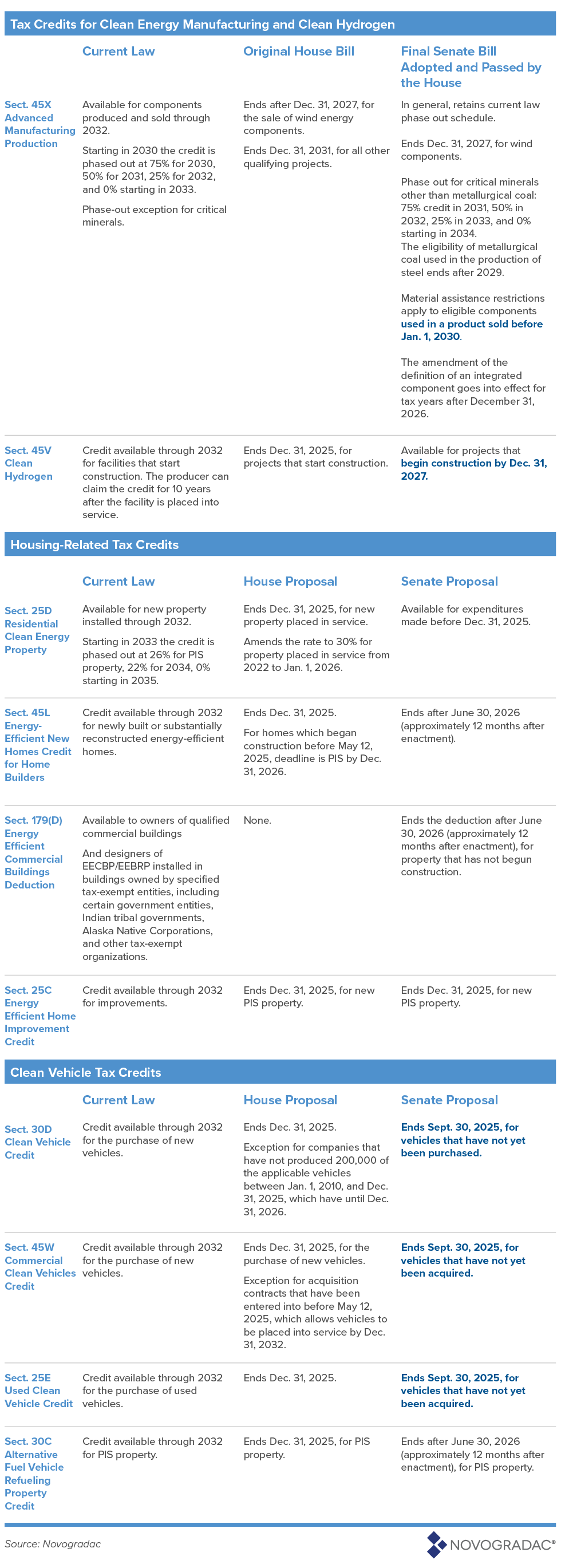 Source: Novogradac



Comentarios
Sé el primero en comentar...