


Germany installs nearly 13 GW of new solar and wind capacity through July 2026
Germany continued to expand its renewable energy fleet during the first seven months of 2026, adding 9,380.6 MW of net solar capacity, 2,262.7 MW of onshore wind and 1,193.7 MW of offshore wind, according to the latest figures from the Market Master Data Register (Marktstammdatenregister, MaStR) of the Federal Network Agency (BNetzA).
Combined, the three technologies added around 12.84 GW of net new capacity between January and July. Biomass, meanwhile, recorded a net increase of 29.5 MW over the same period.
The statistics, based on data evaluated as of August 13, 2026, include registrations through July. BNetzA notes that figures for the most recent months may still change because generating units have one month after commissioning to register in the MaStR.
Solar capacity exceeds 127 GW
Solar remained the main driver of renewable capacity additions. At the end of July, Germany had 127,383 MW of installed solar capacity, up from 118,002 MW at the end of 2025. The country had more than 6.22 million registered solar generating units.
For July alone, BNetzA estimates net solar additions of 1,827.9 MW. This figure includes 1,586.9 MW already registered by August 13 and an additional estimated 241 MW expected to be reported during the one-month registration period.
Germany’s solar target under the Renewable Energy Sources Act is 215 GW by 2030. The regulator’s chart indicates that the current monthly expansion rate remains broadly close to the pace required to meet that target.
Onshore wind reaches 70.4 GW
Germany’s installed onshore wind capacity reached 70,368 MW at the end of July, compared with 68,105 MW at the end of 2025. BNetzA counted 30,445 onshore wind units in operation.
Net additions between January and July amounted to 2,262.7 MW, while July alone contributed 327.7 MW.
Germany has set a target of 115 GW of onshore wind by 2030, meaning the country still needs to add roughly 44.6 GW from the level recorded in July 2026.
More than 11 GW of onshore wind approved in seven months
One of the most notable figures in the report concerns projects that have received permits but have not yet entered operation.
Between January and July 2026, authorities approved 1,714 onshore wind units representing 11,159.6 MW of capacity that remain outside operation.
The figure follows the sharp increase in approvals seen in recent years. A total of 21,026 MW of onshore wind capacity received permits in 2025, compared with 15,252.2 MW in 2024 and 7,686.7 MW in 2023.
Among the federal states, Lower Saxony (Niedersachsen) accounted for 2,505.2 MW of approvals in the first seven months of 2026, followed by North Rhine-Westphalia (Nordrhein-Westfalen) with 2,043 MW and Brandenburg with 1,426.7 MW.
Offshore wind surpasses 10.9 GW
Germany’s offshore wind fleet reached 10,927 MW in July 2026, distributed across 1,770 generating units. At the end of 2025, installed capacity stood at 9,733 MW, representing an increase of almost 1.2 GW in seven months.
Most of the growth was concentrated in Germany’s Exclusive Economic Zone, where 1,193.7 MW of net offshore wind capacity was added between January and July.
Germany is targeting 30 GW of offshore wind capacity by 2030 under the Offshore Wind Energy Act (WindSeeG), leaving around 19 GW to be added from the capacity registered in July 2026.
Bavaria leads regional renewable additions
By federal state, Bavaria (Bayern) recorded the largest increase in renewable capacity between January and July, driven primarily by 2,153 MW of new solar installations.
In solar, Bavaria was followed by Baden-Württemberg with 1,149.2 MW and North Rhine-Westphalia with 1,098.6 MW. For onshore wind, North Rhine-Westphalia added 540.7 MW net, Lower Saxony 462.1 MW and Schleswig-Holstein 392.6 MW.
In terms of total installed capacity across the technologies covered by the report, Bavaria ranked first with around 38.6 GW, followed by Lower Saxony with 27.9 GW and North Rhine-Westphalia with 26.3 GW.
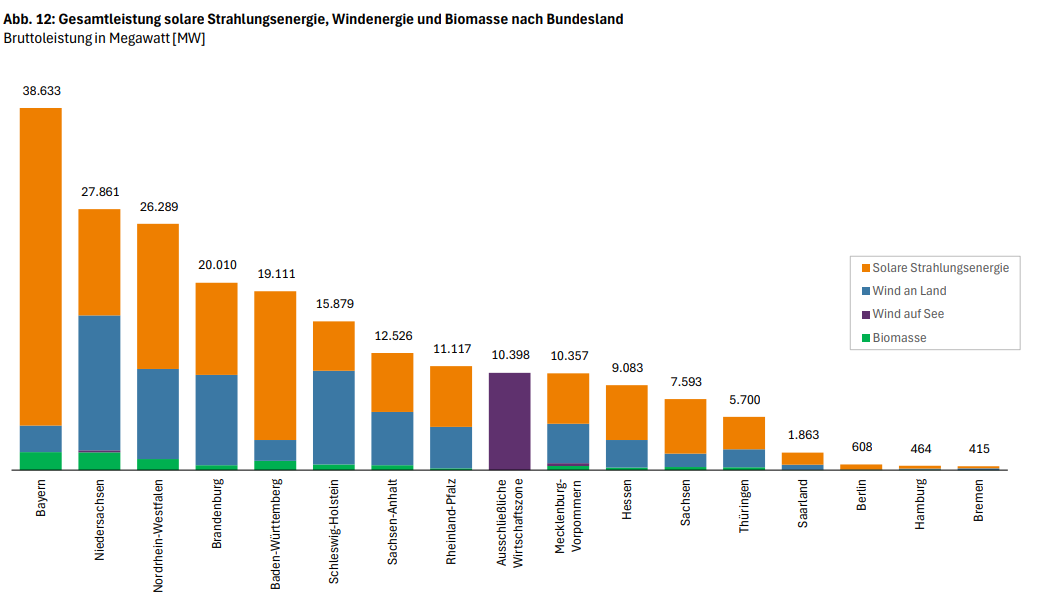 Source: BNetzA
The BNetzA figures show that solar continues to provide the bulk of Germany’s new renewable capacity, while the growing pipeline of permitted onshore wind projects could support a faster build-out over the coming years as the country works toward its 2030 targets.


Comentarios
Sé el primero en comentar...