


Italy's solar output jumps 19.2% in H1 while renewable capacity grows by 3.5 GW
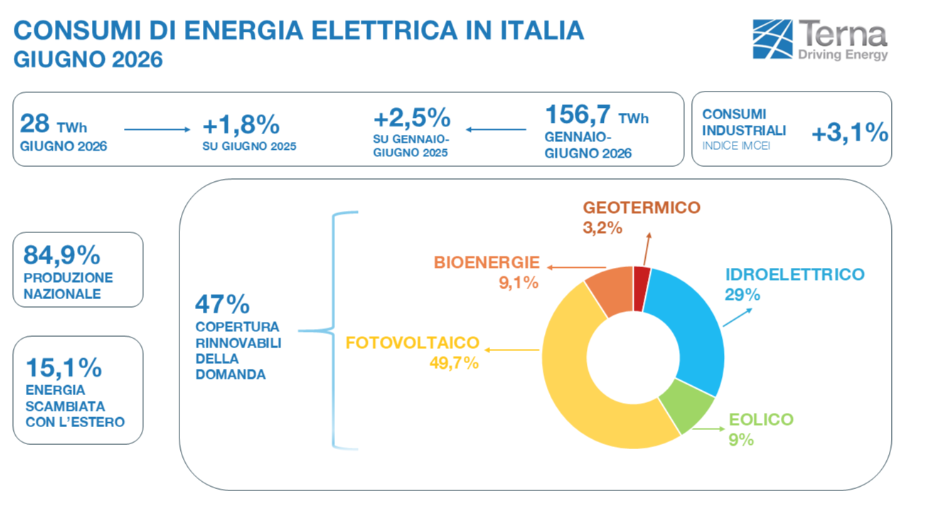
Italy’s electricity demand increased by 1.8% year on year in June 2026, reaching 28 TWh, the highest June figure recorded in the past decade, according to data published by national grid operator Terna.
The country recorded its tenth consecutive month of electricity demand growth, despite the comparison with June 2025, when consumption had already risen by 7.5%.
After adjusting for calendar and temperature effects, demand increased by 2.9% year on year. Considering only the impact of temperatures, the rise would have reached 3.5%. On a month-on-month basis, seasonally adjusted electricity demand grew by 1%.
Demand increased across the country, rising by 1.6% in northern Italy, 1.8% in central regions and 2.1% in the south and the islands.
The power system also recorded a demand peak of 57.4 GW on June 29, up 3.6% from the previous year and the highest monthly figure on record, driven by high temperatures during the final part of the month.
 Source: Terna
Industrial electricity consumption rises 3.1%
Industrial electricity consumption increased by 3.1% year on year in June, according to Terna’s IMCEI index, which monitors the consumption of around 1,000 energy-intensive companies.
This segment also recorded its tenth consecutive month of growth. The steel, ceramics and glass, paper and transport equipment industries posted higher consumption. By contrast, demand declined in the chemical, mechanical engineering, food, non-ferrous metals, and cement, lime and gypsum sectors.
During the first half of 2026, industrial electricity consumption increased by 4.3% compared with the same period of 2025, primarily driven by the steel and non-ferrous metals industries.
Electricity consumption in the services sector, meanwhile, rose by 0.3% in April and accumulated growth of 1.1% between January and April, supported by hotels, restaurants, and information and communication activities.
Solar generation exceeds 6.5 TWh
Solar generation surpassed 6.5 TWh in June, an increase of 15.7% from the same month of 2025, making it Italy’s largest renewable electricity source during the month.
According to Terna, the 888 GWh increase in solar output was mainly driven by newly installed capacity, which contributed an additional 954 GWh and offset a 66 GWh decline caused by less favourable solar irradiation.
Renewables covered 47% of Italy’s electricity demand, down from 49.5% in June 2025. The decline was primarily linked to a 23.7% drop in hydropower output.
Wind generation fell by 3.2%, bioenergy by 8.4% and geothermal production by 2.1%. Thermal generation, meanwhile, increased by 8% to compensate for lower output from intermittent sources and cover the month’s demand peaks.
Italy adds around 3.5 GW of renewable capacity
During the first half of 2026, Italy’s solar generation increased by 19.2%, while wind output rose by 16.4% compared with the same period of 2025. Overall renewable generation grew by 1.4%, constrained by lower hydropower production.
Italy added around 3.5 GW of renewable capacity between January and June, including approximately 3.1 GW of solar installations.
In June alone, renewable capacity increased by 533 MW, including 171 MW of solar and wind facilities connected to the high-voltage network.
At the end of the first half, Italy had 86.95 GW of installed renewable capacity, including 46.61 GW of solar and 13.96 GW of wind power.
The country also had 943,798 energy storage systems, representing 19.34 GWh of capacity and **7.99 GW of nominal power.
Domestic generation supplied 84.9% of Italy’s electricity demand in June, with the remaining 15.1% covered by net electricity exchanges with other countries. Net domestic generation reached 24.2 TWh, up 2.6% year on year.


Comentarios
Sé el primero en comentar...