


Poland's strategies: Combining CfDs and PPAs to maximize profitability in renewable energy
Poland is entering a pivotal phase in its energy transition, with an additional 26GW of renewable energy capacity expected to join its power system by 2030. According to Aurora Energy Research's report “The Future of PPAs in Poland,” this expansion, set to raise the total renewable capacity to 54GW, is part of the Polish government’s updated National Energy and Climate Plan (NECP). The ambitious "With Additional Measures" (WAM) scenario, which supplements the base "With Existing Measures" (WEM) plan, aligns closely with the EU’s Fit for 55 initiatives. This alignment reflects Poland’s commitment to cutting emissions and accelerating the deployment of renewables across the country.
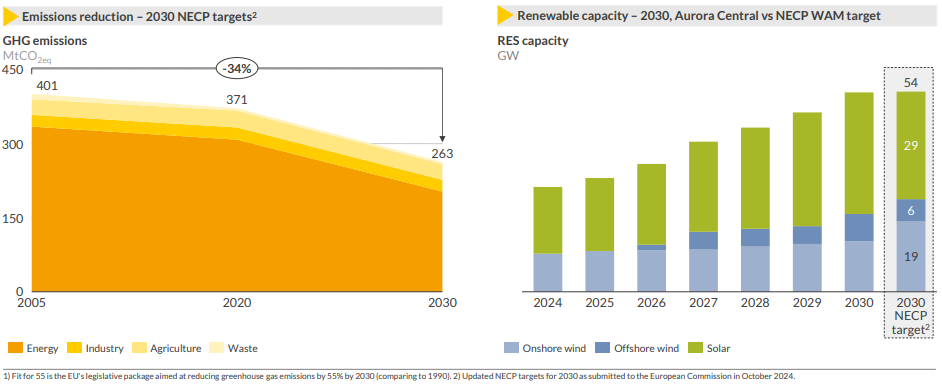
Sources: Aurora Energy Research, revised NECP (Oct ’24)
The evolving polish PPA market
The report also notes that, the Power Purchase Agreement (PPA) market in Poland is undergoing profound changes, influenced by shifting regulations and increasing demand for renewable energy. Over the past two years, the rapid growth of solar PV projects has catalyzed this market, resulting in the signing of 1.5GW worth of PPAs. Currently, solar dominates the PPA landscape with long-term, fixed-price contracts, while onshore wind faces significant delays due to stringent permitting processes and the restrictive 700-meter rule. However, these dynamics are expected to shift dramatically with regulatory reforms in the near future.
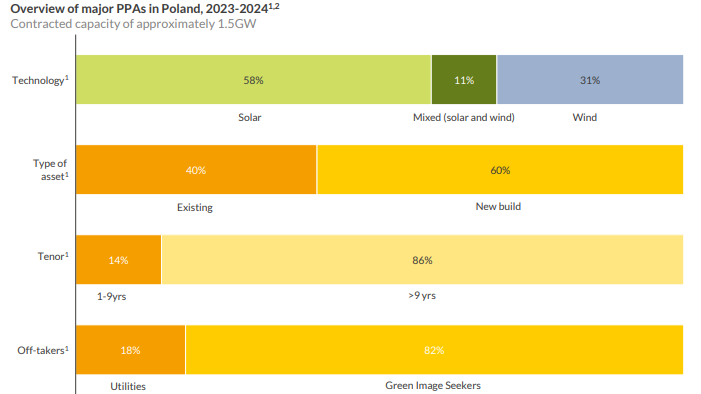 Source: Aurora Energy Research
Key regulatory changes coming in 2025
Starting January 1, 2025, Poland will implement critical regulatory adjustments to address barriers hindering onshore wind development. These changes include:
- Relaxation of distance rules: The removal of the 700-meter rule will unlock opportunities for many stalled wind projects, enabling greater participation in the renewable energy market.
- Streamlined permitting processes: A simplified administrative framework will significantly reduce the time required to develop projects, particularly in Areas of Increased RES Development, where permits will be processed within 12 months.
- Urban planning agreements: Developers will have the option to finance streamlined permitting procedures, further facilitating project development.
These reforms are expected to create a more favourable environment for renewable energy investments, helping to balance the currently solar-heavy PPA market.
Market outlook and emerging dynamics
By 2030, demand for PPAs is projected to grow significantly, driven by both utilities and corporate commitments to decarbonization, highlights the report. Utilities alone are expected to account for almost half of the total demand, equivalent to 26TWh, as domestic distribution system operators (DSOs) play a central role in meeting this need. Corporate buyers, including industries under pressure to decarbonize and improve their green credentials, will contribute an estimated 13.3TWh of demand.
Beyond 2030, demand from electrolysers—used in green hydrogen production—may emerge as a key growth vector. However, the market faces a potential imbalance: rapid increases in utility and electrolyser demand could lead to undersupply, while continued reliance solely on corporate offtake might create oversupply.
Strategies for revenue optimization
In addition, Aurora Research Energy also states in its report that, given the dynamic and complex nature of Poland’s PPA market, revenue optimization strategies will be essential for developers and investors. The profitability of renewable projects will depend on tailored approaches that take into account the differing strengths of onshore wind and solar PV:
- Wind vs. solar: Onshore wind projects are better suited for Contracts for Difference (CfD) schemes, as these mitigate inflationary risks and offer greater financial stability. Solar PV, on the other hand, benefits more from PPAs, which avoid the cannibalization risks associated with CfDs.
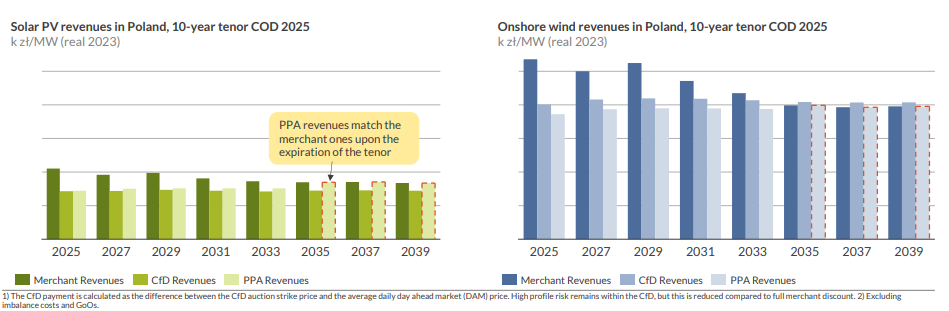
Source: Aurora Energy Research
- Blended models: Combining CfD schemes with short-term PPAs offers a balanced approach, providing revenue stability while capturing merchant market upsides. For example, operators could allocate 50% of their capacity to a CfD while leveraging a short-term PPA during periods of high prices.
- Optimized CfD scheduling: Operators can increase revenues by retrospectively adjusting their contracted volumes under CfD agreements to align with hours of peak electricity prices. This flexibility is a key feature of Poland’s CfD framework, which allows for under-delivery of up to 15% without penalties.
Challenges and opportunities ahead
Finally, despite the rapid expansion of solar projects and upcoming regulatory reforms, challenges remain. The Polish PPA market will likely face undersupply if utility and electrolyser demand grows faster than anticipated. On the other hand, oversupply risks could emerge if direct corporate demand continues to dominate. Additionally, the majority of PPAs in Poland currently use simple, fixed-price contracts, but market evolution is expected to give rise to more complex agreements, such as indexed or collared contracts, to better address risks and capture opportunities.
Conclusion
Poland’s PPA market is poised for significant growth, driven by regulatory reforms, rising corporate demand for green energy, and the increasing involvement of utilities. The combination of PPAs and RES support schemes offers a promising pathway for maximizing project profitability. As the country progresses toward its ambitious 2030 targets, stakeholders will need to adapt to changing market conditions, leveraging innovative strategies to balance risks and returns. With careful planning and execution, the Polish renewable energy market holds immense potential to lead the way in Europe’s energy transition.




Comentarios
Sé el primero en comentar...