


Renewable generating grows in US supported by growth in installed battery capacity
U.S. energy-related CO2 emissions drop 25% to 38% below what they were in 2005 by 2030, according to the U.S. Energy Information Association (EIA) in the Annual Energy Outlook 2023 (AEO2023). Renewable generating capacity grows in all regions of the United States in all AEO2023 cases, supported by growth in installed battery capacity. U.S. electric power demand grows steadily through 2050 in all AEO2023 cases because of increasing electrification and ongoing economic growth. Investment in renewable sources such as wind and solar, and the operating cost advantage of those sources, increases the share of zero-carbon electricity generation in our projections. We project growth in installed battery capacity in all cases to support growth in renewables.
EIA informed about the publication of the AEO2023 report on its web site, along with a separate Issues in Focus paper that examines the impacts of the IRA, taking into account uncertainty around some of the policy provisions. In the Reference case, implementation of the IRA results in a 33% reduction in energy-related CO2 emissions by 2030 relative to 2005 compared to a 26% reduction in the No IRA case. Because of the complexity of the IRA and related challenges to modeling some of its provisions, not all energy system impacts are represented in AEO2023.
According to EIA, they used 2005 as an emissions reference year because the United States’ nationally determined contribution (NDC), submitted as part of the Paris Agreement, calls for a target of 50% to 52% of net greenhouse gas emissions below the 2005 level by 2030. It’s important to note, however, that they only considered energy-related CO2 emissions, which does not cover the full NDC scope.
By the end of the AEO2023 projection period, 2050, U.S. energy-related CO2 emissions are 17% lower in this year’s AEO Reference case compared with last year’s, after we accounted for many of the effects of the Inflation Reduction Act (IRA), energy technology costs and performance updates, a changed macroeconomic outlook, and other factors.
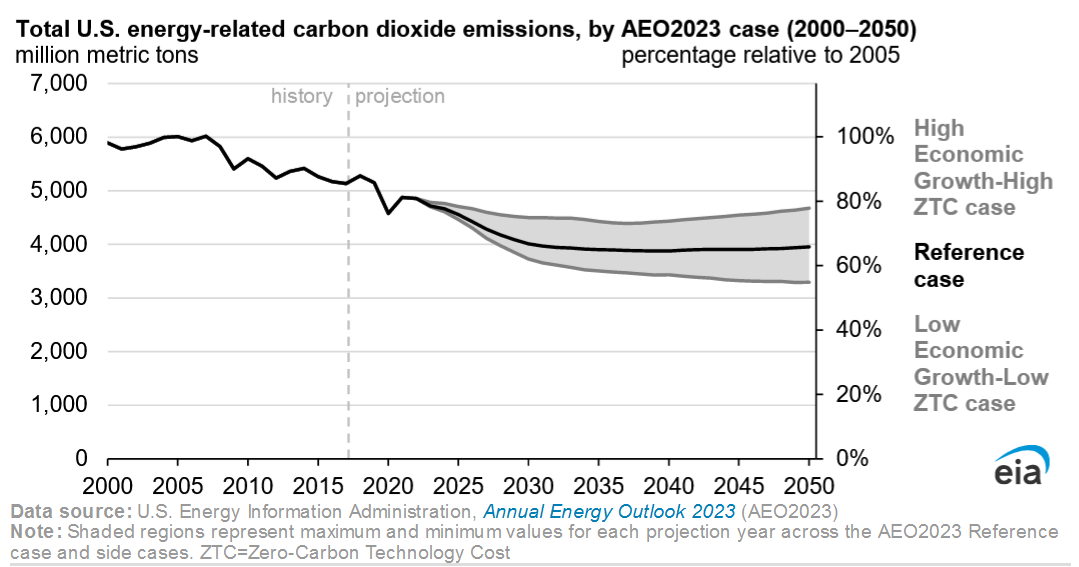
The projected reductions in U.S. energy-related CO2 emissions are driven by increased electrification, higher equipment efficiency, and renewables deployment in the electric power sector. Emissions reductions are limited, however, by longer-term growth in U.S. transportation and industrial activity.
Technological advancements and electrification drive projected decreases to demand-side energy intensity. They project rising numbers of electric arc furnaces in the iron and steel industry, heat pumps, and electric vehicles. In the residential and commercial sectors, higher equipment efficiencies and stricter building codes extend ongoing declines in energy intensity. In the transportation sector, light-duty vehicle fuel efficiency improves due to rising Corporate Average Fuel Economy (CAFE) standards and electric vehicle (EV) sales.


Comentarios
Sé el primero en comentar...