


The cost of delaying renewables: households served by US grid operator PJM face thousands of dollars more in electricity bills
Electricity demand across the PJM Interconnection region is growing at an unprecedented pace, driven by the rapid expansion of data centers, advanced manufacturing, electrification, and broader economic growth. According to a new analysis published by the American Clean Power Association (ACP), failing to deploy new clean energy resources in a timely manner could lead to serious grid reliability risks and sharply higher electricity costs across the Mid-Atlantic and Midwest over the next decade.
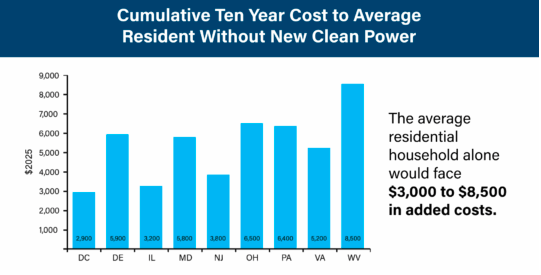
The analysis finds a growing mismatch between accelerating electricity demand and the availability of new generation resources, creating mounting pressure on grid reliability and affordability throughout the PJM region. Without new clean energy development, ACP estimates that ratepayers across nine PJM states would pay an additional $360 billion over the next ten years, largely due to higher wholesale electricity prices.
At the household level, the impact would be significant. The average residential customer could face between $3,000 and $8,500 in additional electricity costs over the next decade if new clean power sources are not brought online, the report concludes.
Energy affordability in the Mid-Atlantic has increasingly become a political issue. According to ACP, both the Trump Administration and a bipartisan group of state governors called on PJM just last week to take action to address rising electricity costs and reliability concerns.
“To keep the lights on and power economic growth, PJM needs resources that can be built quickly, operate reliably, and protect customers from surprises on their electric bills,” said John Hensley, Senior Vice President of Markets and Policy Analysis at ACP. “Our analysis shows that clean energy sources and storage are uniquely positioned to meet near-term demand growth while lowering costs and strengthening reliability for consumers.”
To assess system-wide impacts, ACP modeled PJM under two scenarios: a base case in which all generation resources are available, and a “no new clean power” case, where no additional wind, solar, or energy storage projects are developed beyond those already under construction or required by law. The differences between the two scenarios are stark.
Under the “no new clean power” scenario, PJM would become increasingly dependent on aging, higher-cost fossil fuel generation and imported electricity. Net power imports would rise by nearly 300% by 2035, increasing exposure to fuel price volatility and periods of extremely high electricity prices. The analysis also identifies heightened reliability risks during peak demand periods, when the system is most vulnerable.
By contrast, ACP notes that clean energy resources such as wind, solar, and energy storage can be deployed more quickly and operate at lower long-term cost. New clean energy projects can typically be built within one to two years, while new natural gas power plants generally require five to seven years for permitting and construction and are currently constrained by limited turbine supply.
According to ACP, timely investment in clean energy is critical to meeting rising demand, supporting resource adequacy, stabilizing wholesale electricity prices, and reducing reliance on imported power during a period of rapid load growth.
“These findings make clear that delaying clean energy deployment comes at a steep cost,” Hensley added. “Timely investment in wind, solar, and energy storage is essential to maintaining reliability, reducing dependence on imports, and protecting families and businesses from sharply higher electricity bills as demand continues to grow.”
The American Clean Power Association represents companies involved in energy storage, wind, utility-scale solar, clean hydrogen, and transmission, and positions itself as the leading voice of the multi-technology clean energy industry in the United States.



Comentarios
Sé el primero en comentar...